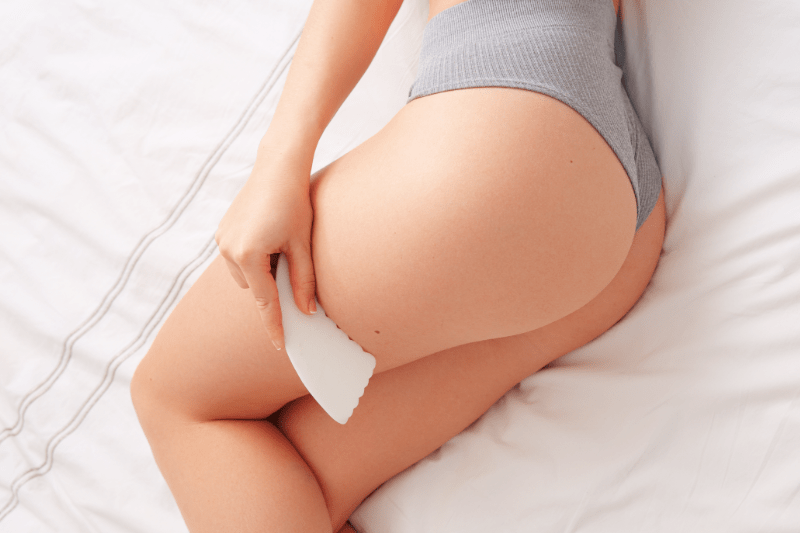
Among the latest skincare trends, one small accessory is winning everyone over: the Gua Sha. Widely used for facial care, it now comes in a body version. But what exactly is it? And is the Gua Sha effective at tackling cellulite? A closer look at the technique, inspired by Traditional Chinese Medicine.
Sommaire
What is the Gua Sha?
The Gua Sha, before being a tool, is a treatment method. It originates from Traditional Chinese Medicine, much like the cupping technique (cupping) or acupuncture. In this context, “Gua Sha” means “to scrape away illness so it escapes the body through the skin”. It involves scraping the skin with a flat, sharp-edged tool made of horn, brass or stone, to free the Qi (vital energy) from toxins. To do so, an intense and deep massage is performed to stimulate lymphatic flow, which is directly involved in immunity. Traditionally, Gua Sha is a technique used to treat various conditions, whether muscular, digestive, joint-related or even psychological. The scraping is performed mainly on the back and can leave impressive red streaks. TCM experts explain them as follows: they are the result of stimulating vital flows and expelling “negative energies”.
Today, the Gua Sha has become more mainstream. But it is above all its applications that have changed:
- It is the tool itself that is now called Gua Sha, rather than the therapy.
- It is used as much for facial care as for body care.
- Different benefits are attributed to it: on the face, it is used for anti-wrinkle massage, promoting product absorption and cell renewal, while on the body, it is credited with anti-cellulite properties.
What are the benefits of Gua Sha massage on the body?
Few studies have been conducted on Gua Sha, and in any case, they focus more on the traditional technique (relieving the body of pain) than on aesthetic applications. But current Gua Sha enthusiasts, who use it to improve the appearance of their skin and overall wellbeing, claim that it allows:
- The excretion of tissue toxins through the skin.
- The stimulation of circulatory flow.
- Improved lymph circulation towards the lymph nodes (provided the Gua Sha massage is performed in the correct direction, of course).
- A reduction in water retention, as venous tone is restored.
As such, Gua Sha massage may have positive effects on cellulite.
Superficial lipodystrophy, or cellulite, is a benign skin condition caused by a combination of three factors:
- Adipocyte hypertrophy, adipocytes being the subcutaneous fat cells. As they fill with fat, they swell and become misshapen, pushing against the skin wall and giving the skin a bumpy appearance. This is the phenomenon known as orange peel skin.
- Veno-lymphatic sluggishness. This sluggishness involves poor blood circulation, which leads to discomforts such as heavy legs, paraesthesia or water retention (water escaping from blood vessels that have become porous and seeping into connective tissue). As for lymphatic sluggishness, it results in tissues becoming congested with organic waste, as the role of lymph is to transport these toxins to the various lymph nodes. Poor blood and lymphatic circulation gives cellulite a swollen, oedematous appearance (typically aqueous cellulite).
- Disorganisation of the subcutaneous elastic network. Hypertrophied adipocytes tend to alter the structure of connective tissue, which is partly made up of elastic collagen and elastin fibres. This disorganisation triggers a phenomenon: fibrosis, which is the cause of stubborn cellulite.
When performed correctly, Gua Sha massage acts on one of the components of cellulite: veno-lymphatic sluggishness. By stimulating the circulation of natural fluids using a specific methodology, it helps:
- Boost blood circulation, to prevent water retention.
- Promote lymphatic drainage, to rid tissues of toxins.
The skin, once drained, appears smoother, firmer and more toned. Cellulite is visibly reduced. The discomforts associated with venous insufficiency are diminished.
How to choose your Gua Sha?
There are different types of Gua Sha.
1- A different shape for each use
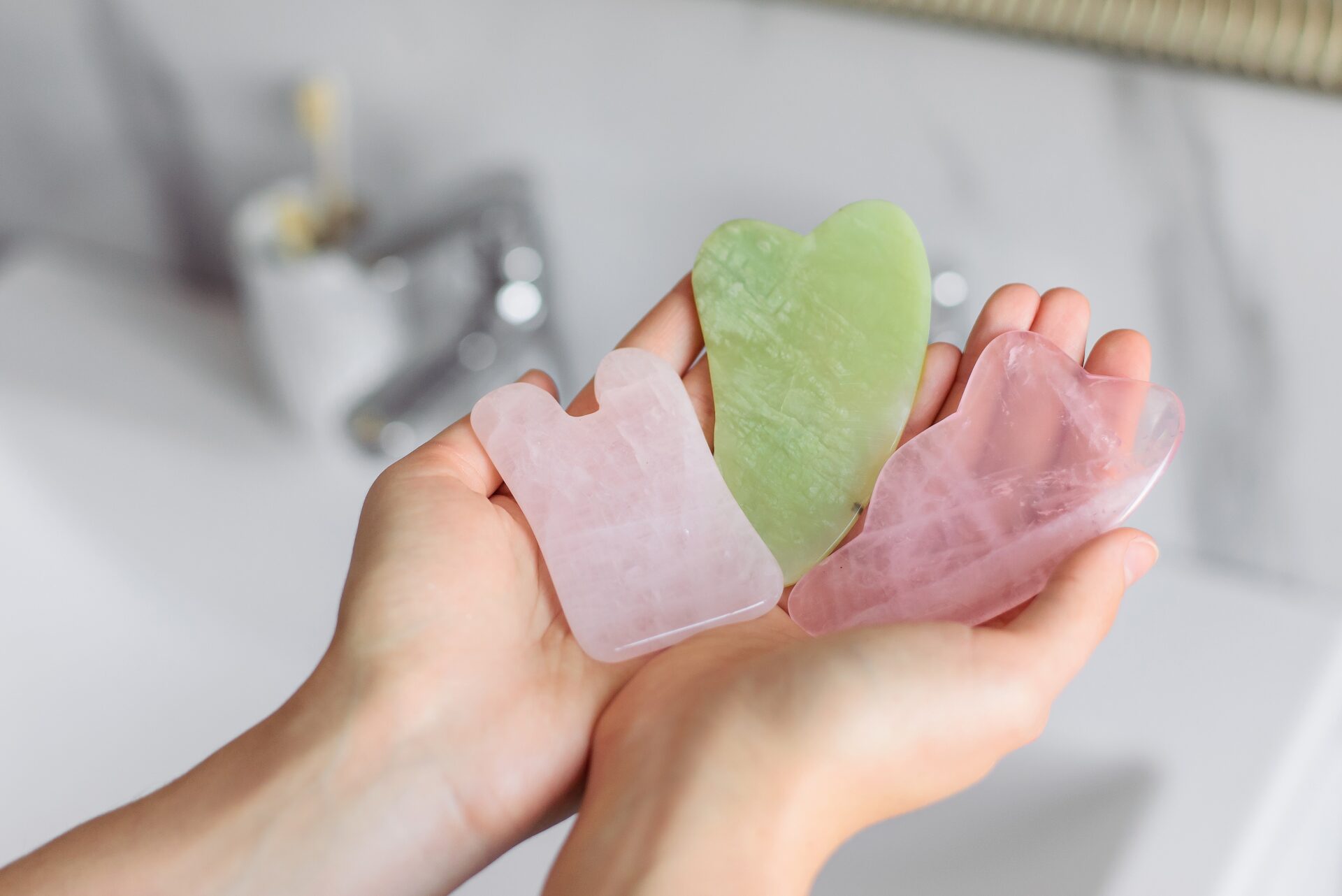
The best-known shape remains the “heart” shape: one edge is curved, the second is rounded and the last has two “bumps”. This type of Gua Sha is primarily used for facial massage.
The second shape is broadly similar, except that the rounded edge is replaced by a serrated one. This serration is said to be more effective at stimulating microcirculation. This type of Gua Sha is also intended for facial massage.
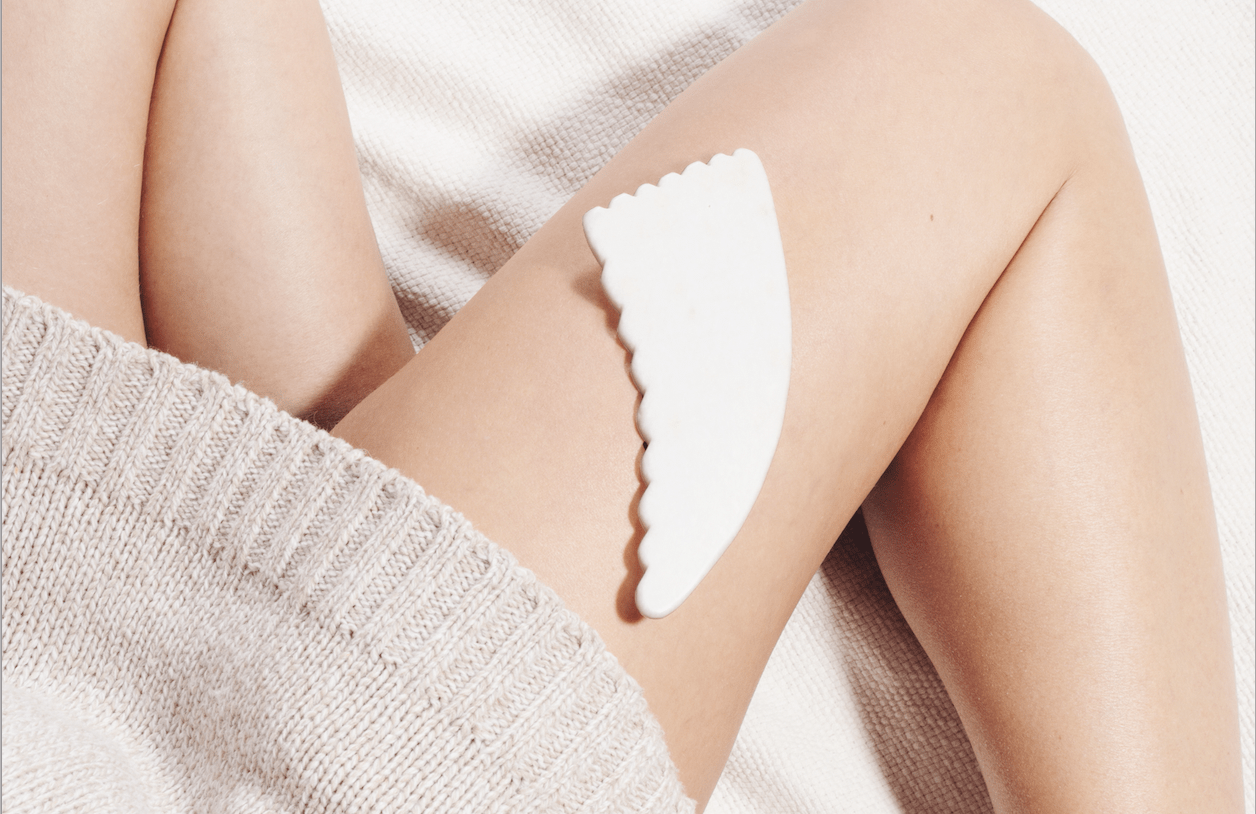
Finally, the third most common shape is the “horn” shape. This Gua Sha has one rounded edge, a second that is curved and serrated, and a third that is flat and serrated. This shape allows for a comfortable, intuitive grip and makes it possible to massage different areas of the body.
2- A variety of materials
In addition to their varying shapes, Gua Sha tools can also be found in a range of materials. In TCM, accessories made from horn (buffalo, ox) or metal (mainly brass) were traditionally used. But today, with the renewed interest in crystal healing, Gua Sha tools are most commonly made from polished stone. These crystals are used to craft the tool as they are believed to hold therapeutic properties. You will therefore frequently find:
- Rose quartz: said to help regulate blood pressure and the endocrine system, improve skin quality and support the elimination of toxins through the kidneys. The stone is therefore considered particularly suitable for water retention and venous issues commonly associated with cellulite.
- Jade: a stone renowned for soothing skin irritations and promoting its elasticity. It is also said to ease kidney and urinary complaints, and encourage the elimination of waste by stimulating circulatory flow.
- Obsidian: this stone is said to have a detoxifying effect. It is believed to help regulate blood circulation and thus purify the body. In return, it is said to promote the absorption of micronutrients, supporting a stronger immune system.
- Mookaite: another crystal renowned for its many benefits on the circulatory system. It is also said to support the digestive system by promoting food assimilation and thus stimulating weight loss. It may therefore help limit the appearance of adipose cellulite.
- Amethyst: a stone particularly beneficial for women, as it is said to harmonise female hormones. It may therefore have a positive impact on the effects of hormonal fluctuations – and cellulite is closely linked to these fluctuations.
This is why Gua Sha tools designed for body and skin care are often crafted from these stones.
What does a Gua Sha session involve?
It all depends on what you are referring to! Are we talking about Traditional Chinese Medicine or the anti-cellulite technique?
1- A Gua Sha session in TCM
In this context, Gua Sha is primarily aimed at people suffering from physical or mental pain. Before the session, it is recommended to have had a good night’s sleep, to be well hydrated and relaxed. The Gua Sha treatment involves “scraping” the patient’s back, which has been pre-coated with massage oil. The rhythm and pressure are adapted to the individual’s sensitivity. Throughout the session, drinking warm water is recommended, as hydration speeds up the elimination of “loosened” toxins through the body’s natural elimination pathways — namely the skin and kidneys. After the Gua Sha treatment, it is advisable to keep the back covered, rest, eat lightly and continue drinking warm water. The day after the session, several things are to be avoided: swimming, all kinds of excess (alcohol, tobacco, rich meals, parties…), applying cream or oil to the area treated with the Gua Sha, and other treatments.
The back, after a Gua Sha session, is heavily marked. The red streaks can look striking, but they generally fade quickly.
2- Gua Sha body sculpting in a salon
This has little in common with the ancestral technique, either in its procedure or its purpose. Gua Sha body sculpting aims to reduce the visible appearance of cellulite by stimulating veno-lymphatic circulation. The movements are inspired by the traditional method, but the scraping is far less intense and leaves very few marks.
The session will treat all or part of the body, depending on individual needs. The sculpting is performed on skin that has been pre-coated with natural plant-based oil. The Gua Sha is then used to massage areas affected by cellulite, following a specific direction:
- For cellulite on the arms, the skin is “scraped” with the tool from the wrist up to the neck (submandibular, cervical and submental lymph nodes), the armpit (axillary lymph node) and even the chest (bronchial lymph node).
- For cellulite on the stomach, scraping begins from the navel towards the heart (draining lymph towards the aortic lymph node), then from the navel towards the lower abdomen (iliac lymph node).
- For cellulite on the thighs and legs, the Gua Sha is moved from the ankle to the knee (popliteal lymph node), then from the knee to the groin (inguinal lymph node).
The different edges of the Gua Sha are used depending on whether the area being worked on is convex, flat or concave.
A sculpting session typically lasts 1 hour.
Can you perform your own Gua Sha massage at home?
It is perfectly possible to perform your own Gua Sha massage right in your bathroom! All you need is the right equipment: a Gua Sha and a massage oil. And of course, we have thought of everything, as we keep a close eye on the latest trends! We are therefore delighted to introduce our new Body Gua Sha, made from jade stone. Its shape is designed for sculpting, offering a comfortable and intuitive grip. Its three sides allow you to massage all areas of the body affected by cellulite: limbs, stomach, buttocks and hips. Using it couldn’t be simpler:
- Apply massage oil all over your body, such as our Anti-Cellulite Oil with lipolytic grapefruit and draining ivy.
- Gently stimulate the lymph nodes corresponding to the areas to be treated, by pressing them softly with your fingertips.
- Then use the Gua Sha following the massage protocol provided with the tool.
- Once the massage is complete, repeat the palpation of each lymph node.
- Stay hydrated (drink plenty of water) after the session, and take time to relax.
The recommended frequency of use is once to twice a week maximum. After just a few sessions, you should notice a clear difference: less visible cellulite, skin that is not only firmer but also more radiant, and above all, the disappearance of the discomforts associated with veno-lymphatic sluggishness. Say goodbye to water retention, heavy legs and swelling!
References
Nielsen A, Knoblauch NT, Dobos GJ, Michalsen A, Kaptchuk TJ. The effect of Gua Sha treatment on the microcirculation of surface tissue: a pilot study in healthy subjects. Explore (NY). 2007 Sep-Oct;3(5):456-66. doi: 10.1016/j.explore.2007.06.001. PMID: 17905355.
Braun M, Schwickert M, Nielsen A, Brunnhuber S, Dobos G, Musial F, Lüdtke R, Michalsen A. Effectiveness of traditional Chinese “gua sha” therapy in patients with chronic neck pain: a randomized controlled trial. Pain Med. 2011 Mar;12(3):362-9. doi: 10.1111/j.1526-4637.2011.01053.x. Epub 2011 Jan 28. PMID: 21276190.
The science of gua sha, Arya Nielsen, PhD, Pacific College of health and science; https://www.pacificcollege.edu/news/press-releases/2015/05/05/the-science-of-gua-sha