
You’re a fan of alternative medicine and would love to use it to lose weight. But you’re not sure which approach to choose: naturopathy, herbal medicine, hypnosis, acupuncture… What about homeopathy? Discover what this practice involves and, most importantly, whether it can help you lose weight naturally without dieting.
Sommaire
What is homeopathy?
Homeopathy is a gentle medicine developed in the 18th century. It is based on two principles:
- A substance that causes a symptom can be used to treat that same symptom.
- The active power of a substance can be obtained through a process of successive dilutions and dynamizations. This process is said to enhance the effects of the substance, even at very low concentrations.
Homeopathic preparations come in several forms:
- The most well-known is the granule form – small white pellets that dissolve under the tongue
- The dermatological form – whether as an ointment or a gel
- The mother tincture – a hydro-alcoholic solution to be diluted in water
Homeopathy is available over the counter at pharmacies and does not require a prescription. However, like conventional medicines, it is subject to a marketing authorisation. The manufacturing laboratory simply needs to demonstrate that the homeopathic preparation poses no risk to health.
Furthermore, homeopathy is not subject to clinical trials, which means it has many critics. Yet it also has a large and loyal following who find it genuinely effective. In France, despite no longer being reimbursed, it continues to enjoy widespread support — as evidenced by the large number of homeopathic doctors (over 3,500) and users (10% of pharmacy sales, with 3 in 4 French people having already tried a homeopathic treatment).
How does homeopathy work?

Homeopathy is built on five core principles that define its unique approach.
The principle of similars: a patient is treated with a diluted substance that, if undiluted and given to a healthy person, would produce the same symptoms as those of the patient. Yet that same substance, when diluted, can help soothe those symptoms.
The principle of dilution: the substance must be diluted multiple times and dynamized (shaken) to become effective. Various dilution techniques exist, but all are based on the infinitesimal principle — the idea that even a very small dose of a substance can have a therapeutic effect. For reference, the numbers and letters on homeopathic granule bottles indicate how many dilutions the substance has undergone to become ‘activated’ (for example, 9CH means 9 dilutions).
The principle of wholeness: homeopathy considers each individual as a whole. The treatment prescribed takes into account not only symptoms, but also lifestyle, psychological state, and medical history. It is therefore a holistic and personalised approach.
The principle of constitution: homeopathy relies on a precise classification of patients according to their constitution — heredity, previous treatments, lifestyle…
The principle of diathesis : diathesis refers to each individual’s predisposition to developing certain conditions.
As you can see, homeopathy is a holistic approach that focuses on the individual rather than the condition itself. Homeopathic treatment is therefore personal and varies from person to person — both in terms of the substance used and the number of dilutions. Moreover, in homeopathy, the concept of recovery differs from the conventional medical definition. A patient is considered healed when they have regained a general sense of balance, not simply when their symptoms have disappeared.
Can homeopathy help with weight loss?

1- A few important points first
First of all, and as mentioned above, every homeopathic treatment is unique and tailored to the individual. Homeopathy is a subtle practice: each combination and dosage corresponds to a specific case. While general guidance can be offered, these are only broad outlines. For a homeopathic treatment perfectly suited to your personal situation, it is always best to consult a homeopathic doctor.
One more thing: homeopathy is not a miracle cure. Certain homeopathic treatments may support weight loss by addressing factors that contribute to weight gain. That said, no one should expect to swallow a few granules and watch the pounds melt away. Any homeopathic ‘slimming’ treatment should be combined with healthy lifestyle habits: a balanced diet , stress management, quality sleep , and regular physical activity. This applies to all types of wellness routines: herbal medicine, food supplements, body treatments…
2- Homeopathic treatments recommended for weight loss
With those points in mind, here are some homeopathic treatments that may support your weight loss journey:
- If you tend to experience generalised water retention: Natrum Sulfuricum 7 CH, 5 granules at bedtime.
- If your water retention is more localised in the lower body (heavy legs, oedema around the waist and thighs): Thuya Occidentalis 5 CH, 2 granules morning, noon and evening.
- If you tend to be a big eater: Foenum Graecum 30CH, taken 20 minutes before meals to help curb feelings of hunger.
- If you feel you have a slow metabolism and struggle to lose belly fat: Calcarea Carbonica Ostrearum 15 CH.
- If your hunger is never satisfied and leads you to snack constantly: Antimonium Crudum 9CH, 3 times a day.
- If you eat out of boredom or stress: Ignatia Amara 5CH, 2 granules 3 times a day, to help ease anxiety.
- If you tend to be an emotional eater and are particularly sensitive: Pulsatilla 9CH, 2 granules 3 times a day, to help soothe sensitivity, emotional reactivity and/or low mood.
- If you snack occasionally, especially during high-pressure periods (exams, interviews, heavy workloads): Gelsemium 9CH, 2 granules 3 times a day, throughout the stressful period.
- If stress tends to cause bloating: Lycopodium 5CH, 2 granules 3 times a day.
- If your bloating is more related to intestinal irritation and digestive discomfort: Carbo Vegetabilis 2CH, 2 granules 3 times a day.
- If you suffer from digestive irregularity that causes abdominal bloating: Nux Vomica 5CH, 5 granules morning and evening, during periods of constipation.
- Finally, if you’d like to support weight loss through a general detox of your system: orthosiphon mother tincture, 20 drops diluted in a glass of water, 3 times a day for one month.
What are the alternatives to homeopathy for weight loss?

If you’re particularly drawn to gentle, natural approaches and believe in their effectiveness, you can absolutely combine a homeopathic treatment with a course of food supplements. Both are rooted in the same idea: supporting weight loss through the active compounds found in plants. That said, it’s important to choose your supplements carefully to ensure real results — namely, a slimmer silhouette and an improved sense of wellbeing.
We offer a complete range of slimming capsules. Each formula targets a specific factor contributing to weight gain:
- Our Weight Loss Slimming Capsules work on two fronts: reducing the absorption of dietary fats (ascophyllum acts as a lipid binder) and boosting metabolism (cola nut caffeine and chilli capsaicin, both known for their lipolytic properties).
- Our Appetite Control Slimming Capsules focus on reducing appetite. Enriched with carob and fucus — natural appetite suppressants (fibres) — they help you manage hunger and keep portion sizes in check.
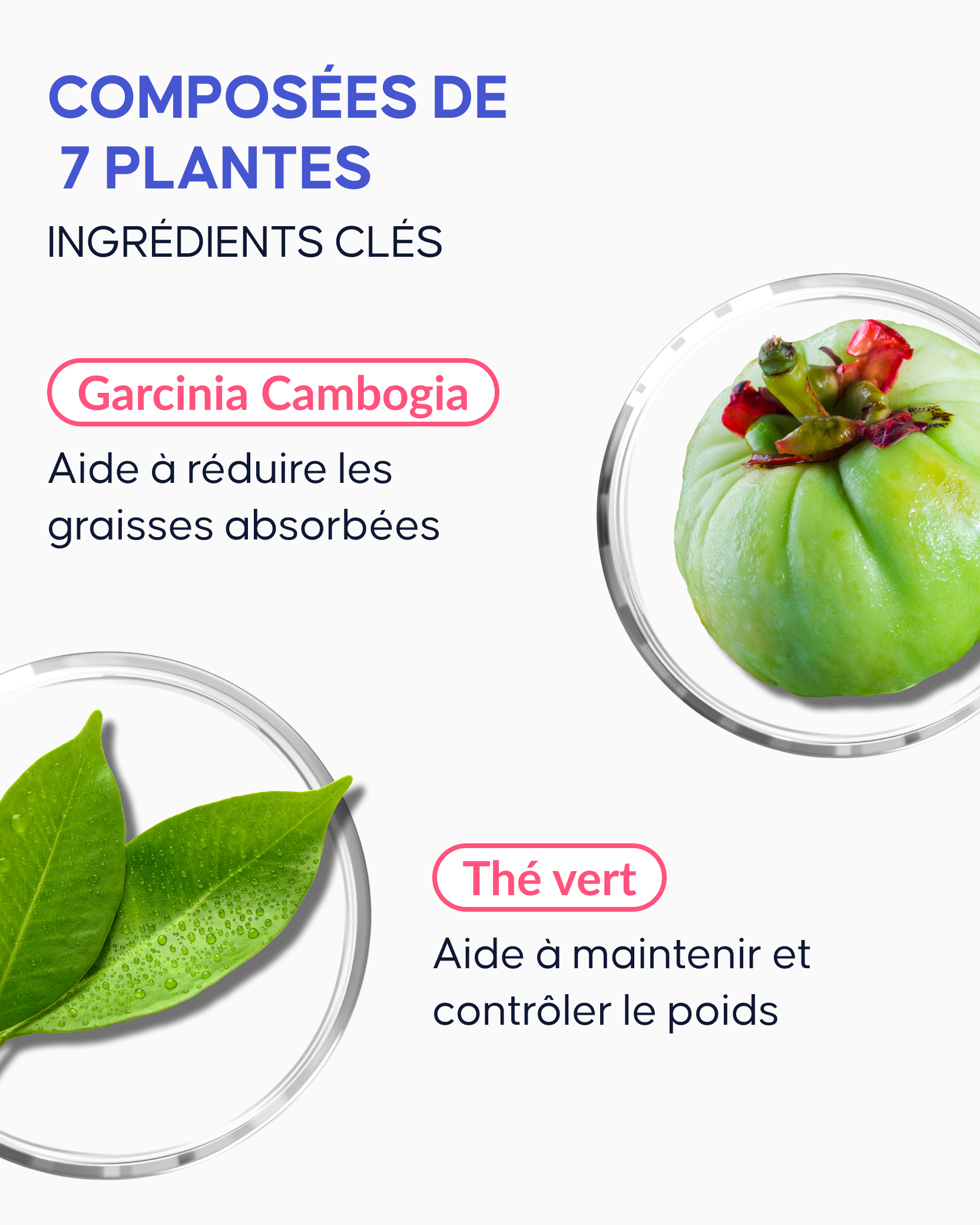
- Our Fat-Burning Slimming Capsules support fat oxidation and overall digestion. Garcinia Cambogia and pineapple stem are well-known fat-burning ingredients, while dandelion and artichoke contribute to digestive comfort.
Regular courses of our capsules can, just like homeopathy, support your weight loss goals. The ideal approach: a supplement course with each change of season, to help maintain your ideal weight.


Frequently Asked Questions
What is homeopathy?
homeopathy is a gentle medicine developed in the 18th century. It is based on two principles: A substance that causes a symptom can be used to treat that same symptom. The active power of a substance can be obtained through a process of successive dilutions and dynamizations. This process is said to enhance the effects of the substance, even at very low concentrations. Homeopathic preparations come in several forms: The most well-known is the granule form – small white pellets that dissolve under the tongue The dermatological form – whether as an ointment or a gel The mother tincture – a hydro-alcoholic solution to be diluted in water Homeopathy is available over the counter at pharmacies and does not require a prescription. However, like conventional medicines, it is subject to a marketing authorisation. The manufacturing laboratory simply needs to demonstrate that the homeopathic preparation poses no risk to health. Furthermore, homeopathy is not subject to clinical trials, which means it has many critics. Yet it also has a large and loyal following who find it genuinely effective. In France, despite no longer being reimbursed, it continues to enjoy widespread support — as evidenced by the large number of homeopathic doctors (over 3,500) and users (10% of pharmacy sales, with 3 in 4 French people having already tried a homeopathic treatment).
How does homeopathy work?
Homeopathy is built on five core principles that define its unique approach. The principle of similars: a patient is treated with a diluted substance that, if undiluted and given to a healthy person, would produce the same symptoms as those of the patient. Yet that same substance, when diluted, can help soothe those symptoms. The principle of dilution: the substance must be diluted multiple times and dynamized (shaken) to become effective. Various dilution techniques exist, but all are based on the infinitesimal principle — the idea that even a very small dose of a substance can have a therapeutic effect. For reference, the numbers and letters on homeopathic granule bottles indicate how many dilutions the substance has undergone to become 'activated' (for example, 9CH means 9 dilutions). The principle of wholeness: homeopathy considers each individual as a whole. The treatment prescribed takes into account not only symptoms, but also lifestyle, psychological state, and medical history. It is therefore a holistic and personalised approach. The principle of constitution: homeopathy relies on a precise classification of patients according to their constitution — heredity, previous treatments, lifestyle… The principle of diathesis : diathesis refers to each individual's predisposition to developing certain conditions. As you can see, homeopathy is a holistic approach that focuses on the individual rather than the condition itself. Homeopathic treatment is therefore personal and varies from person to person — both in terms of the substance used and the number of dilutions. Moreover, in homeopathy, the concept of recovery differs from the conventional medical definition. A patient is considered healed when they have regained a general sense of balance, not simply when their symptoms have disappeared.
What are the alternatives to homeopathy for weight loss?
If you're particularly drawn to gentle, natural approaches and believe in their effectiveness, you can absolutely combine a homeopathic treatment with a course of food supplements. Both are rooted in the same idea: supporting weight loss through the active compounds found in plants. That said, it's important to choose your supplements carefully to ensure real results — namely, a slimmer silhouette and an improved sense of wellbeing. We offer a complete range of slimming capsules. Each formula targets a specific factor contributing to weight gain: Our Weight Loss Slimming Capsules work on two fronts: reducing the absorption of dietary fats (ascophyllum acts as a lipid binder) and boosting metabolism (cola nut caffeine and chilli capsaicin, both known for their lipolytic properties). Our Appetite Control Slimming Capsules focus on reducing appetite. Enriched with carob and fucus — natural appetite suppressants (fibres) — they help you manage hunger and keep portion sizes in check. Our Fat-Burning Slimming Capsules support fat oxidation and overall digestion. Garcinia Cambogia and pineapple stem are well-known fat-burning ingredients, while dandelion and artichoke contribute to digestive comfort. Regular courses of our capsules can, just like homeopathy, support your weight loss goals. The ideal approach: a supplement course with each change of season, to help maintain your ideal weight. Weight Loss Capsules 29,99 Buy Now 14,99 Buy Now Detox Slimming Capsules 14,99 Buy Now
Related articles
- Slimming belts: do they really work for weight loss?
- Reflexology for cellulite: does it really work?
Useful categories : Slimming Solutions, Weight Management.