You’re tempted to try a course of food supplements for your cellulite, but the overwhelming choice of products and their promises leave you confused. Not sure what to pick? Here’s what you need to know about anti-cellulite capsules: what’s in them, how they’re supposed to work, what you can reasonably expect from them and how to choose them wisely.
What are anti-cellulite capsules?
1- A quick definition
An anti-cellulite capsule is a food supplement, available over the counter in pharmacies, parapharmacies, health and nutrition stores, dedicated websites or the dietetics aisle of supermarkets. The stated goal of these capsules is to target the various causes of cellulite and its visible appearance, commonly known as orange peel skin. According to their manufacturers, an anti-cellulite capsule is intended to work on:
- Leg comfort, which is particularly mentioned in relation to water-retention cellulite, mainly linked to water retention
- Digestive comfort
- “Eliminating toxins”, an idea with little basis, as the liver and kidneys already take care of this
- The lipolysis process, often mentioned in relation to adipose cellulite or fibrous cellulite
2- How anti-cellulite capsules work
There are different types of anti-cellulite capsules, but most share the same core ingredients, namely plant extracts. These natural actives are credited with several functions:
- So-called diuretic function: a common claim on packaging, which refers to eliminating water; no effect on cellulite has been demonstrated.
- So-called venotonic function: some of the actives are found in venotonic medicines, which are a matter for medical advice.
- So-called “fat-burning” function: some plant extracts have been studied for their role in lipolysis (breaking down fats during digestion or in adipocytes, the subcutaneous fat cells). Their effect on cellulite has not been demonstrated.
3- Ingredients in anti-cellulite capsules
It’s common to find shared ingredients across different anti-cellulite capsules:
- Plants commonly used in herbal teas, such as dandelion, horsetail, hibiscus, orthosiphon, nettle, birch, couch grass, meadowsweet or mouse-ear hawkweed – and many more!
- Plants found in venotonic medicines, such as red vine, horse chestnut, butcher’s broom, melilot, blackcurrant, ginkgo biloba, witch hazel or cypress.
- Natural actives studied in relation to lipolysis, such as caffeine from guarana, tea, coffee, kola nut or maté; synephrine from raspberry ketones; capsaicin from chilli pepper; or bromelain from pineapple stem – to name just the best-known ones.
How effective are anti-cellulite capsules?

No capsule can make cellulite disappear. If you choose to take them, it’s important to incorporate food supplements into a healthy lifestyle that includes:
- A varied and balanced diet, free from processed foods and low in salt, sugar and saturated fats
- Daily physical activity, combined with regular exercise at moderate to high intensity
- Anti-cellulite massages, such as the pinch-and-roll technique, to look after your skin
That said, it’s worth knowing that certain natural actives have been studied for a possible effect on cellulite:
- Paraxanthine, a compound related to caffeine, has been studied for its role in lipolysis, while theobromine is also among the compounds studied.
- Several studies have looked at capsaicin and whether it may have an effect on energy intake (1). This research does not focus specifically on cellulite.
- Certain plants – such as meadowsweet, ginkgo and red vine – are now included in the composition of venotonic medicines. Indeed, phytotherapy is found in many treatment courses, whether in the form of capsules, ampoules, tablets or creams.
Which anti-cellulite capsules should you choose?

Choosing anti-cellulite capsules requires a little care. Some capsules have a questionable composition:
- Natural actives are present in low amounts or of poor quality
- The origin of the plants used is unclear
- The capsules contain excessive texturing agents, colourants and preservatives
- The products are not vegan (animal fat is used to make the capsule shell)
It’s best to opt for transparency — choosing anti-cellulite capsules whose full composition is clearly stated on the packaging, and which comes as close as possible to 100% natural.
Other criteria can also help guide a well-informed choice:
- User reviews, which can be found in product reviews, videos, testimonials, forums or on the manufacturer’s website.
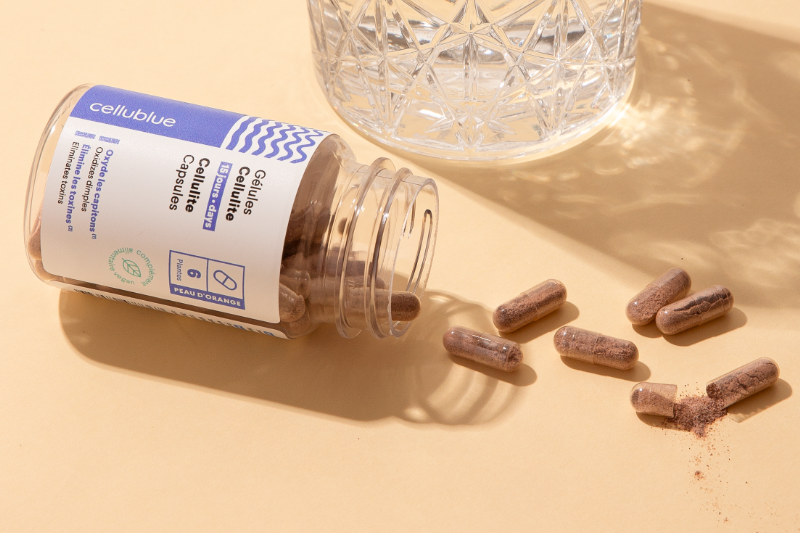
Here’s what characterises our Cellulite Capsules:
- Ingredients of natural origin and a vegan product
- A blend of plants: guarana, cherry stalk, green tea, red vine, ascophyllum and artichoke. Pineapple is not part of the blend.
- Easy to use: simply take 2 capsules at breakfast and 2 at lunch as a course followed by a break, alongside your other habits for tackling dimples.
The capsules contain green tea, as does our dilutable drink: don’t take them on the same day. To find out more about drainers, have a look at our dedicated article. If you’re dealing with water retention or the feeling of heavy legs, which affects so many women, ask a medical professional for advice.
So, if you have no contraindications (pregnancy, medication, kidney disease, breastfeeding…), why not try a quality anti-cellulite supplement course?
References
(1) 2014, Whiting, Derbyshire, Tiwari, Could capsaicinoids help to support weight management? A systematic review and meta-analysis of energy intake data