
You’re a fan of gentle medicine: essential oils, herbal therapy, naturopathy… Nothing beats natural remedies for everyday ailments, in your view. But what about homeopathy? Discover what this alternative therapy involves, what it can (or can’t) offer when it comes to cellulite, and which preparations are generally mentioned for your type of cellulite.
What is homeopathy?
Homeopathy is an alternative medicine invented in the 18th century. It is based on two founding principles:
- A substance (often plant-based) that causes a symptom would, according to this principle, be used for that very same symptom.
- The potency of a substance is achieved through a process of serial dilutions and agitation (the dynamisation phase). This process is said to enhance the effect of the substance, despite an extremely low concentration of active ingredients.
Homeopathic preparations come in various forms. The best-known is of course the granule form – small white pellets that dissolve under the tongue. But homeopathic treatments also exist as ointments, gels or drops to be diluted in water.
Homeopathy is available over the counter at pharmacies and does not require a prescription. It is, however, subject – like conventional medicines – to a marketing authorisation. The laboratory simply needs to demonstrate that its homeopathic preparation poses no risk to health.
It is not subject to any clinical trials aimed at evaluating its efficacy. As a result, it has many detractors. Yet the fact remains that a large number of people continue to use it. It is particularly popular in France:
- The country has 3,581 homeopathic doctors
- 40% of the population say they occasionally use this therapy for self-care
- Homeopathy accounts for 10% of pharmacy sales
How does it work?
As mentioned above, homeopathy rests on several principles:
- Principle of similars: the patient is treated with a diluted substance which, if undiluted and given to a healthy person, would provoke the same symptoms. According to this principle, that same diluted substance would be expected to ease the symptoms of someone who is unwell.
- Principle of dilution: the original substance must, according to homeopathic doctrine, be diluted multiple times and dynamised (shaken). Various dilution techniques exist, but all follow the infinitesimal rule – meaning that a very small dose of a substance may bring relief. The numbers and letters on homeopathic granule bottles indicate the number of dilutions (e.g. 1CH – one dilution, 15CH – 15 dilutions).
- Principle of totality: homeopathy considers the patient as a whole – symptoms, lifestyle, psychological state… It is therefore a holistic and personalised therapy.
- Principle of constitution: homeopathy relies on classifying patients according to their constitution, determined by heredity, previous medical treatments and lifestyle.
- Principle of diathesis: in addition to constitution, homeopathy takes into account diathesis – that is, the patient’s predispositions to certain conditions.
Homeopathy is therefore a holistic therapy, addressing the patient as a whole rather than a single condition. Treatment will vary from person to person. Moreover, a patient may consider themselves well when they have regained a sense of balance, not merely when their symptoms have disappeared.
Can homeopathy be effective against cellulite?
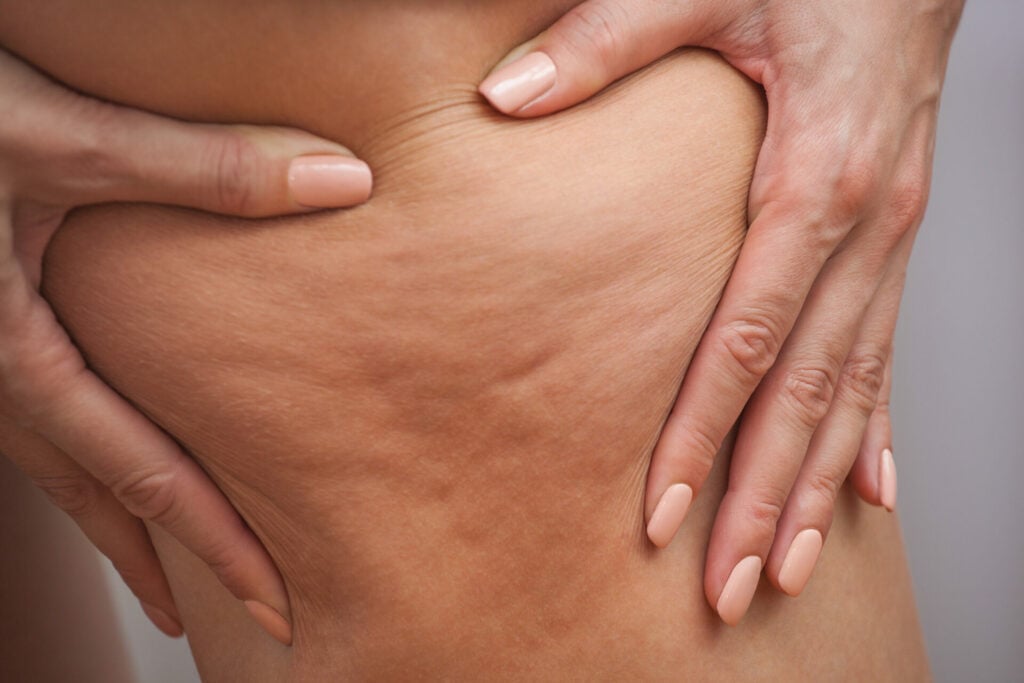
Since homeopathy is a gentle, holistic medicine, many people wonder what place it could have when it comes to cellulite. It is indeed often used to address everyday complaints, and some mention it in connection with certain causes of cellulite.
Its followers associate homeopathy with several of the factors linked to cellulite, although this has not been assessed:
- toxins, a term often used by its followers
- water retention
- food intake and feelings of hunger
- the feeling of heavy legs
- salt
- stress
- skin sensitivity
Of course, homeopathic treatment alone cannot make cellulite disappear. At best, it can go alongside a broader approach. Without healthy lifestyle habits (hydration, a balanced diet, exercise) and massage techniques (pinch-and-roll, lymphatic drainage, cupping massage), homeopathy on its own makes little sense when it comes to orange-peel skin.
The cupping tool that replicates pinching and rolling, 3 minutes per zone
- The professionals' technique, at home: you lift, glide, and release, and the tool grips the skin fold like a manual pinching and rolling
- Soft silicone that fits thighs, buttocks, stomach, and arms
- 3 minutes per zone, every day, always with a massage oil so the tool glides
Homeopathy for cellulite: what’s the verdict?
Homeopathy divides opinion. Its effects are not evaluated before it goes on sale, and it has plenty of critics. Even so, it remains widely used in France, particularly for minor everyday complaints.
When it comes to orange-peel skin, it’s best seen as a possible extra, never as a solution in its own right. Staying hydrated, eating a balanced diet, keeping active and regular massage remain the foundations. And if your cellulite appears during the menopause or pregnancy, or if you’re already taking medication, ask a doctor or pharmacist for advice before starting a course.
What types of treatment should you consider?

There is a vast range of homeopathic treatments – as many as there are patients, in fact! Here are the preparations most often mentioned. They are no substitute for advice from a doctor or pharmacist.
If you have a gynoid body shape, typically pear-shaped, with a slender upper body and cellulite around the saddlebags, hips and thighs: a course of several months of Thuya 5CH, 1–2 times a day, 3 granules per dose.
If you experience water retention throughout the body (including fingers and eyelids), with multiple oedemas, ask a doctor for advice first. The preparation sometimes mentioned is a course of several months of Natrum Sulfuricum 7CH, 5 granules at bedtime.
Among the mother tinctures often mentioned are:
- Orthosiphon mother tincture: 20 drops 3 times a day, diluted in a large glass of water, for one month.
- Pilosella mother tincture: 30 drops 3 times a day, diluted in a glass of water, also for one month.
If your cellulite is of the adipose type, generally linked to a rich diet and concentrated on the thighs: Natrum Muriaticum 5CH, 3 granules morning and evening. This homeopathic preparation is also mentioned for those who are fond of salty foods.
If you suffer from heavy legs or notice signs of venous insufficiency (leg swelling at the end of the day, tingling, broken capillaries), see a doctor. Pulsatilla 5CH and Hamamelis 5CH are sometimes mentioned.
If your cellulite is painful to the touch and particularly deep-set, you may have fibrous cellulite. The preparations generally mentioned are Rhus Toxicodendron 5CH, alongside Natrum Muriaticum and Natrum Sulfuricum, as well as Cantharis 5CH, at a rate of 2 granules 3 times a day. Pain that persists is, however, worth seeing a doctor about.
Finally, if you feel that stress is affecting your routine, a course of Argentum Nitricum (acute stress), Phosphorus (emotional sensitivity) or Sepia (anxiety) is sometimes mentioned.
Homeopathy for cellulite on the thighs: the key points
The thighs come up often in the suggestions above. For a pear-shaped (gynoid) figure, with cellulite on the saddlebags, hips and thighs, Thuya 5CH is the preparation mentioned. For adipose cellulite on the thighs, or for those fond of salty foods, Natrum Muriaticum 5CH is more often cited.
Either way, these granules do not replace the other steps in your routine. They fit into a routine that combines a balanced diet, exercise and massage techniques such as pinch-and-roll. A homeopathic doctor is best placed to choose the preparation that suits you.
Finally, remember that nothing replaces a consultation with a homeopathic doctor: based on your type of cellulite, your lifestyle and medical history, they will be able to guide you.