There is little doubt that after your pregnancy, cellulite has made its appearance on certain parts of your body.
Those stubborn dimples settled in gradually as you gained your pregnancy weight, before welcoming your little one into the world.
After giving birth, a choice presents itself: whether or not to breastfeed your baby. Several factors may influence this decision, including the idea that breastfeeding could help you regain your figure and reduce the appearance of cellulite.
But are you sure any of this is actually true? Here’s a closer look at cellulite, the role of hormones such as prolactin during pregnancy and breastfeeding, what breastfeeding may actually change, and a few simple habits you can adopt every day.
What exactly is cellulite?
The word cellulite is one that many women wish they had never come across.
Often described as orange peel skin, cellulite typically appears on the thighs, buttocks, stomach, and arms in the form of small pockets of subcutaneous fat.
These tiny fat deposits become enlarged and give the skin that uneven, bumpy texture.
As adipocytes (fat cells) increase in volume and, during pregnancy, the weight of the belly and the baby puts more strain on the tissues beneath the skin, the dimpled appearance of certain areas of the body may become more noticeable.
There are three types of cellulite:
- Adipose cellulite, often linked to a diet too rich in fat and sugar.
- Fibrous cellulite, which shares the characteristics of cellulite and is also accompanied by fibrosis.
- Water-retention cellulite, associated with a tendency towards water retention. This type of cellulite tends to be hereditary.
The role of hormones in cellulite
Pregnancy brings with it a surge of intense hormonal activity. All those little discomforts endured over nine months — mood swings, fatigue, nausea, breakouts, and weight gain — are directly linked to the hormones that turn a woman’s body upside down.
For the sake of bringing a beautiful new life into the world, what wouldn’t we put up with? And yet, cellulite keeps creeping in, and it’s not entirely your fault.
Hormones play a key role in the development of cellulite. This is precisely why women are so much more affected by it than men.
While hormones don’t directly create cellulite, female hormones influence how fat is distributed throughout the body.
This is a type of fat known as gynoid fat, as it tends to settle in the lower half of a woman’s body.
Unfortunately, during pregnancy, we tend to be a little less mindful of what we eat, and small indulgences can have a greater impact.
These minor dietary excesses contribute to the formation of fat cells and fluid retention associated with cellulite.
But food choices aren’t the only thing to blame! Another hormone, produced specifically during pregnancy, also plays a role in encouraging cellulite to develop.
Prolactin and cellulite
Several hormones play a central role in milk production in a new mother’s body: oestrogen, progesterone, prolactin, and oxytocin.
During pregnancy, oestrogen and progesterone work to suppress milk secretion. After birth, oestrogen levels drop, which then encourages lactation.
Prolactin, meanwhile, rises steadily throughout pregnancy.
Its primary role is to trigger milk production and sustain it throughout the breastfeeding period.
And because the female body never does anything without reason, prolactin — which develops and increases during the conception of your baby — is also one of the contributors to the cellulite that forms on your body.
In preparation for the arrival of your newborn, prolactin encourages the body to store fat.
Why? Simply because your body is gearing up to become a source of nourishment and energy for your little one.
But don’t panic! If cellulite became more noticeable during pregnancy, it hasn’t necessarily built up over many years. Give yourself time to find your feet again after giving birth.

Can breastfeeding affect the appearance of cellulite?
A study (1) by Dewey, Heinig and Nommsen (1993) looked at weight patterns in mothers who were able to breastfeed and chose to do so for at least six months. It describes an observed association, not an outcome you should expect from breastfeeding.
Milk production is part of the natural process of breastfeeding.
The longer breastfeeding lasts, the more the reserves built up during pregnancy may be drawn on, although this is not always the case.
This is why you shouldn’t expect to see visible changes in the first month of breastfeeding. It is a long process that takes place gradually over time.
A word of caution, however!
This doesn’t mean that diet plays no role. Breastfeeding can accompany you through the postpartum period, but it isn’t enough on its own to restore your figure or reduce the appearance of cellulite.
It needs to be combined with a healthy, balanced diet. The old saying that you need to eat for two while breastfeeding because you’re feeding a baby is simply not true.
The quantity or quality of your milk is not affected by how much you eat.
Eating well, getting back into physical activity with your doctor’s agreement, and breastfeeding if you wish — that’s a combination that can help you look after yourself, without focusing on cellulite or your pre-pregnancy weight.
A few helpful habits
For everyday care, you can adopt a few simple steps on the areas where you’d like to reduce the appearance of cellulite.
Using a cream designed for the look of orange-peel skin is not a bad idea, but it’s important to check the product’s ingredients carefully before applying it to your body.
Always make sure that any products you apply are compatible with breastfeeding.
Also, applying the cream alone is not enough. The main benefit of a cream designed for the look of orange-peel skin lies in the massage performed while applying it.
The best approach is to massage the area with the cream for ten minutes, working upward from the bottom, kneading the skin gently but firmly.
What about Cellublue treatments while breastfeeding?
If, after pregnancy, you would like to use a Cellublue treatment for the look of orange-peel skin, the same precautions apply as with any other product. Read the ingredients carefully. Throughout breastfeeding, ask your doctor or midwife for advice before applying it.
Think of it as one extra self-care step, alongside a balanced diet and a gradual return to physical activity.
In summary
Breastfeeding is, above all, a personal choice and a possibility. But if you were still on the fence about it, beyond the profound act of nourishing your child through your own body, you now have another reason to consider this feeding option for your baby.
It will be beneficial not only for your newborn, but for your body too.
If cellulite is something that significantly affects how you feel in your own skin and makes daily life difficult, remember that breastfeeding is above all a loving connection to share with your baby, and that your body needs time.
So, what are you waiting for?
Why do we get more cellulite during pregnancy?
Sources and references
*Maternal weight-loss patterns during prolonged lactation, Dewey KG; Heinig MJ; Nommsen LA (1993).
To go further, explore the Cellublue shop: our anti-cellulite products.


The scrub that leaves skin smooth and skin texture refined*
*User test on 21 volunteers over 4 weeks, based on participants' feedback.
- Olive & apricot kernels: these natural grains gently sweep away dead skin cells
- Caffeine & monoi scent, so your shower instantly smells like a holiday
- In the shower, two to three times a week, massaging your thighs, bottom and stomach

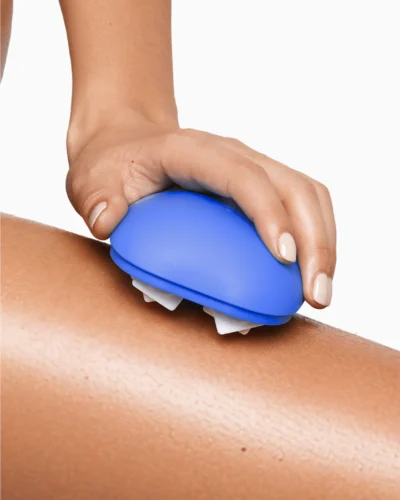
The cupping tool that replicates pinching and rolling, 3 minutes per zone
- The professionals' technique, at home: you lift, glide, and release, and the tool grips the skin fold like a manual pinching and rolling
- Soft silicone that fits thighs, buttocks, stomach, and arms
- 3 minutes per zone, every day, always with a massage oil so the tool glides