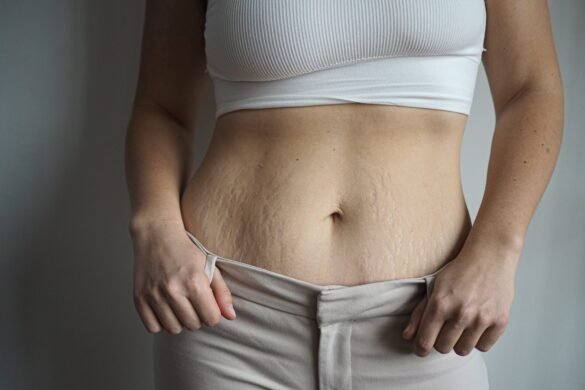
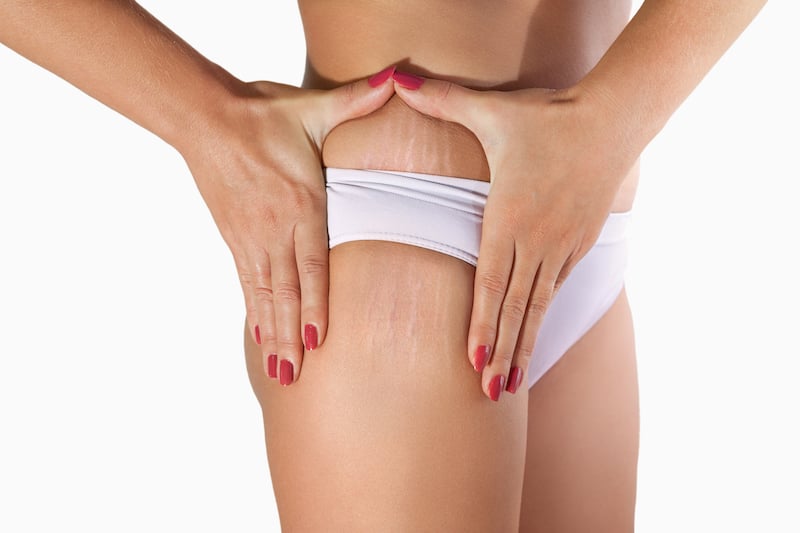
Red stretch marks are unsightly marks that often appear on the skin following significant weight fluctuations or a surge in hormonal activity. In women, the appearance of red stretch marks is most commonly associated with pregnancy.
Creams, oils, procedures carried out by professionals and everyday habits: there are several ways to look after these streaks. Here is how they form, what causes them, which areas of the body are most affected, the options available and the habits to adopt every day.
How do red stretch marks form?
Skin elasticity plays a key role in its overall tone and suppleness. When the cellular fibres responsible for this elasticity are stretched beyond their limit, they suddenly break.
This sudden tearing creates a collapse of tissue between the epidermis and the hypodermis. The resulting inflammation causes fissures to appear on the skin in the form of soft, reddish scars — these are red stretch marks.(1)
The red colour corresponds to the initial stage of stretch mark formation. When left untreated, they gradually shift from red to purple, then fade to white over time.
Even if you tend to hide them out of self-consciousness, it is worth knowing that this type of stretch mark poses no risk to your health. Many women carry them on their bodies, as do men, though less frequently.
What causes red stretch marks to appear?
As explained above, red stretch marks form as a result of breaks in the skin’s elastic fibres. In many cases, a significant build-up of cortisol or corticosteroids triggers this tearing of the fibres.
This is why red stretch marks typically appear during pregnancy or puberty — both periods of major hormonal change.
More specifically, around the second trimester of pregnancy, cortisol levels rise in the body and affect the skin’s elasticity and suppleness. Stretch marks may then appear, and will be more pronounced on fragile or sensitive skin.
Growth spurts and weight fluctuations are also common triggers for the development of red stretch marks.
Which parts of the body are most affected?
The areas of the body most prone to stretch marks are those subject to the greatest skin stretching:
- The buttocks
- The thighs
- The hips
- The backs of the knees
- The stomach
- The breasts
As soon as red stretch marks appear on one or more of these areas, it is best to start caring for them promptly, before they turn into white stretch marks, which are much harder to treat.
It is worth remembering that red stretch marks are described as “immature” because they are still at an early stage of development. That makes this the right time to look after them.
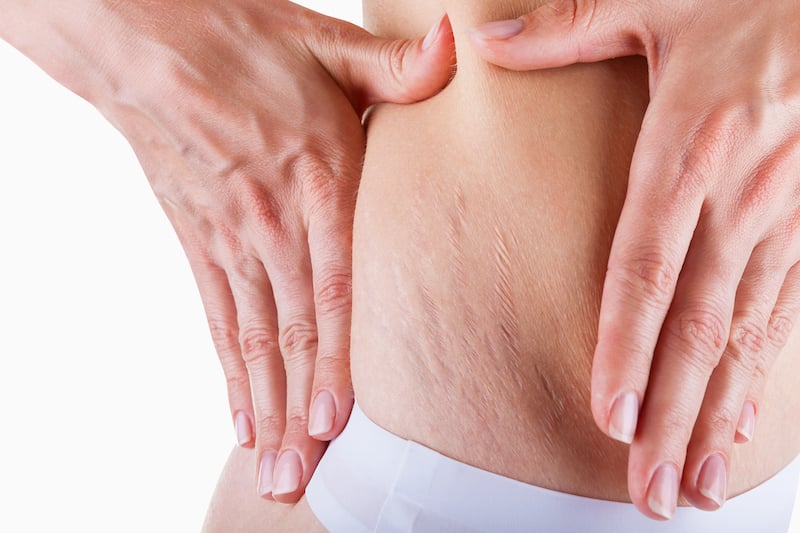
Red stretch marks on the thighs: what can you do?
The thighs are one of the areas where the skin is stretched the most, particularly during growth spurts or when your weight changes. Red stretch marks often appear here, on both the outer and inner thighs. The skincare and habits described below apply to this area too. For advice specific to the thighs, take a look at our article on stretch marks on the thighs.
How to treat red stretch marks: the right skincare
Stretch mark solutions (2) range from creams and oils to procedures carried out by professionals.
When choosing the right solution, skin sensitivity must be taken into account. Pay close attention to the ingredients you use. We recommend opting for treatments based on natural ingredients and avoiding overly chemical formulations.
Red stretch mark creams
The key selection criteria are the product’s formulation and your skin type (dry, oily or normal). Stretch mark creams combine a range of active ingredients chosen to care for the skin.
They have a pleasant texture that absorbs quickly. Apply them directly to the areas concerned using firm, regular movements.
The Cellublue Anti-Stretch Mark Cream is designed for all types of stretch marks, even long-standing ones. It is rich in provitamin B5 and natural actives (98%).
The cream that helps prevent the appearance of stretch marks* and improve how they look
*Consumer test on 22 volunteers over 3 weeks, based on participants' feedback.
- Helps prevent the appearance of stretch marks on the stomach, hips, thighs and bust. Apply morning and night
- Three plant oils: macadamia softens, sunflower soothes and coconut holds in hydration
- Velvety texture: it absorbs easily and calms feelings of tightness
Red stretch mark oils
Just as popular as creams, oils have earned their place in the stretch mark skincare aisle. They are naturally richer than creams, contain no water and absorb quickly into the skin. Look for natural plant-based oils.
Like creams, they are applied with a gentle massage to the affected areas. However, avoid mineral oils and essential oils, which are not suitable for treating red stretch marks.
The Stretch Mark Prevention Oil combines several plant-based oils. It absorbs quickly and is applied to the area you want to care for.

The massage oil that helps prevent stretch marks from appearing*, during pregnancy and beyond
*User test on 21 volunteers over 3 weeks, based on participants' feedback.
- Why does it work?
Medical treatments
Sometimes red stretch marks become particularly bothersome in everyday life. If creams and oils have not met your expectations, there are also procedures carried out by healthcare professionals.
These treatments require a significant investment and, as with any procedure, they may leave scars. They also have contraindications: only a dermatologist or doctor can tell you whether one of them is right for your skin and your situation.
Here are a few examples of these procedures, usually described as abrasive:
• Laser therapy
Laser treatment is widely used in dermatology. During a session, the dermatologist uses a beam of light that targets the reddish pigments in the blood vessels (3). The session may be accompanied by a burning sensation.
It should be noted that this treatment is contraindicated on certain areas of the body such as the breasts, inner thighs or lower abdomen, on dark and olive skin tones, and during pregnancy.
• Peeling
This method involves superficially burning the skin with glycolic acid so that it renews itself. The effects vary from person to person and can only be assessed after several months.
• Reconstructive surgery
This treatment combines localised injections with the removal of skin tissue. It is intended for people whose red stretch marks are particularly pronounced and bothersome. In some cases, this type of reconstructive surgery may be covered by national health insurance.
Everyday preventive habits
A balanced diet and a healthy lifestyle are among the good habits for looking after your skin and your body as a whole.
In other words, looking after your skin every day also means cutting back on excess (alcohol, tobacco…) and eating fewer fatty, sugary and salty foods.
Moisturise your skin every day with nourishing creams or oils, drink plenty of water and exercise regularly to keep your muscles toned.
With our stretch mark skincare and regular application, you can look after the skin affected by your red stretch marks every day.
Discover our complete solution dedicated to stretch marks. The Cellublue team has developed a comprehensive routine, suitable for all skin types. Click below to find out more.

The complete stretch marks routine, from shower to massage, during and after pregnancy
- Instructions for use
- Friendly advice
Sources and references
(1): Are Pregnancy Stretch Marks Different
(2): Traitement pour effacer les vergetures
(3): Les études scientifiques sur la photothérapie LED
Frequently asked questions
Can you get rid of stretch marks in a week?
No, no product will make stretch marks disappear in a matter of days. Caring for your skin takes patience and consistency: the creams and oils described in the skincare section are designed for daily use. If your stretch marks are very pronounced, a dermatologist can advise you.
How should you care for stretch marks?
There is no one-size-fits-all solution. The right choice depends on the stage of the stretch mark (red or white), your skin type and how much it bothers you. Both skincare products and procedures carried out by professionals are covered in the section “How to treat red stretch marks”.
Should I be worried about red stretch marks?
Red stretch marks are usually seen as a cosmetic concern. They affect many women and, to a lesser extent, men. If they worry you or appear during pregnancy, ask a doctor or healthcare professional for advice.
Related articles
Useful categories: Red Stretch Marks, Stretch Marks.