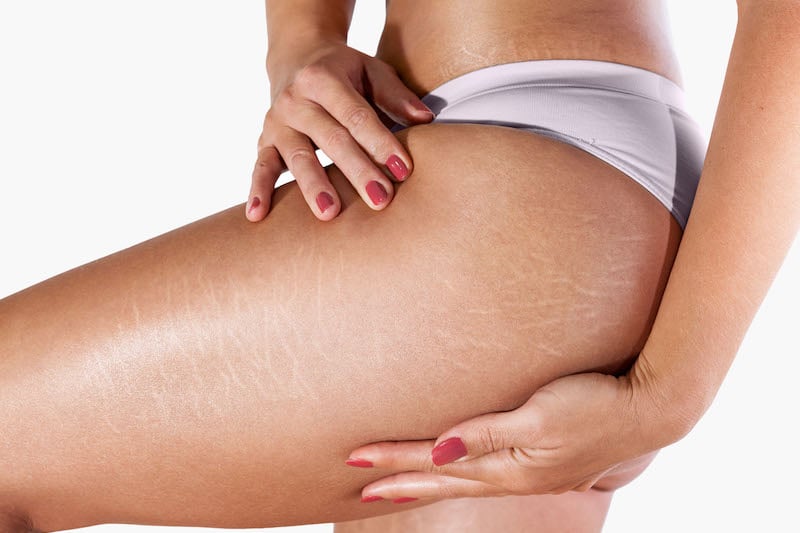
The appearance of stretch marks is a common concern for many women. Nearly 80% of women notice them at some point. The concern grows when they appear on specific areas of the body, such as the thighs.
That’s why so many people wonder about their origins. If you’re looking for answers about why stretch marks have appeared on your thighs, here’s a comprehensive overview of the main causes: rapid growth during adolescence, being overweight, pregnancy or cortisone-based treatments. You’ll then find an overview of the main treatments and techniques used for stretch marks.
Why do you get stretch marks on your thighs?
Several factors can trigger the appearance of stretch marks. They are primarily caused by a breakdown of two types of fibres in the skin: collagen fibres and elastic fibres.
This breakdown occurs when the skin stretches too quickly, exceeding its natural elasticity. There are also several underlying causes specific to stretch marks on the thighs.
Inner thighs, back of the thighs or between the thighs: where do they appear?
Stretch marks can form anywhere on the thigh: on the inner thighs, the back of the thighs, between the thighs or at the top of the leg. The skin in these areas can stretch when the body changes quickly, whether during a growth spurt, after weight gain or during pregnancy.
Stretch marks on the back of the thighs often go unnoticed at first, simply because they are hard to see. Checking regularly in a mirror helps you spot them sooner and look after the area.
Rapid growth during adolescence
According to various studies on adolescence and the onset of stretch marks, 25% of girls versus 10% of boys may develop stretch marks during puberty.
They tend to appear when the body grows too quickly. During puberty, growth hormones are produced at very high levels.
This causes the body to develop rapidly. Since this growth is physical, it also affects the skin — leading to a stretching of its fibres.
Being overweight
This is one of the most common causes. Weight gain means the body begins to accumulate large amounts of fat.
This fat typically settles beneath the skin, causing it to expand. As the process intensifies, it leads to tearing of the skin’s fibres.
Pregnancy
Stretch marks in pregnant women affect 50 to 70% of women by the end of pregnancy. When you become pregnant, your entire body undergoes a transformation. Your appetite increases significantly, and your body mass rises.
Under these circumstances, the body struggles to keep up with these changes. The skin in particular tends to undergo significant expansion, which can cause intense stretching — especially around the stomach and chest.
Cortisone-based treatments
Stretch marks can appear if you undergo prolonged treatment with cortisone. This is the case with repeated use of cortisone creams or oral corticosteroids.
These can weaken the skin, leading to various issues — including stretch marks.
Can stretch marks on the thighs be faded, and how?
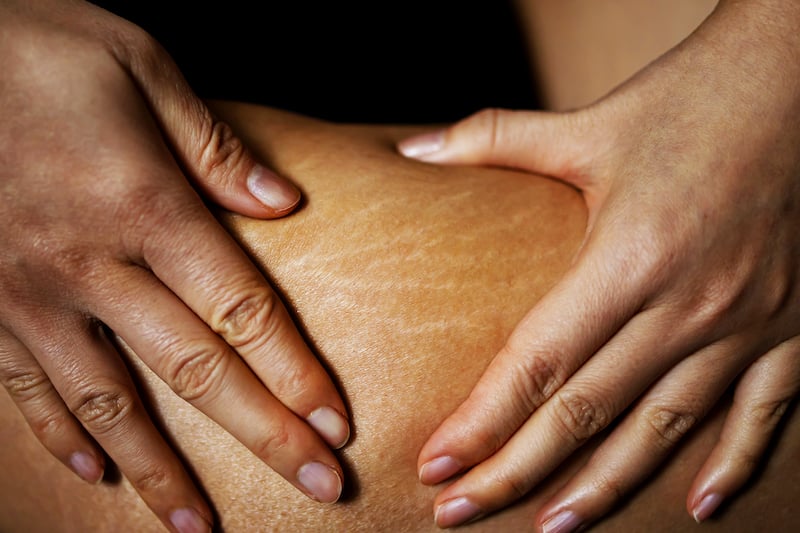
There are several treatments and techniques for stretch marks. However, making them disappear completely is difficult. They are essentially scars that form on the skin. Some treatments and techniques aim to make them less visible.
Several approaches can be used for stretch marks on the thighs, for example:
Anti-stretch mark creams
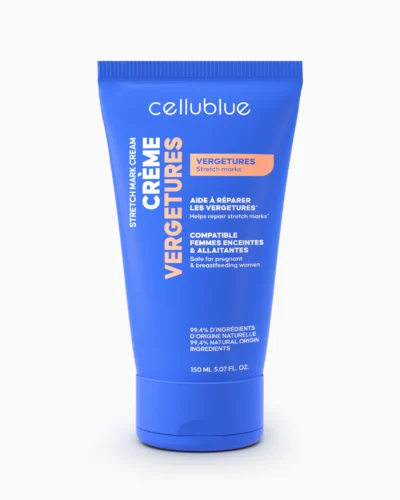
Anti-stretch mark creams are massaged into the targeted area to nourish and soften the skin. At Cellublue, our repairing anti-stretch mark cream has been specially formulated with naturally derived ingredients for skin marked by stretch marks. It contains 98% naturally derived ingredients, is free from allergens and essential oils, and is suitable for use during pregnancy and breastfeeding.
The cream that helps prevent the appearance of stretch marks* and improve how they look
*Consumer test on 22 volunteers over 3 weeks, based on participants' feedback.
- Helps prevent the appearance of stretch marks on the stomach, hips, thighs and bust. Apply morning and night
- Three plant oils: macadamia softens, sunflower soothes and coconut holds in hydration
- Velvety texture: it absorbs easily and calms feelings of tightness
Peeling
This involves a dermatologist applying certain acidic and abrasive substances to the skin. The aim is to smooth the skin, so that stretch marks look less noticeable.
The plasma method
This technique involves extracting plasma from the patient’s blood. Once collected, it is centrifuged to achieve a high platelet concentration, then injected beneath the stretch marks.
This technique is sometimes offered for stretch marks: a dermatologist will be able to tell you whether it is right for you.
Microneedling
True to its name, this method uses needles. The dermatologist rolls a micro-needle device over the stretch marks. Here too, it is the dermatologist who decides whether the technique is suitable for your skin.
Laser treatment
Using laser is one of the solutions for reducing the visibility of stretch marks. It is carried out by a dermatologist.
The technique known as fractional resurfacing uses this tool. It creates micro-perforations that can reach the epidermis. As with other techniques, the aim is to make stretch marks less visible on the skin.
A dermatologist will be able to tell you whether this procedure is suitable for you, regardless of which part of the body is affected.
Cosmetic surgery
This treatment is sometimes considered, particularly when stretch marks are visible on the abdominal area. It primarily aims to tighten the skin in the targeted zone: it is a medical procedure to discuss with a surgeon.
Nutricosmetics
Some food supplements fall into the category of nutricosmetics.
Before taking them, especially during pregnancy or breastfeeding, ask your GP or pharmacist for advice.
The Cellublue Anti-Stretch Mark Routine
Our Anti-Stretch Mark Pack is the complete solution for caring for stretch marks naturally. A complete programme designed to prepare, protect and nourish skin prone to stretch marks.

The complete stretch marks routine, from shower to massage, during and after pregnancy
- Instructions for use
- Friendly advice
✅ Our anti-stretch mark oil, made with 5 nourishing natural oils, cares for skin elasticity and suppleness. ✅ The dry massage brush removes dead skin cells. ✅ The anti-stretch mark cream looks after skin marked by existing stretch marks and scars. ✅ To complete the routine, the scrub exfoliates the skin.
Frequently asked questions
Why do I have stretch marks on my thighs?
Several situations can make them more likely to appear on the thighs, including rapid growth during adolescence or weight gain, when the skin stretches quickly in this area. If you are pregnant or taking medication, ask your GP for advice.
How do you get rid of stretch marks on your thighs?
Making them disappear completely is difficult, as they are scars. Several approaches aim to make them less visible: anti-stretch mark creams, peels, the plasma method, microneedling or laser treatment. For in-clinic techniques, a dermatologist will be able to advise you.
Are stretch marks on the thighs common in women?
Yes, they are common in women. During puberty, girls are affected more often than boys. They can also appear later in life, during pregnancy or after weight gain, when the skin stretches quickly.
Should I see a doctor about stretch marks?
If the appearance of stretch marks worries you, if you are pregnant or if you are taking any treatment, ask your GP for advice. For peels, plasma, microneedling or laser treatment, a dermatologist will be able to advise you.
Related articles
- Growth stretch marks in teenagers: causes & solutions
- Red stretch marks: causes, affected areas and care options
Useful categories: Stretch marks on thighs, Stretch Marks.