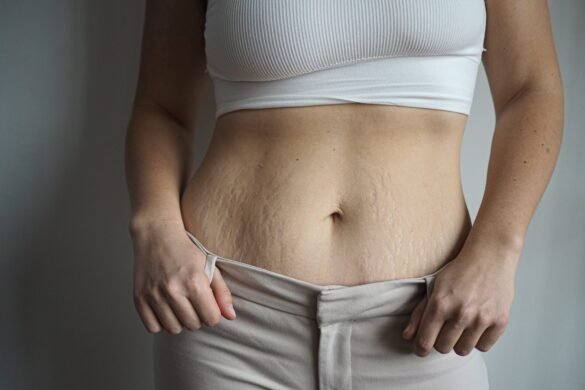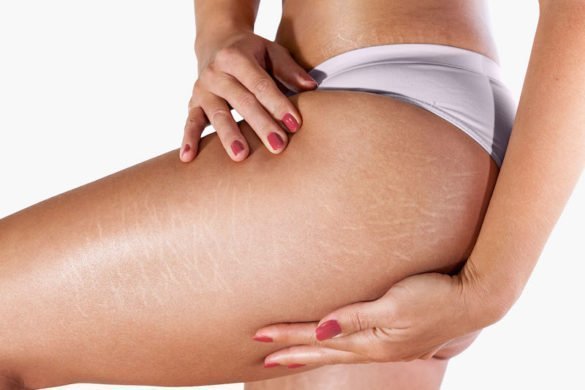
You’ve recently noticed stretch marks appearing on your thighs, stomach or chest. Panic sets in: you’re not sure what to do, and these marks are making you a little anxious. To top it off, your stretch marks aren’t white, they’re purple, which makes them anything but discreet! In this article, we look at what causes these coloured stretch marks, why they look purple, and what you can do to make them less noticeable. Let us walk you through everything, calmly.
Causes of purple stretch marks
Stretch marks, or striae distensiae, are micro-tears in the elastic fibres of the skin’s deeper layers. These tears are caused by a sudden and intense stretching of the skin which, under tension, “breaks” in places.
In the dermis (the middle layer of the skin), collagen and elastin fibres provide the skin with its suppleness and elasticity. But when subjected to sudden distension, they rupture. The result is visible at the surface of the skin: stretch marks.
The causes of stretch marks are varied. Among the most common:
1- Puberty
These are known as growth stretch marks, typical ofadolescence. They are triggered by a mismatch between bone growth (as a child becomes a teenager and reaches adult height) and skin growth. When growth spurts are rapid and intense, purple stretch marks can appear on a teenager’s skin — on the thighs, legs, lower back, and chest in girls.
2- Pregnancy
Pregnancy is perhaps one of the most common circumstances in which purple stretch marks appear. The belly grows month by month during gestation. The dermis, subjected to increasing and rapid stretching, sometimes lacks the elasticity needed to keep up. Under the pressure, the elastic fibres give way and stretch marks appear. Pregnant women may also notice stretch marks on their hips and chest, due to the weight gain that naturally comes with pregnancy.
3- Weight fluctuations
Rapid weight loss or gain, as well as yo-yo dieting, are factors that encourage the appearance of stretch marks. The skin, despite its remarkable suppleness, is vulnerable when subjected to repeated distension. When the demand for elasticity caused by significant weight changes becomes too great, collagen fibres will break.
4- Significant muscle mass gain
Purple stretch marks can affect dedicated athletes. Weight gain and muscle mass gain place a similar strain on the dermis. It is therefore not uncommon to see people who train regularly (particularly in weightlifting, high-impact sports, powerlifting…) develop stretch marks on theshoulders, arms, pectorals orchest, andcalves.
5- Stress
Sustained stress or prolonged anxiety triggers a hormonal response in the body. The adrenal glands overproduce cortisol, a hormone released in response to stressful situations. Naturally present in the body, cortisol is necessary — however, elevated cortisol levels in the blood can have damaging effects on the skin and blood capillaries, and may lead to the appearance of purple stretch marks.
6- Medication
Cortisone-based medications and hormonal treatments (contraceptive pill, hormone replacement therapy) can, over time, have a detrimental effect on the quality of the dermis and on microcirculation. Stretch marks may therefore appear following prolonged use of this type of treatment.
7- A pathological cause
Cushing’s syndrome, or chronic hypercortisolism, is a chronic condition of the adrenal gland. The body, out of balance, produces more cortisol than it needs. Among the consequences of this condition: the appearance of wide, vertical, purple stretch marks on the abdomen.
Pink, red or purple stretch marks: what’s the difference?
Depending on the person and the area of the body, a new stretch mark can look pink, red or purple. Whatever the shade, it points to the same thing: a recent mark that is still coloured, unlike white stretch marks, which are older and have lost their colour.
There’s no hidden meaning to read into the shade. It simply shows that the skin is still healing, and that’s exactly when looking after it makes the most sense, as we explain below.
Why are my stretch marks purple?
When they first appear, stretch marks are often coloured. They may turn pink,red or take on a purplish hue.
The colour of stretch marks reflects how recently they have appeared and, by extension, the degree of subcutaneous inflammation. The dermis has sustained a recent injury, so the atrophic skin lesions are still immature and pigmented.
The purple colouration of stretch marks is actually the body’s response to these lesions. The skin’s immune cells get to work on healing and rebuilding an elastic network.
What can you do to reduce purple stretch marks?
The best time to look after stretch marks is while they are still coloured. The inflammatory stage is actually an opportunity: the skin, which is still healing, is more receptive to care. Purple stretch marks are more likely to fade when treated early than white stretch marks, which are mature and more deeply set.
Tip #1: nourish from within
Skin health starts from the inside. When stretch marks develop, staying well hydrated is essential — the dermis needs water to heal. Diet also plays a key role. Your meals should provide the nutrients your skin needs to repair and rebuild quickly. Focus on foods rich in:
- Vitamin C: fresh produce such as blackcurrants, kiwi, citrus fruits, peppers and parsley.
- Vitamin A: offal such as liver, and dairy products.
- Vitamin B5: brewer’s yeast, wheat germ. Cheese-
- Vitamin E: vegetable oils, nuts and dried fruits, seafood.
- Copper: offal such as liver, cocoa, shellfish.
- Silicon: dehydrated foods (soups, coffee).
- Zinc: meat, oysters, wholegrains and nuts.
Tip #2: treating purple stretch marks
- Medical treatment for stretch marks
Several dermatological techniques are now used in an attempt to reduce the appearance of stretch marks. Their effectiveness varies from case to case. They are often costly and require consultations with specialist practitioners, which aren’t covered by insurance because they are cosmetic.
These include mechanical techniques (peeling,dermabrasion), which aim to exfoliate the upper layers of the skin to stimulate cell renewal; as well aslaser, pulsed light,LED photo-stimulation andradiofrequency, procedures designed to encourage collagen production; and injections.
- Topical treatment for stretch marks
The cosmetics world has developed formulations based on plant-derived ingredients to help reduce stretch marks and deeply nourish and repair the skin. Certainplant oils, plant butters andessential oils are particularly beneficial for rebuilding the dermis, thanks to their richness in vitamins and antioxidants (flavonoids and tannoids).
Our Stretch Mark Routine harnesses the power of nature and draws inspiration from the best medical techniques to help you improve the appearance of purple stretch marks.
- The Dry Massage Brush exfoliates the skin to help you make the most of your stretch mark care and massage routine. Its bristles and nodules work hand in hand with the massage movement.
- The Anti-Stretch Mark Treatment Oil, a blend of 6 nourishing and restorative oils, nourishes the skin and helps with stretch mark prevention. Used daily, it helps reduce the visible appearance of purple stretch marks.
- The Anti-Stretch Mark Cream, with its velvety texture (cocoa butter and macadamia oil), helps maintain skin elasticity and reduce the appearance of purple stretch marks.
The complete stretch marks routine, from shower to massage, during and after pregnancy
- Instructions for use
- Friendly advice
Kelly’s review of this routine: Highly effective ⭐️⭐️⭐️⭐️⭐️ 5/5Just 2 days of use and I’m already seeing results. I’ve only tried the oil and the milk so far and I’m absolutely delighted — I had red stretch marks and they’re completely invisible now. I’m blown away by how well it works.
This gentle routine, which pregnant women and breastfeeding mothers can use after checking with their doctor, supports the prevention and care of purple stretch marks while treating your skin with the utmost respect.
Frequently asked questions
How do you get rid of purple stretch marks?
Strictly speaking, you can’t simply make them disappear. The aim is to make them less visible. As explained in the section “What can you do to reduce purple stretch marks?”, the skin is most receptive to care while stretch marks are still coloured. The article suggests nourishing your skin from within, massaging it and using suitable topical products. For personalised advice, speak to a GP or a dermatologist.
Why do I have stretch marks on my thighs?
The thighs are one of the areas where stretch marks can appear, as outlined in the section “Causes of purple stretch marks”. Puberty, pregnancy, weight fluctuations and gaining muscle mass can all stretch the skin quickly, which shows up as coloured stretch marks when they first appear. Where they appear mostly depends on which areas of skin are under the most strain.
Will my purple stretch marks stay purple?
Not usually. The purple colour is a sign of a recent stretch mark, as explained in the section “Why are my stretch marks purple?”. Over time, these marks generally become paler, closer to white. White stretch marks are older and more deeply set, which is why the article recommends looking after them while they are still coloured.
Purple stretch marks during pregnancy: what can I do?
Pregnancy is one of the most common times for purple stretch marks to appear, as described in the section “Causes of purple stretch marks”. The article suggests nourishing your skin from within and using gentle topical products. For any question related to your pregnancy, ask your doctor, midwife or another medical professional.
What is the best treatment for purple stretch marks?
The article describes two approaches. The first is dermatological techniques carried out by specialist practitioners: peeling, dermabrasion, laser, pulsed light, LED photo-stimulation, radiofrequency and injections. The second is topical products made with plant-derived ingredients. Either way, looking after a stretch mark makes the most sense while it is still coloured. To find the right option for you, see a dermatologist.
Related articles
- Stretch marks on the buttocks: how to reduce their appearance?
- Stretch marks in men: how to reduce their appearance?
Useful categories: Purple Stretch Marks, Everything About Stretch Marks.