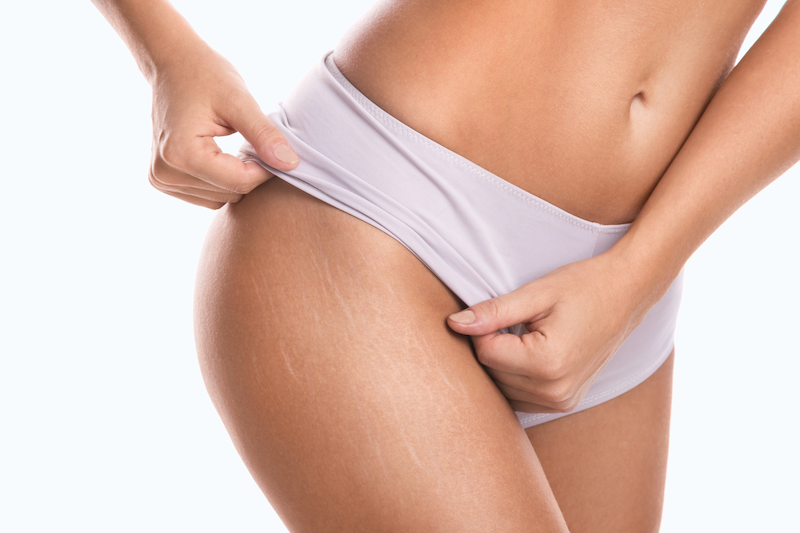
Stretch marks are thought to affect 80% of women and 40% of men. They can look unsightly and often make people feel self-conscious, especially once they’ve turned white. Why do they turn white, what causes them and where on the body do they tend to appear? Below, you’ll also find at-home care (cream, oil and scrub) and the techniques offered by doctors to make white stretch marks less noticeable.
What are white stretch marks?
Stretch marks are skin irregularities caused by sudden and rapid stretching of the skin. As a result, the skin loses its elasticity, leading to spontaneous tearing of the deep dermis — the layer of skin between the epidermis and the hypodermis. When they first appear, stretch marks take the form of streaks resembling elongated scars. These lesions can develop on various parts of the body.
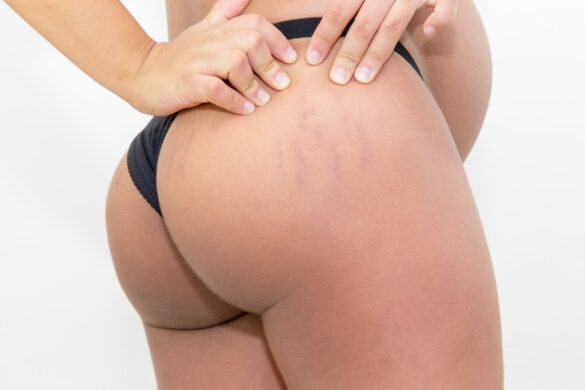
Generally speaking, stretch marks come in two types based on their colour: red stretch marks and white stretch marks. In reality, they are the same stretch marks at different stages. Red stretch marks are recent, so-called “immature” stretch marks. Their colour comes from the inflammatory response triggered by the tearing of collagen fibres within the skin.
After the inflammation phase, the skin begins its regeneration process to replace damaged skin cells. However, these new support cells form thinner, less pigmented tissue with a slightly sunken appearance — giving rise to white stretch marks. In other words, they are simply the same red stretch marks that have changed colour over time. At this stage, they are considered “mature” and more difficult to treat. That said, it is still possible to reduce the appearance of white stretch marks, which is exactly what we’ll explore in this article.
What causes white stretch marks?
Stretch marks can sometimes be linked to medical conditions. One example is stretch marks associated with Cushing’s syndrome: wide and vertical, they are linked to an excess of corticosteroids. If you’re unsure, ask a doctor for advice. There are also “classic” stretch marks, unrelated to any health condition, which are finer and less noticeable.
White stretch marks can have several causes. Among the most common are weight fluctuations and pregnancy. Between 75 and 90% of women develop stretch marks during pregnancy, due to hormonal changes and rapid weight gain. Obesity is also a leading cause, as it is associated with multiple hormonal imbalances and excessive weight gain that can trigger stretch marks.
Beyond pregnancy and obesity, the breakdown of collagen fibres that leads to white stretch marks can also be triggered by stress. In stressful situations, the body secretes cortisol, which increases the likelihood of stretch marks developing.
Which areas of the body are affected by white stretch marks?
The areas of the body most commonly affected by white stretch marks differ slightly between women and men.
- In women, they tend to appear on the buttocks, thighs, abdomen and breasts.
- In men, they are more commonly found on the upper and lower back, as well as on the arms. This is often attributed to intense physical training.
The skin in these areas is not necessarily fragile, but these parts of the body are generally subject to greater tension. Despite its natural elasticity, the skin can eventually give way and tear. Boys and girls alike often develop stretch marks during adolescence, due to hormonal changes and faster, more significant muscle growth.

White stretch marks on the thighs and buttocks
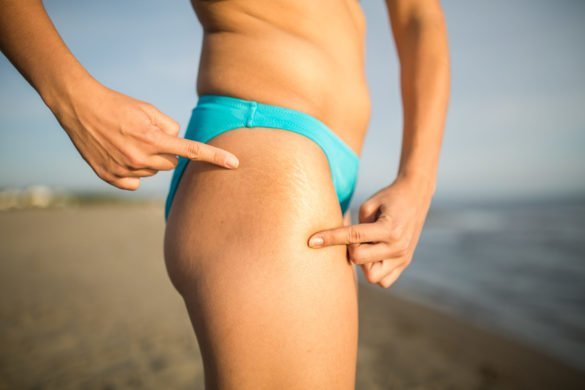
In women, the thighs and buttocks are among the areas where white stretch marks most often appear. The skin there isn’t necessarily more fragile, but these areas come under particular strain when your weight changes, during pregnancy or during adolescence. Under this tension, the skin can give way, leaving fine streaks that gradually turn from red to white over time. The care described below can be used on these areas too.
How to fade white stretch marks?
At-home solutions
Completely eliminating a white stretch mark is quite challenging. However, there are still at-home methods you can use to care for the affected skin.
Anti-stretch mark creams
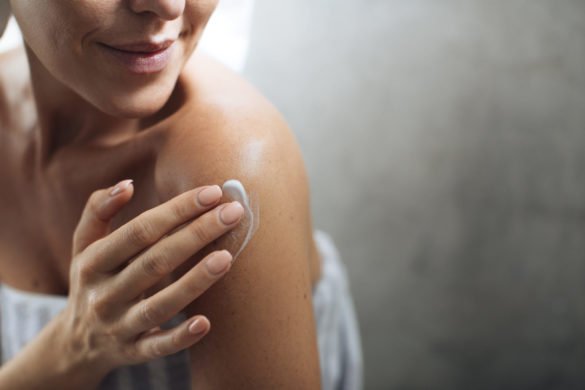
One way to help fade white stretch marks is to apply a dedicated cream for white stretch marks. These creams work by nourishing the skin. Regular, consistent moisturising is strongly recommended. You’ll need to be patient and consistent over the long term. Opting for a natural formula is a good idea. As well as caring for white stretch marks, these creams hydrate the skin and leave it feeling softer. For sensitive skin, hypoallergenic anti-stretch mark creams are also available.
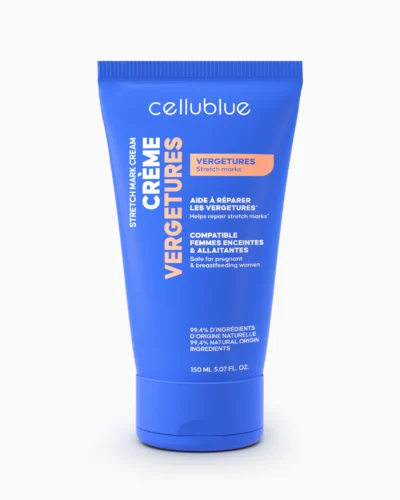
Our Anti-Stretch Mark Cream is an ally in the care of skin with stretch marks, helping to support skin elasticity. It is enriched with macadamia oil to care for skin cells, and provitamin B5 to support the skin’s elasticity.
The cream that helps prevent the appearance of stretch marks* and improve how they look
*Consumer test on 22 volunteers over 3 weeks, based on participants' feedback.
- Helps prevent the appearance of stretch marks on the stomach, hips, thighs and bust. Apply morning and night
- Three plant oils: macadamia softens, sunflower soothes and coconut holds in hydration
- Velvety texture: it absorbs easily and calms feelings of tightness
Anti-stretch mark oils
Anti-stretch mark oils are another option for white stretch marks. Apply them generously morning and evening to the areas being treated as well as any at-risk zones. After application, massage the skin using circular movements to help the oil absorb, paying extra attention to all the areas concerned. Unlike creams, anti-stretch mark oils penetrate the skin more easily as they contain no water.
At Cellublue, we have developed a stretch mark oil to care for skin prone to all types of stretch marks. This oil is formulated with 4 plant-based oils:
- Sesame oil: cares for stretch-marked skin and soothes irritation
- Jojoba oil: has moisturising and nourishing properties
- Sweet almond oil: softens the skin and provides deep hydration
- Sunflower oil: soothes and helps care for the skin

The massage oil that helps prevent stretch marks from appearing*, during pregnancy and beyond
*User test on 21 volunteers over 3 weeks, based on participants' feedback.
- Why does it work?
Exfoliating treatments
Regular exfoliation is another approach that can complement your stretch mark care. Sloughing away dead skin cells helps leave the skin feeling softer. It also allows any anti-stretch mark products applied afterwards to penetrate better.
Our Anti-Stretch Mark Scrub contains ingredients such as wheat germ oil for smoother, more radiant-looking skin. Its texture transforms into a delicate creamy foam in the shower, for a gentle full-body exfoliation.
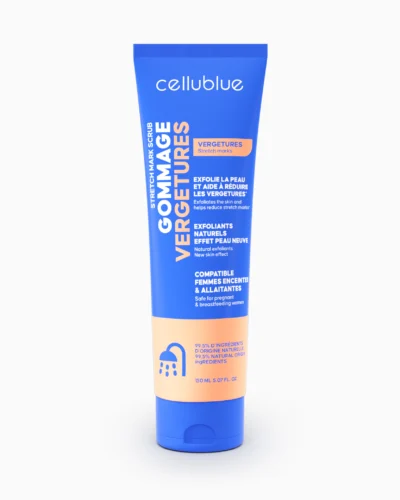
The gentle scrub that helps prevent the appearance of stretch marks* and preps your skin for care
*Usage test on 21 volunteers over 3 weeks, participants' opinions.
- Instructions for use
- Friendly advice
Medical treatments
To reduce the appearance of white stretch marks, medical treatment is also an option. It is, however, considerably more expensive, and some techniques don’t always live up to their promises. Before committing, it’s worth weighing up the pros and cons with a doctor to avoid wasting time and money.
Microdermabrasion
One of the available alternatives is microdermabrasion. This is a mechanical peeling technique that aims to fade stretch marks. Aluminium microcrystals are projected onto the areas being treated, creating micro-injuries. The aim of the process is to make stretch marks less noticeable. Depending on the case, a microdermabrasion session can last up to an hour and costs between €60 and €150.
Micro-needling
Besides microdermabrasion, another technique offered to help fade stretch marks is micro-needling. This technique works by triggering an inflammatory response in the skin to set off the healing process. The practitioner first applies a local anaesthetic before using a rotating cylinder fitted with rows of micro-needles. The treatment is completed with the application of silicon. Sessions typically cost between €150 and €300.
Laser therapy
Another option is laser therapy. Lasers used for this purpose are specifically designed to treat skin lesions without affecting the surrounding tissue. Results vary depending on the type of laser used. Some smooth the skin over mature stretch marks, while others repigment them or tighten the scar tissue. The choice of laser is made by the practitioner based on each patient’s individual needs. Sessions are estimated to cost between €150 and €300.
You now have a full overview of the natural and medical solutions available to reduce the appearance of your white stretch marks.

The complete stretch marks routine, from shower to massage, during and after pregnancy
- Instructions for use
- Friendly advice
Frequently asked questions
How can I get rid of white stretch marks naturally?
It’s difficult to make a white stretch mark disappear completely, as it is considered “mature”. At home, an anti-stretch mark cream, oil and scrub let you care for it day to day. They are covered in the “At-home solutions” section.
Can stretch marks disappear in a week?
No, you shouldn’t expect a quick change. White stretch marks are considered “mature” and remain difficult to treat. It’s better to focus on a regular skincare routine and be wary of any claims promising they’ll disappear quickly.
Which cream should I choose for white stretch marks?
Go for an anti-stretch mark cream that nourishes and hydrates the skin, ideally a natural formula. If you have sensitive skin, hypoallergenic versions are available. The key is to apply it consistently.
Can white stretch marks be linked to a health problem?
Some stretch marks can be linked to a health problem. If your stretch marks have appeared for no obvious reason, have changed in appearance or worry you, the simplest thing is to ask a doctor for advice. They can point you in the right direction.
Related articles
- Purple stretch marks: causes and solutions
- White stretch marks: is self-tanner a good concealing solution?
- Stretch marks on the knees: how to reduce them?
Useful categories: White Stretch Marks, Stretch Marks.