

Health authorities recommend eating 5 fruits and vegetables a day to stay healthy. Fair enough, but is fruit actually a good idea in the evening? Since it contains sugar, could it make you put on weight? And, most importantly, is there a particular fruit worth choosing at night when you’re watching your weight?
Should you eat fruit at dinner?
There is absolutely no reason to avoid fruit in the evening. Quite the opposite! Fruit is a varied food that has its rightful place in a balanced diet. And to anyone who claims that fruit, being sweet, makes you put on weight, our answer is that it all comes down to quantity. Eating too much fruit can of course have an impact on your weight, since it does contain fructose. But the body processes this sugar well, and 2–3 pieces of fruit a day fit easily into a balanced diet.
As for the ideal time to eat them, opinions vary. Some prefer consuming them between meals rather than as a dessert (see also our article on bloating). Another option: eating them at the start of a meal. They provide fibre and are generally well tolerated.
So, are there any fruits worth choosing in the evening when you’re watching your weight?
Fruit 1: kiwi

This small exotic fruit has its place in the evening. First, kiwi is a light fruit that won’t make you gain weight if eaten in moderation: just 60 kcal per 100 g. Second, it’s easy to enjoy on its own, in a fruit salad or as a starter. Third: the idea that its vitamin C could keep you awake is simply a myth, so there’s no need to save it for breakfast.
Fruit 2: strawberry

One of the lightest fruits around. Very low in sugar, low in calories (39 kcal per 100 g), and rich in potassium and vitamin B9, the strawberry has its place on the evening menu. It also works beautifully as a starter: strawberry and beetroot soup, rocket salad with strawberries and feta, or a tomato and strawberry salad with basil. We love them all!
Fruit 3: pear

A touch of sweetness with this absolutely delicious autumn fruit! The pear has the advantage of being light in calories (60 kcal per 100 g) and comes in a wonderful variety of types. Firm or melt-in-the-mouth, subtly fragrant, it can brighten up a salad or, lightly pan-fried, make a lovely accompaniment to white meat. Go ahead and indulge: it fully deserves its place at dinner.
Fruit 4: apple

Let’s go with a tried-and-true classic: the apple remains a go-to for light meals. It’s rich in pectin, a soluble fibre. It’s nice to eat at the start of a meal, and it also features in our selection of snacks. It’s also incredibly versatile, whether eaten raw or cooked. A true kitchen staple.
Fruit 5: avocado

Yes, avocado is a fruit, even if it’s eaten as a vegetable in our part of the world. It is admittedly calorie-dense (205 kcal per 100 g, no less), but those calories are far from empty: healthy fats, low sugar, magnesium, fibre and tryptophan. What more could you ask for?
Fruit 6: pineapple
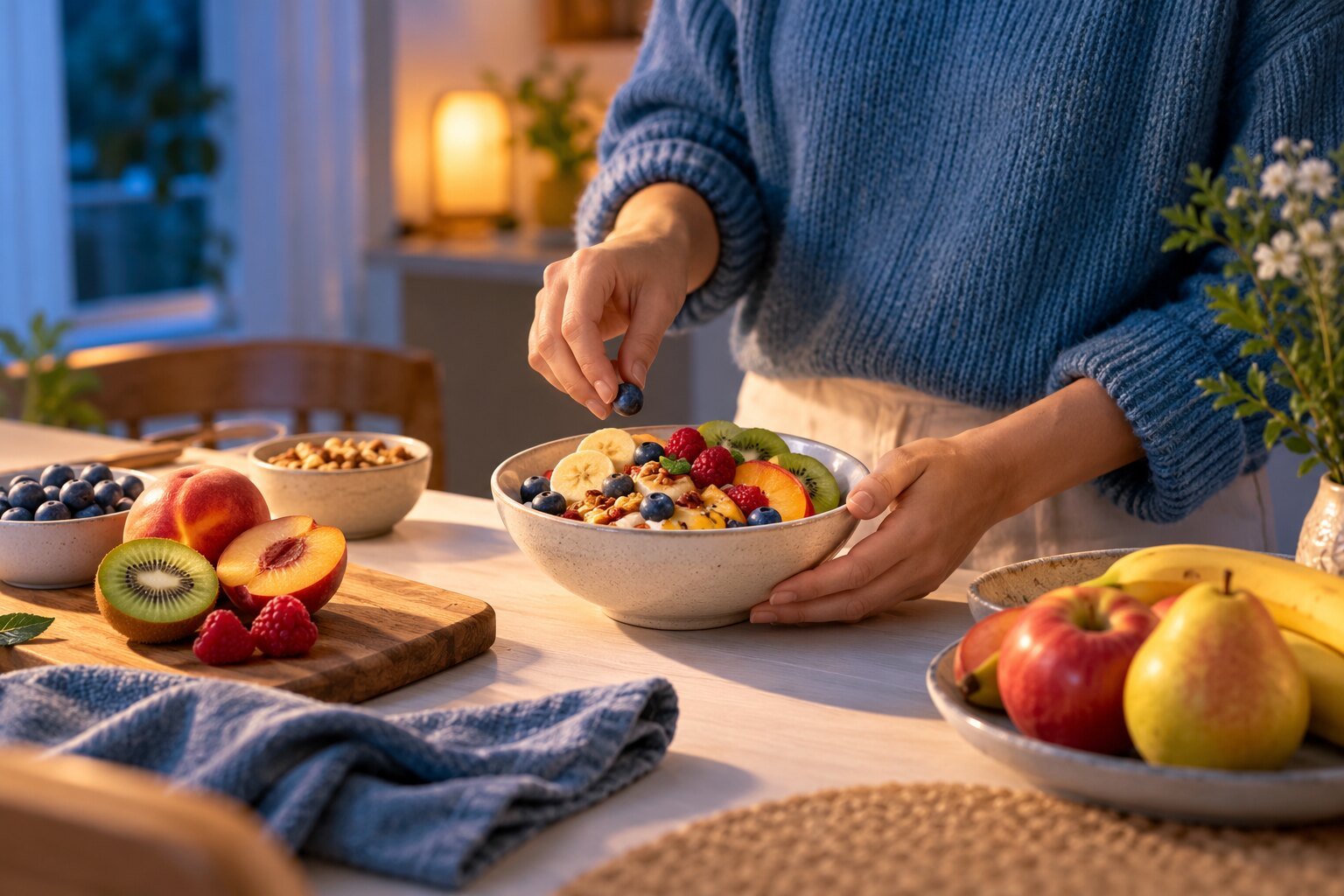
Pineapple contains an enzyme called bromelain. Its reputation as a “fat burner” is not backed up by evidence, however. It’s also wonderfully easy to cook with, pairing perfectly with oily fish (thanks to its natural acidity) and white meats. So go ahead and invite it to dinner!
What about belly fat: which fruit should you eat at night?
The answer is simple: no fruit works on one specific area of the body, and the tummy is no exception. Neither kiwi nor pineapple, nor any other fruit on this list, targets that part of the body. They all have their place at dinner, but as part of a varied, balanced diet combined with regular physical activity. It’s these overall habits, far more than any single food, that matter for your figure.
Frequently asked questions
Does kiwi make you put on weight if you eat it at night?
No, not if you eat it in moderation. Kiwi is light (60 kcal per 100 g). The idea that its vitamin C will keep you awake is a myth. So it fully deserves its place at dinner, for example at the start of the meal.
Which fruit makes you gain weight at night?
No fruit makes you gain weight on its own, whether in the evening or at any other time of day. It’s eating too much that can make a difference, as fruit contains fructose. Stick to 2–3 pieces of fruit a day and keep portions of the more calorie-dense ones, such as avocado (205 kcal per 100 g), reasonable.
What fruit is good to eat before bed?
Kiwi, avocado and pineapple are all good options at the end of the day. Kiwi is light, avocado provides magnesium and tryptophan, and pineapple goes well with oily fish. Ideally, enjoy them at dinner, at the start of the meal.
Which fruit should you eat in the evening when you’re watching your weight?
Go for light fruit: strawberries (39 kcal per 100 g), kiwi and pears (60 kcal per 100 g), or apples. Many people like to eat them at the start of a meal.
Related articles
- Counting calories to lose weight: useful or pointless?
- Fermented milk: what it is and how to add it to your diet
- Juice cleanse: what it is, side effects and how to start
Useful categories: Slimming Nutrition, Weight Management.
To go further, explore the Cellublue shop: our body care products.


 -61%
Seven supplements and a connected scale: the whole programme in one pack
- In the morning, the Silhouette Capsules and the Apple Cider Vinegar Gummies: chromium contributes to the maintenance of normal blood glucose levels
- At mealtimes, the Silhouette Drainer and a Weight Loss Tablet: green tea and ash round out the formula
- In the afternoon and evening, the Lightness Tea, the Metabolism Capsules and the theine-free Detox Infusion: plants that contribute to digestive functions