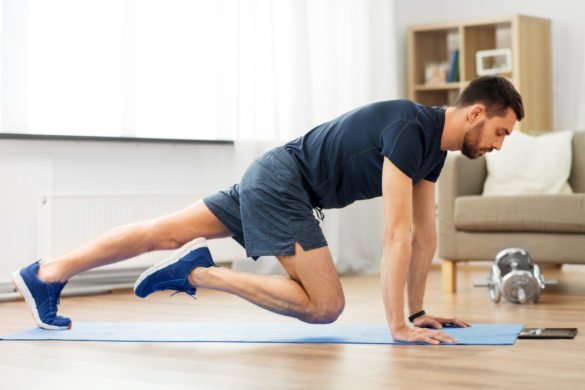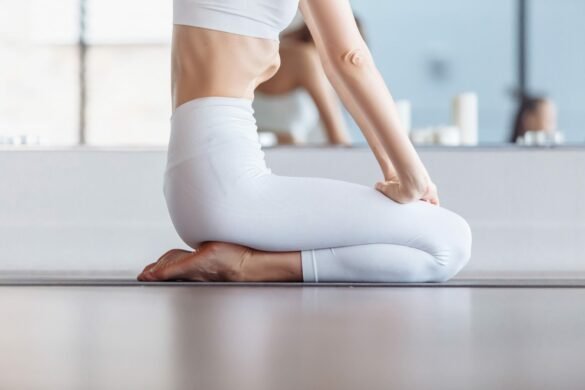
Yoga, Pilates, abdominal breathing… You’ve already tried plenty of methods to take care of your stomach. What if hypopressive gym could round out your toolkit? Hypo-what? Don’t worry: we’ll explain where this method comes from, what it aims to do, who should avoid it, and suggest 4 hypopressive gym exercises to get you started.
What is hypopressive gym?
Behind this rather unusual name lies a method developed in the 1980s by Belgian physiotherapy doctor Dr Marcel Caufriez. Drawing on research in histochemistry (the study of the chemical composition of cells), electromyography (or EMG, used to study nerves and muscles) and functional anatomy, he developed a pelvic floor and abdominal rehabilitation method, often offered after childbirth. Hypopressive gym also offers a way to work the core muscles and pelvic floor.
In practice, the principle is as follows: combining breathwork (diaphragmatic inhalation and breath-holding before exhaling) with postural work (specific positions held during these brief apnea phases). The method aims to lower pressure in the thorax and abdomen during the exercise. Its proponents describe several intended effects:
- Reflex contraction of the deep abdominal muscles
- Contraction of the pelvic floor muscles
- Reduced pressure on the lumbar region
- Support for the pelvic organs — a topic to discuss with a healthcare professional if you experience discomfort
When practised correctly and consistently, hypopressive gym helps you work the abdominal muscles in depth, become aware of your posture and maintain muscle tone.
So, what can hypopressive gym be used for?
It is often recommended for women following childbirth (from 3 months postpartum), but it’s not just for new mothers! It may appeal to a wide range of people. Its main aims include:
- Working the pelvic floor alongside rehabilitation supervised by a midwife or physiotherapist: an alternative to classic squeeze-and-release exercises.
- Supporting you through menopause; for pelvic organ prolapse and/or urinary leakage, ask a doctor for advice.
- Taking care of your waistline and/or complementing a flat stomach routine.
- Working the thorax and abdomen through a technique sometimes called an “internal massage”.
- Becoming aware of poor posture.
- Taking care of your back; if you have pain, such as lower back pain, hernias or osteoarthritis, ask a doctor first.
However, hypopressive gym is not recommended for certain people, including:
- Pregnant women, as hypopressive gym can trigger uterine contractions.
- Women who have recently given birth — wait at least 3 months before starting!
- People with high blood pressure, as hypopressive gym affects blood pressure.
- People with specific joint conditions — a physiotherapist can assess on a case-by-case basis.
Before you start: good habits
If you belong to one of the groups listed above, or if you have any doubts about your health, ask a doctor or physiotherapist for advice before starting. For your first sessions, settle into a quiet place, wear comfortable clothing and begin with the costal opening (exercise 1): it is one of the founding principles of the hypopressive method.

The cooling gel that leaves the skin on your stomach firmer
- Arctic Algae, Prosveltyl® & Menthol, combined in a formula designed for the stomach and hips
- Sorbet texture: it absorbs faster and makes the fresh sensation last longer
- 🍃 98.3% natural-origin ingredients
Take it step by step. Don’t hesitate to shorten a breath hold if you feel uncomfortable, and catch your breath between repetitions.
Which hypopressive gym exercises should you start with?
If you’re not particularly keen on endless crunches (and they’re far from a guarantee of a flat stomach — quite the opposite!), here are a few exercises to help you master the basics of hypopressive gym.
Exercise 1: Learning the costal opening

Diaphragmatic breathing and costal opening are the founding principles of hypopressive gym. Without this mechanism, no other exercises can be performed correctly.
- Sit comfortably cross-legged, with your back straight.
- Place your hands on your ribs to feel the natural movement of your ribcage as you breathe: the ribs open on the inhale, close on the exhale.
- Breathe while increasing the range of opening and closing.
- After several repetitions, exhale fully and begin a breath hold. Without taking in any air, try to open your ribs as if you were inhaling (but without actually breathing in!).
- Intensify the exercise by opening and closing your ribs 2 or 3 times during the breath hold.
To perform the hypopressive gym exercises that follow, understanding the costal mechanism is essential, as is mastering the expiratory breath hold: these are the foundations of the method. To go further, discover our tips for a toned stomach.
Exercise 2: Sustaining the breath hold

A second exercise to help you learn to sustain the expiratory breath hold. It also engages the abdominal muscles.
- Stand with your feet parallel, hip-width apart.
- Slightly bend your knees and lean your body gently forward, without locking your back.
- Place your hands on your iliac crests (the bony points at the sides of your pelvis).
- Perform 3 expiratory breath holds of around 10 seconds each.
- If you can only hold for 10 seconds, that’s perfectly fine. The key is to breathe with the diaphragm: perform a “false” inhale by opening the ribs, without actually taking in air.
Exercise 3: Really feeling your core

This posture helps you truly feel the abdominal work that hypopressive gym involves.
- Start standing, feet and knees parallel and hip-width apart, not turned outward.
- Lean forward, keeping your back straight, and rest your weight on your thighs. Place your hands just above your knees, fingers pointing inward.
- As with the second exercise, perform 3 expiratory breath holds of 10 seconds each.
- During the breath hold, you’ll feel your stomach hollow out.
Exercise 4: Pairing breath with movement

A final hypopressive gym exercise, inspired by a yoga pose you’re likely familiar with: the bridge.
- Lie on your back, knees bent, arms extended above your head.
- On the inhale, lift your stomach and pelvis toward the ceiling. Tuck your chin to your chest, keep your shoulders on the floor and your arms relaxed.
- Exhale slowly while holding the position. Then perform a “false inhale” by opening your ribs and sustain the breath hold for 10 seconds.
- On the exhale, slowly return to the starting position.
- Repeat the exercise 3 times.
This dynamic exercise, more active than the previous ones, will help you master the posture and breathing specific to hypopressive gym.
Related articles
- 8 core exercises for a flat stomach inspired by fitness and yoga
- Lemon and Cumin: What We Really Know
- The Cellublue Belly Care Routine, Morning to Night
Useful categories: Slimming Exercises, Weight Management.
To go further, explore the Cellublue shop: our body care products.
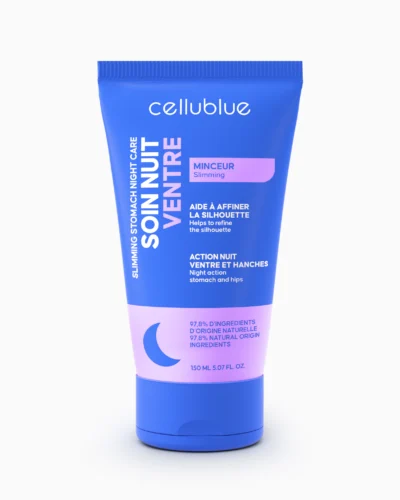
The evening treatment with Ginger & Slimsize® for the belly and hips
- Targeted night treatment for belly & hips, to massage in every evening before bed
- Ginger & Slimsize®, with a patented active ingredient at the heart of the formula
- Helps smooth and firm the skin