Among the most popular techniques right now for losing belly fat, the stomach vacuum comes up time and again. But what exactly lies behind this slightly intimidating term? Its roots in yoga, its claimed benefits, the contraindications to be aware of and some exercises to get you started, whether lying down, sitting or standing: here’s everything you need to know about this yoga-inspired exercise!
What is the stomach vacuum?
As the name suggests, it is an abdominal breathing technique that involves emptying (vacuum) the stomach of all its air, through contraction and pressure on the abdominal core.
1- Origins rooted in yoga
The stomach vacuum is drawn from Hatha Yoga, drawing directly from a practice called Bandha (to lock or seal, in Sanskrit). There are 3 major Bandhas in yogic tradition:
- Mula Bandha: the Muladhara lock, or Root Chakra lock, located at the base of the spine, at the level of the perineum. In yogic tradition, this chakra is said to be connected to vital energy and the life force.
- Uddiyana Bandha: the upward lock, with the word “uddiyana” expressing the action of taking flight and soaring. This is the Bandha most commonly associated with the stomach vacuum.
- Jalandara Bandha: the throat lock, which in yogic tradition is linked to the Vishuddha Chakra, the throat chakra, associated with the expression of emotions and feelings.
The goal of the Bandhas is not so much to achieve a flat stomach as to regulate the flow of energy within the human body.
2- The stomach vacuum today
The ancient practice of Bandhas later inspired a fitness method created in the 1980s by a Belgian physiotherapy doctor, Dr Marcel Caufriez: hypopressive gymnastics. The stomach vacuum is one of its movements. This form of exercise, built around hypopressive techniques, draws on studies in histochemistry (the study of cellular chemical composition), electromyography (the study of nerves and muscles) and functional anatomy. It combines breathing and postural work, with the aim of reducing pressure in the thorax and abdomen. According to the method’s advocates, this is meant to involve:
- a reflex contraction of the deep abdominal muscles;
- a perineal contraction;
- reduced pressure on the lumbar spine;
- correct repositioning of the urogenital system.
What are the benefits and contraindications of the stomach vacuum?
1- The benefits of this type of exercise
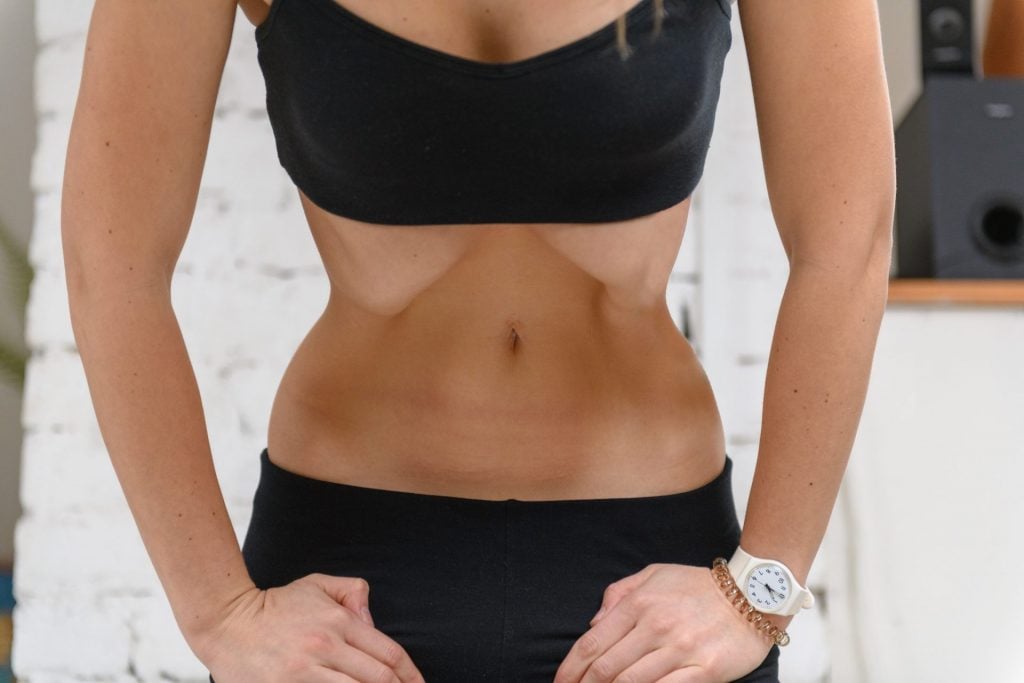
An ancient practice that has made a remarkable comeback, the stomach vacuum is credited by its fans with a wide range of benefits, most of which have not been proven, including:
- easier digestion, as the movement is said to massage the digestive organs, particularly the liver, gallbladder and spleen;
- a more engaged pelvic floor, as the hypopressive exercise is said to reduce pressure on the pelvic floor;
- a more toned stomach and core, as the muscles (including the deep transverse abdominis) are engaged;
- a more relaxed back, as the stomach vacuum is said to relieve pressure on the lumbar spine and works on your posture;
- better breathing control, as the exercise teaches you to breathe differently and more deeply;
- pelvic floor work, at a time when organ prolapse or urinary leakage is a common concern for women after menopause (on this subject, ask a medical professional for advice);
- less stress, as the practice is deeply relaxing!
2- Contraindications
However, the stomach vacuum and, more broadly, hypopressive gymnastics, are not recommended for certain people — despite their seemingly gentle nature. This applies to:
- people with blood pressure issues;
- in cases of vascular conditions such as an aneurysm;
- individuals with a pulmonary condition;
- people with an abdominal condition (such as a hernia);
- following recent surgery, especially abdominal or perineal;
- pregnant women, particularly in early pregnancy, as the technique may trigger unwanted uterine contractions;
- women in the post-partum period (wait a few months).
If you’re unsure whether it’s suitable for you, particularly during or after pregnancy, speak to a doctor or medical professional before you start.

The cooling gel that leaves the skin on your stomach firmer
- Arctic Algae, Prosveltyl® & Menthol, combined in a formula designed for the stomach and hips
- Sorbet texture: it absorbs faster and makes the fresh sensation last longer
- 🍃 98.3% natural-origin ingredients
How to practise the stomach vacuum?
Does this abdominal breathing technique appeal to you? It’s entirely up to you to give it a go. And to help you along the way, here are a few simple exercises to do lying on your back (exercise no. 1), sitting cross-legged (exercise no. 2) and then standing up (exercise no. 3)!
Exercise no. 1: introduction to the stomach vacuum
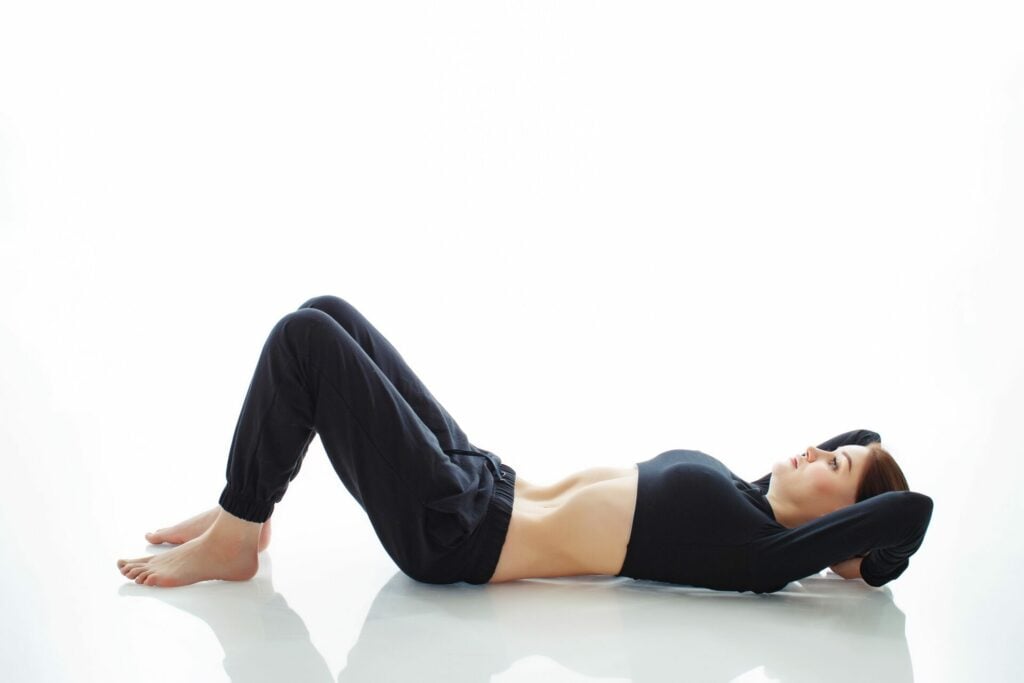
A first exercise to help you get to grips with the technique.
- Start lying on your back, knees bent, feet hip-width apart and arms alongside your body.
- Inhale, gently expanding your belly, then engage your pelvic floor as if you were trying to stop the flow of urine.
- Exhale through your mouth, fully emptying your lungs.
- Once completely empty, close your mouth, pinch your nose and act as if you are inhaling again — but without taking in any air.
- At the same time, draw your stomach in as far as possible, navel towards your spine, stomach lifted towards your ribs.
- Hold this contracted position for a few seconds, then gently release.
- Repeat 5 to 10 times, according to your ability.
Exercise no. 2: opening up the rib cage
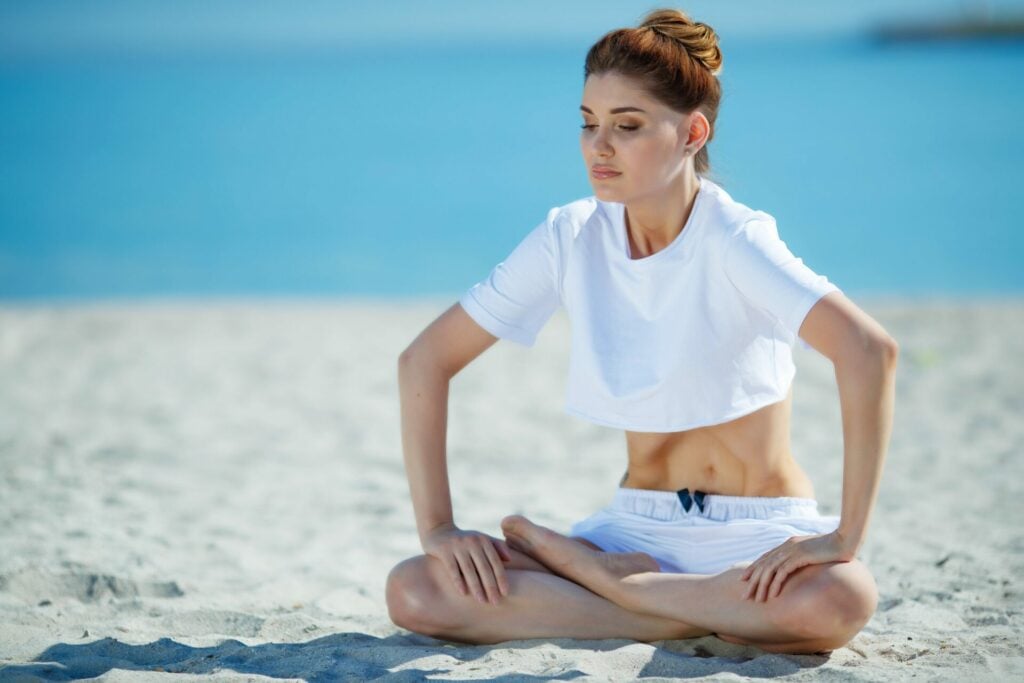
A good stomach vacuum requires a wide costal opening, as with any diaphragmatic breathing exercise. And that’s something you can train!
- Sit cross-legged with your back straight.
- First, breathe normally and place your hands on your ribs to feel how they move with each breath. They expand when you inhale and close when you exhale.
- Then breathe more deeply to better feel this opening and closing movement.
- On your last exhale, empty your lungs completely and hold your breath. Without taking in any air, try to open your rib cage as wide as possible while drawing in your stomach.
- Repeat the exercise 3 times. This practice should gradually help you open up your rib cage more and more, for a fuller stomach vacuum.
Exercise no. 3: breath-hold work
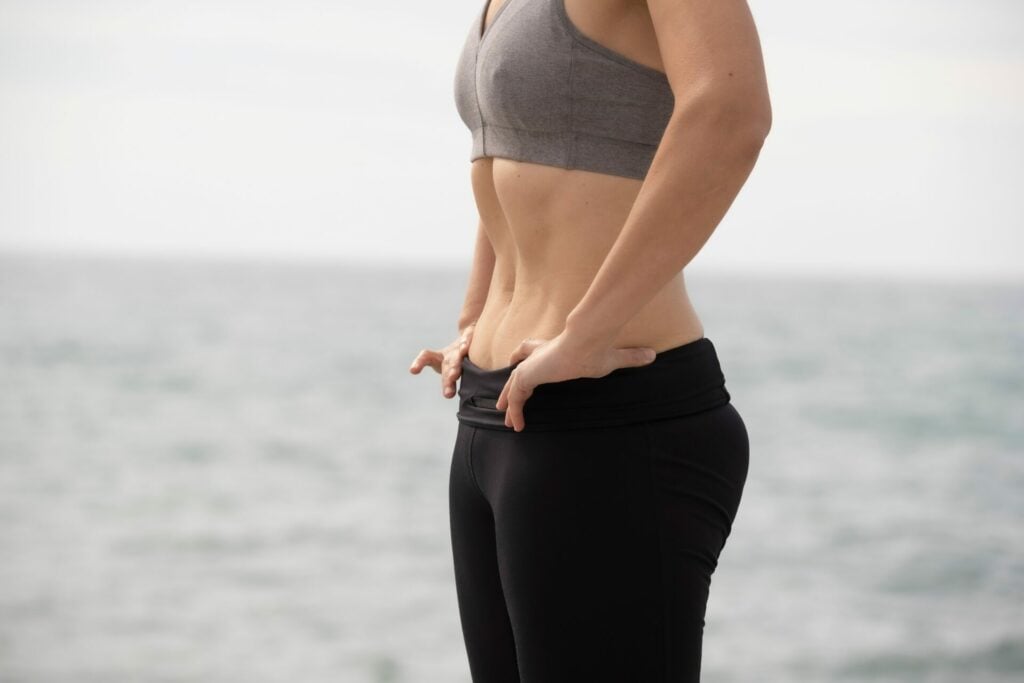
Now that you have mastered the basics of the stomach vacuum and understand how your diaphragm works, it’s time to focus on the breath hold — a key element in performing the exercise correctly.
- Stand upright, feet hip-width apart, hips relaxed.
- Bend your knees very slightly and lean just a little forward, without compressing your stomach.
- Place your hands on your hip bones.
- Perform what is known as an expiratory breath hold: exhale completely, then perform a false inhale (no air intake — only the rib-opening movement as in the second exercise).
- Hold for 10 seconds. Your pelvis should not move; only the diaphragm opens and the abdominal muscles retract.
- Release gently and repeat 3 to 5 times to fully understand how the expiratory breath hold works.
These three exercises should help you become familiar with the stomach vacuum. They will help you work your abdominal core. Practised regularly (ideally every day) and at your own pace, the stomach vacuum can earn its place in your exercise routine. And if belly firmness is something you’re interested in, you’ll find more tips on the blog.
Frequently asked questions
How do you do a stomach vacuum?
Exhale through your mouth, emptying your lungs completely. Then, with your mouth closed and your nose pinched, act as if you are inhaling, without taking in any air, and draw your stomach in as far as possible, navel towards your spine. Hold for a few seconds, then gently release. The three exercises in the “How to practise the stomach vacuum?” section take you through the progression step by step.
How do you do a standing stomach vacuum?
That’s what exercise no. 3 is for. Standing with your feet hip-width apart, knees slightly bent and hands on your hips, you perform an expiratory breath hold: a full exhale, then a false inhale without taking in any air. Your pelvis stays still. Always release gently.
Does the stomach vacuum come from yoga?
Yes. It is drawn from Hatha Yoga and takes direct inspiration from Uddiyana Bandha, the “upward lock”. In yogic tradition, the Bandhas are mainly used to regulate the flow of energy within the body. This practice later inspired hypopressive gymnastics, of which the stomach vacuum is one of the movements.
Can you do the stomach vacuum when pregnant?
During pregnancy, after giving birth or if you have a medical condition, ask a doctor or medical professional for advice before trying the stomach vacuum. The “Contraindications” section lists the situations in which this technique is not recommended.
Related articles
- Pilates: 6 exercises to get a flat stomach
- 8 core exercises for a flat stomach inspired by fitness and yoga
Useful categories: Slimming the Belly, Slimming Exercises.
To go further, explore the Cellublue shop: our body care products.

The evening treatment with Ginger & Slimsize® for the belly and hips
- Targeted night treatment for belly & hips, to massage in every evening before bed
- Ginger & Slimsize®, with a patented active ingredient at the heart of the formula
- Helps smooth and firm the skin
 -26%
-26%The cordless massager: 2 900 rotations per minute to stimulate your skin
- A deep mechanical massage: rotations and vibrations, up to 2 900 turns per minute, knead the skin on your thighs, stomach, arms and bottom
- 2 complementary heads: the ball head kneads deep down, then the wave head smooths and tones the surface
- 5 intensity levels on a touchscreen, a blue light, cordless and quiet