You hear a lot about “superfoods” in wellbeing advice. But in practical terms, what sets them apart from other foods, and what place should they have on your plate?
The answer comes down to two words: nutrient density. These foods pack in a good amount of nutrients: antioxidants, omega-3s, fibre, vitamins and minerals. That said, the term “superfood” has no official definition: it’s first and foremost an expression popularised by marketing.
As part of a balanced, varied diet, they bring colour and variety to your meals, without being miracle products.
What is a superfood?
Not all foods have the same make-up. Superfoods stand out for their high concentration of nutrients.
These include:
- antioxidants: polyphenols, vitamin C, catechins…
- omega-3s: fatty acids the body can’t produce and which must come from your diet
- minerals (potassium, magnesium)
- fibre: soluble or insoluble depending on the food
To find out more, take a look at our tips for a balanced everyday diet.
Our pick of superfoods
Turmeric
Turmeric is one of the best-known superfoods. It contains curcumin, the pigment that gives it its yellowy-orange colour and which has been the subject of numerous studies.
How to use it?
In the kitchen, it adds flavour to curries, soups, pulse dishes and hot drinks such as “golden milk”.
It’s mostly sold as a powder, but you can also find it fresh, as a root for grating, in Asian grocers and some supermarkets.
👉 Traditionally, it’s paired with a pinch of black pepper.
Ginger
Ginger is a root with a spicy, lemony flavour, widely used in Asian cooking. In particular, it contains gingerol, the compound responsible for its spicy taste.
It livens up herbal teas, marinades, vegetable stir-fries, soups and even fruit desserts.
Fresh or ground? Fresh ginger has a sharper, more aromatic flavour. Ground ginger remains a handy everyday alternative.
Chia seeds
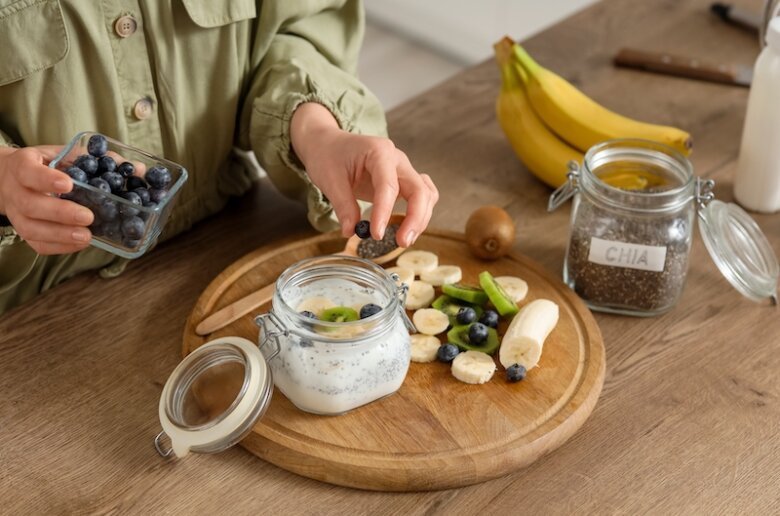
Chia seeds contain soluble fibre and plant-based omega-3s. Two strengths that explain their popularity:
- Their fibre gives them a gel-like texture once soaked, perfect for a pudding or porridge.
- Their plant-based omega-3s add to those found in walnuts, rapeseed oil and oily fish.
Another distinctive feature: chia seeds absorb up to 10 times their weight in water, hence that gel-like texture. So remember to soak them and drink enough water.
They can also complement your plant-based sources of protein.
Flaxseeds
Flaxseeds are rich in soluble fibre, lignans (compounds from the polyphenol family) and omega-3s. Their mild, nutty flavour goes well with yoghurts, salads and homemade bread.
Important: for the body to absorb their nutrients, flaxseeds need to be ground. Whole, they pass through the digestive tract without being digested.
Green tea
Green tea is a drink rich in antioxidants, particularly catechins. It also contains caffeine (sometimes called theine): it’s best to avoid drinking it in the evening or in large quantities, and to ask your doctor for advice if you’re pregnant or breastfeeding.
Hot, iced or as matcha, it lends itself to all sorts of preparations, from a simple brewed tea to bakes.
It easily finds its place among your everyday drinks, alongside water.
Berries (goji, blueberries…)
Berries are among the foods richest in antioxidants, particularly polyphenols, the pigments that give them their vibrant colours.
Why choose them?
For their tangy flavour, their colours and their versatility: on their own, in a smoothie, in a yoghurt, on a bowl of oats or as a coulis.
They also provide vitamin C, fibre and potassium.
Blueberries, raspberries, strawberries, redcurrants, goji berries or açaí: fresh when in season, frozen or dried the rest of the year, they all have their place in a varied diet.
👉 The simplest approach is to mix up your berries, rather than relying on a single “superfood”.
Some berries also feature in our selection of fruits to put on the menu.
Raw cacao
Raw (unprocessed) cacao contains flavonoids, compounds from the polyphenol family.
It tastes more bitter than chocolate, as it contains no added sugar or milk.
Enjoy in moderation:
- in a yoghurt
- in a smoothie
- or as a powder in homemade recipes.
What about water retention?
Water retention has a variety of causes: heat, standing for long periods, the hormonal cycle… No food can make it disappear on its own, and persistent swelling warrants medical advice. When it comes to your plate, the basic rule is to drink enough water throughout the day, not overdo the salt and eat a variety of fruit and vegetables.
The superfoods to remember
- Turmeric: ground or fresh, traditionally paired with a pinch of pepper.
- Ginger: fresh or ground, to liven up herbal teas and dishes.
- Chia seeds: rich in fibre and omega-3s, to be soaked.
- Flaxseeds: to be eaten ground.
- Green tea: rich in catechins, in moderation because of the caffeine.
- Berries: to be varied with the seasons.
- Raw cacao: rich in flavonoids, to be enjoyed in moderation.
How to add superfoods to your daily routine
- to a smoothie
- to a yoghurt
- to a salad
- as a herbal tea
- as a topping on dishes
The idea is simply to add them regularly to vary your diet.
Are superfoods enough to reduce cellulite?
Let’s be honest: superfoods cannot, on their own, erase cellulite. The “orange peel” appearance is a complex phenomenon that depends on several factors:
- circulation
- water retention
- tissue structure
- lifestyle
These foods are simply part of an overall healthy lifestyle: a balanced diet, regular physical activity and enough water. To fight the appearance of cellulite, focus instead on regular anti-cellulite massages.
Related articles
- Snacking: which foods to choose between meals?
- Dietary fibre: food sources and tips to eat more every day
- Green Juices: What They Are and Easy Home Recipes
Useful categories: Anti-Cellulite Diet.

The cupping tool that replicates pinching and rolling, 3 minutes per zone
- The professionals' technique, at home: you lift, glide, and release, and the tool grips the skin fold like a manual pinching and rolling
- Soft silicone that fits thighs, buttocks, stomach, and arms
- 3 minutes per zone, every day, always with a massage oil so the tool glides

The scrub that leaves skin smooth and skin texture refined*
*User test on 21 volunteers over 4 weeks, based on participants' feedback.
- Olive & apricot kernels: these natural grains gently sweep away dead skin cells
- Caffeine & monoi scent, so your shower instantly smells like a holiday
- In the shower, two to three times a week, massaging your thighs, bottom and stomach