Summer is in full swing: time for lazy days in the sun and refreshing swims! The only downside is your white stretch marks. A tan tends to make the pale streaks on your thighs, hips, stomach or chest stand out even more. So how can you hide them? Can self-tanner help make them less noticeable, and what other options are there to help you feel more comfortable in your skin?
Why do I have white stretch marks?
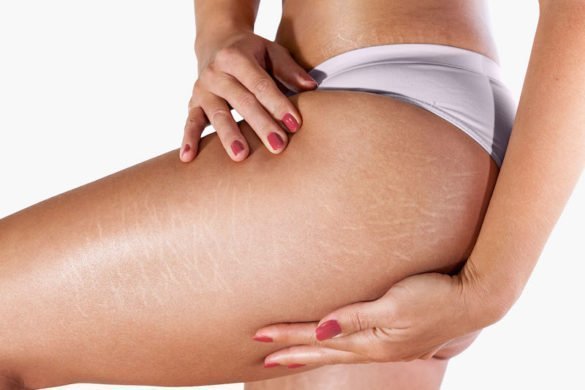
When they first appear, stretch marks are usually reddish. This is due to the skin’s inflammatory state. In theory, if treated early enough, stretch marks have a chance of fading somewhat. But more often than not, we don’t treat them properly — or we wait too long. Over time, their appearance changes: they turn white. Some women aren’t bothered by this and wear their white stretch marks as part of their personal story. For others, however, stretch marks are a real source of insecurity — especially when warmer weather arrives, bringing sun exposure that makes the pearly white appearance of their stretch marks even more noticeable.
What effect does the sun have on stretch marks?
- First things first: no, the sun does not cause stretch marks. They are linked to significant and sudden tension on the dermis, such as weight gain, growth spurts or pregnancy, and to the breaking of collagen fibres, the protein that contributes to the skin’s elasticity. Once broken, these fibres do not regenerate, so the appearance of stretch marks tends to settle in over time.
- A word of caution: if your stretch marks are still in the inflammatory stage, it is strongly recommended to avoid sun exposure, as this can cause them to darken.
- The next stage: once the inflammatory phase has passed, stretch marks take on a pearly white hue. This colour can remain visible, partly because of a loss of collagen and a lack of pigmentation in that area. A tan is then likely to heighten the contrast with your stretch marks.
- One final tip: stretch marks, like the rest of your skin, need suitable sun protection before any time in the sun, whether brief or prolonged.
Is self-tanner a good solution for hiding my stretch marks?
So what are your options if you don’t want your stretch marks to stand out? There aren’t many. You can learn to live with them, wrap yourself in a sarong for the rest of your days, avoid the beach altogether — or try to conceal your stretch marks with self-tanner.
Self-tanner is a cosmetic product used to achieve a temporary tan similar to a natural one, without any sun exposure. Since this faux glow offers no UV protection, it’s essential to apply sunscreen before spending time in the sun. In recent years, cosmetic brands have made huge strides in quality: self-tanners are easier to apply and deliver a more even finish.
But when it comes to effectively concealing stretch marks, a few drawbacks remain:
- Since stretch marks are essentially grooves in the skin, applying self-tanner to each one is a tedious task…
- Self-tanner may give your skin a lovely glow, but it won’t fill in the skin irregularities caused by stretch marks.
- Watch out for product quality! Some lower-grade self-tanners leave patchy colour rather than an even, unified tone.
Rather than going all-in on a “conceal at all costs” approach, you might consider blurring your white stretch marks instead by choosing a pearlescent product containing soft-focus pigments. These pigments, made from mica, pearl or silica powders, diffuse light rather than reflect it. They create an optical illusion that can visually soften skin irregularities. It’s a more subtle cosmetic approach than a standard self-tanner, for a discreet blurring effect.
Isn’t it better to treat my stretch marks rather than hide them?
It’s something you’ll hear time and again: it’s better to embrace your body as it is than to try at all costs to hide what you see as flaws. That said, giving your skin regular care can be a worthwhile investment, rather than focusing solely on hiding what doesn’t need to be hidden. The Mom’s World routine, enriched with plant-based ingredients such as jojoba oil, wheat germ and cocoa butter, follows 3 steps:
- A gentle scrub that removes dead cells from the upper layers of the epidermis and prepares the skin for the next steps.
- A massage oil, a blend of natural plant oils, to nourish the skin.
- A moisturising cream with plant-based actives, to be applied every other day to care for your skin.
With consistent use, you’ll be able to see a difference in how your skin feels, and the appearance of your white stretch marks may become slightly less noticeable: skin that feels softer and more supple, and stretch marks that look a little less streaked. Let’s be honest: white stretch marks don’t disappear, but well-nourished skin often makes them less visible.
The complete stretch marks routine, from shower to massage, during and after pregnancy
- Instructions for use
- Friendly advice
Frequently asked questions
How do you get rid of white stretch marks?
They can’t be erased completely. A regular skincare routine (a gentle scrub, massage oil and cream) can help soften their appearance, and some doctors offer in-clinic treatments such as microdermabrasion. To hide them, you could try self-tanner or a pearlescent product.
How can I hide my stretch marks?
Self-tanner can help reduce the contrast between your skin and your stretch marks, but it doesn’t fill in skin irregularities and offers no UV protection. A pearlescent product containing soft-focus pigments can also visually soften their appearance.
Which plant-based ingredients are good for white stretch marks?
Jojoba oil, wheat germ and cocoa butter are often used in stretch mark skincare, as they nourish the skin and help keep it supple. They won’t erase stretch marks, but they help keep your skin soft and comfortable.
Related articles
- Microdermabrasion for Stretch Marks: Does It Work?
- Natural Ways to Care for Stretch Marks
- Purple stretch marks: causes and solutions
Useful categories: White Stretch Marks, Stretch Marks.