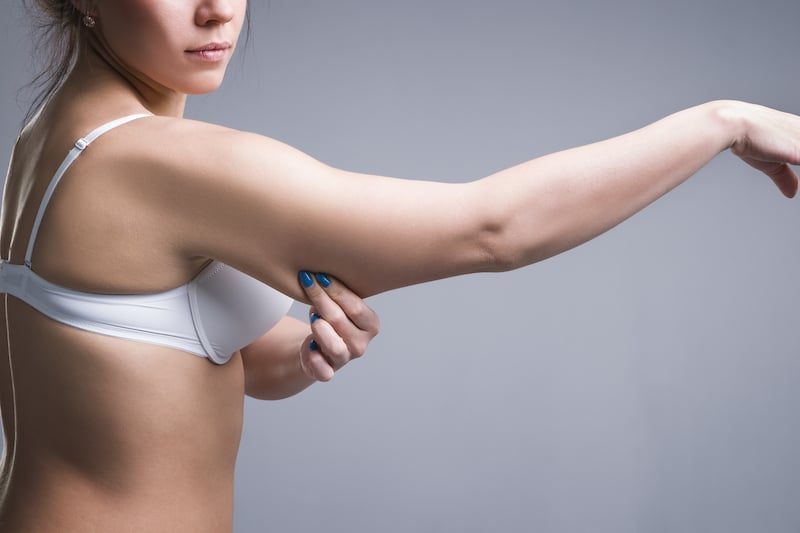
Some people feel self-conscious about cellulite on their arms and avoid wearing short-sleeved tops. Here’s where it comes from, followed by some simple steps you can take to care for your arms: targeted exercises, cupping massage, anti-cellulite skincare and a balanced diet.
What is cellulite?
Cellulite results from excess fat stored in the adipose cells. Adipose tissue is made up of fibres and cells called “adipocytes”. These sit just beneath the skin and are distributed across various areas of the body, including the arms.
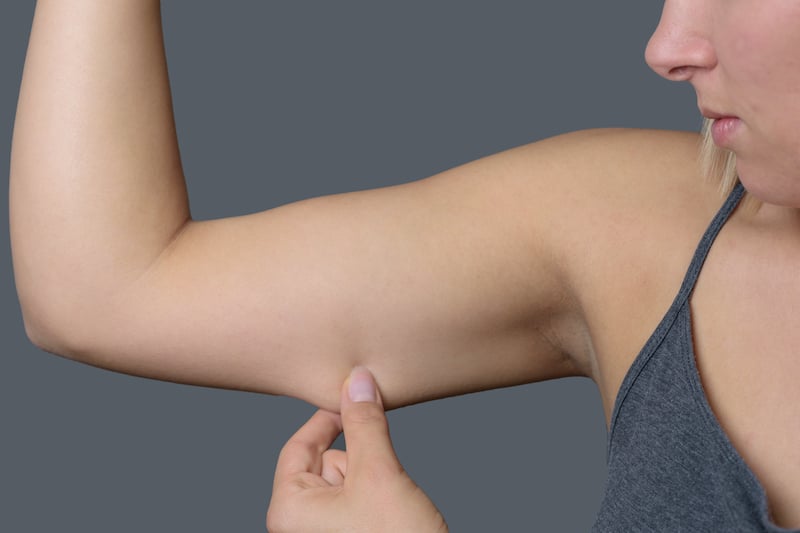
As adipocytes increase, cellulite becomes increasingly visible. Instead of a smooth surface, your skin takes on the appearance of orange peel, with a dimpled, uneven texture. Cellulite most commonly appears on the thighs, stomach and buttocks, but it can also develop on the arms — which is exactly what we’ll be exploring in this article.
For more information on what cellulite is, you can read our full guide dedicated to the subject.
Why do we get cellulite on the arms?
The causes of cellulite are many and varied. Women are more prone to cellulite than men (2). This is simply because adipose cells are not structured the same way in both sexes (3). This change in skin texture is linked to hormones, collagen, genetics and poor circulation. In addition, diet, lifestyle, lack of physical activity and weight gain can also contribute to the appearance of cellulite. Poor habits can lead to fat accumulation in any part of the body, including the arms.
What are the solutions for getting rid of arm cellulite?
There are several solutions to help you care for your arms, including exercises, massages, anti-cellulite treatments and a healthy diet. Dermatological treatments are also available.
Arm cellulite: exercises to help tackle it
Targeted exercises and endurance sports are options for getting your arms moving. Opt for cardio activities that engage the arms, such as skipping rope, swimming, kickboxing or using an elliptical trainer with arm handles.
If you lead a sedentary lifestyle, build up gradually.
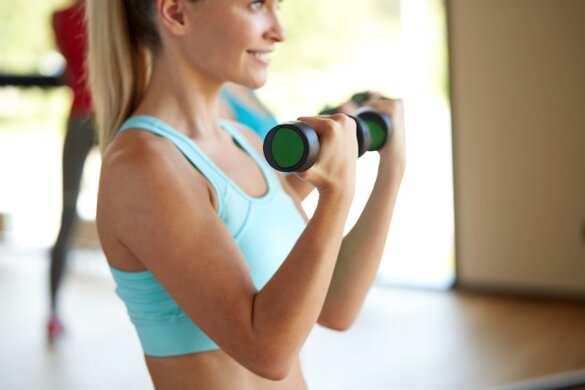
Specific arm-targeted exercises focus on this area. Aim to work your biceps and triceps around 3 times a week.
Shoulder press

This arm exercise targets both the triceps and biceps. Hold a dumbbell in each hand. Position your hands on either side of your shoulders and press them upwards. Complete 3 sets of 10 repetitions.
Triceps extensions

This exercise targets the triceps. Stand upright and hold your dumbbells. Extend your arms above your head, then bend them behind your neck. Complete 3 sets of 15 reps.
Seated extensions

This exercise is done seated on a bench. Hold your arms at 90° on either side of your shoulders. Push your arms upwards for 10 repetitions over 2 minutes. Repeat twice.
Massaging your arms
There are many types of massage to help care for your arms, but the most recommended for the arms is the pinch-and-roll, which is also the basis of the cupping technique described below.
You can do a manual pinch-and-roll massage on your arms yourself, though it can be a little tricky. To make things simpler, we recommend using an anti-cellulite cupping cup.
Anti-cellulite cups replicate the pinch-and-roll technique in a quick and easy way. You can find an anti-cellulite cup along with the complete method in our Anti-Cellulite Method Pack. It includes all the products and accessories needed to follow the complete Cellublue Method in 3 steps. Here’s how to use it on your arms:
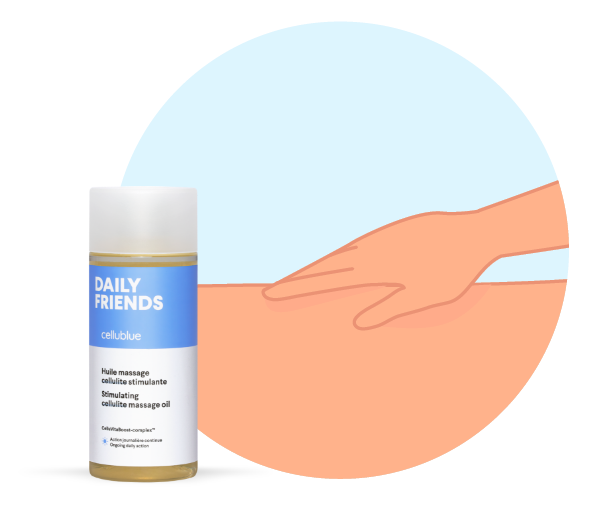
For an anti-cellulite arm massage, the first step is to apply the Massage Oil. This step is essential so that the cups can glide smoothly over your arms.

Take your cup and squeeze the sides between your fingers to release the air. Always start with light pressure.

You can control the suction of the cup on your skin by gently pressing the sides to release more or less air.
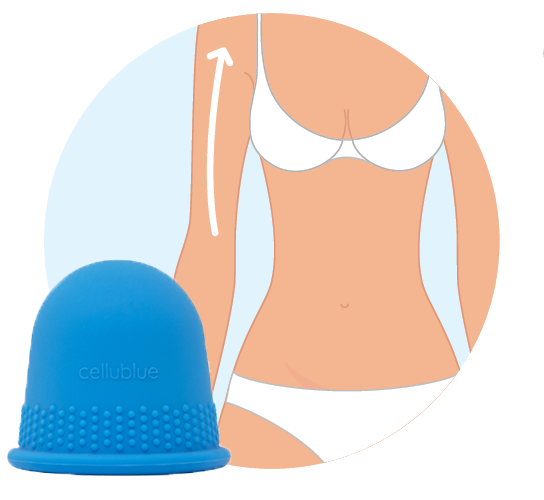
⏱1 minute
Place the cup at elbow level, then glide it upward without lifting it, towards the shoulder. Lift the cup, reposition it at the bottom and repeat.
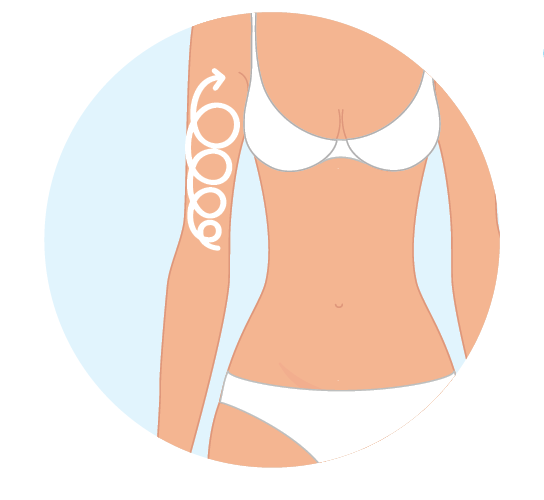
⏱1 minute
Place the cup on the underside of your arm and glide it up to the shoulder in a zig-zag motion. Repeat.
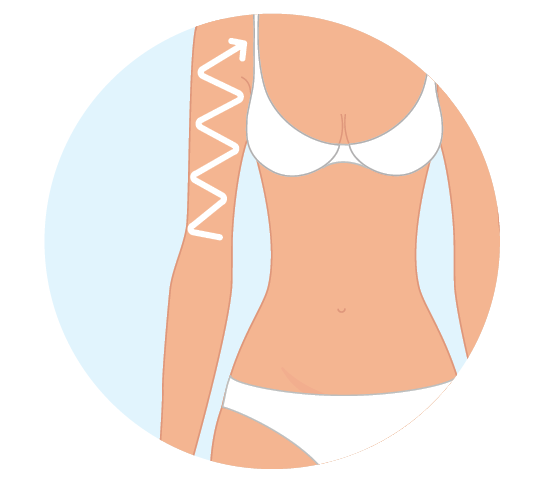
⏱1 minute
Make circular movements from bottom to top, always moving up the arm towards the shoulder. Repeat.
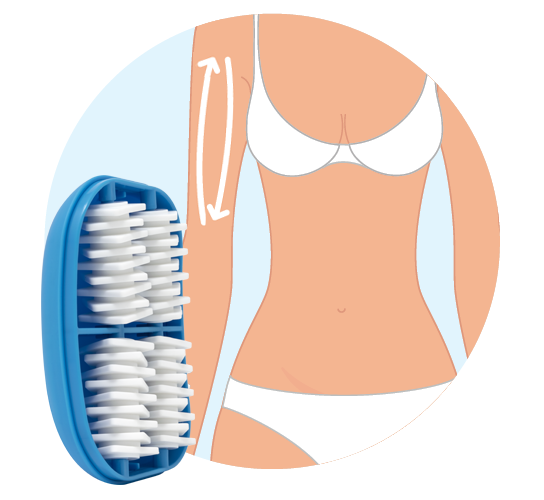
⏱3 minutes
Gently roll the Orange Peel Massager over your arms so that the skin passes between the nodules. Repeat.
Anti-cellulite treatments for the arms
When it comes to anti-cellulite treatments, the most recommended are those containing caffeine or algae, as they have long been used as ingredients in these types of creams for the skin. Apply them daily to your arms.
Also use anti-cellulite scrubs to exfoliate the skin on your arms 2 to 3 times a week.
In summer, UV rays can damage collagen and make cellulite more visible. Don’t forget to apply sunscreen to your arms for protection, especially when this area is exposed.
A balanced everyday diet
Eating healthily is a good everyday habit. Focus on eating more fruit and vegetables, which are rich in antioxidants and water. There are no specific foods that target arm cellulite directly. Oranges, apples and spinach are great examples of foods for a balanced diet.
Avoid snacking between meals and limit your intake of sugary or salty foods.
Remember to drink enough water: water is essential for health.
What about dermatological treatments for arm cellulite?
You may also consider dermatological treatments for arm cellulite. Options include laser therapy, liposuction and shockwave therapy. These are medical procedures, so to find out whether they might be right for you, ask a doctor or healthcare professional for advice.
Laser therapy
Laser therapy emits infrared light that heats the fat. It is delivered beneath the skin via a cannula.
Liposuction
Liposuction is a surgical procedure that involves suctioning out fat. It can be performed on the arms, both the outer and inner sides. The surgeon makes small incisions in the skin and inserts cannula tubes. The procedure is carried out under local or general anaesthesia.
Shockwave therapy
Shockwave therapy is another treatment for cellulite. There are several types: planar shockwaves, radial pressure waves and high-frequency waves. These waves emit vibrations that penetrate the layers of the skin. Several sessions are typically needed.
Sources and references
(1) Janda K, Tomikowska A. (Cellulite.causes, prevention,treatment). Ann Acad Med Stetin.2014 ;60 (1) :29-38. https://www.ncbi.nlm.nih.gov/pubmed/25518090
(2) Proebstle TM. (Cellulite). Hautarzt.2010 Oct ;61 (10): 864-72.doi: https://www.10.1007/s00105-010-1986-8
(3) De la Casa Almeida M, Suarez Serrano C, Rebollo Roldàn J,Jiménez Rejano JJ. Cellulite’s aetiology: a review. J Eur Acad Dermatol Venereol.2013 Mar ;27 (3) :273-8.doi: https://www.10.1111/j.1468-3083.2012.04622.x.
Frequently asked questions
How do you get rid of cellulite on your arms?
No single step will make it disappear on its own. Several habits can be combined: staying active with exercises that work the arms, massaging your arms with an anti-cellulite cupping cup, applying an anti-cellulite product every day and eating a balanced diet. For dermatological treatments, ask a doctor for advice.
Why do I have cellulite on my arms?
There are many causes: hormones, collagen, genetics, diet, lifestyle, lack of physical activity or weight gain. Women are also more prone to it than men, because their fat cells are structured differently. These factors can encourage fat to be stored on any part of the body, including the arms.
Can you get orange peel skin on your arms?
Yes. Cellulite mostly appears on the thighs, stomach and bottom, but it can also develop on the arms. Instead of looking smooth, the skin then appears dimpled and uneven, hence the name orange peel skin. Its causes are explained in the section ‘Why do we get cellulite on the arms?’.
How do you massage your arms with a cupping cup?
First apply a massage oil so that the cup glides easily. Then glide it from the elbow up to the shoulder, then in a zig-zag motion along the underside of the arm, then in circular movements, always working upwards. Start with light pressure. Finish with the Orange Peel Massager. The steps are described in the massage section.