Ah, monoi — a holiday essential… Its delicious scent, rich texture and the comfort it brings to skin and hair make it a true favourite. If monoi oil is already a staple in your summer beauty bag, you may be surprised to learn it can be used year-round — and may even find a place in a care routine for areas prone to stretch marks. Here’s why.
What is monoi oil?
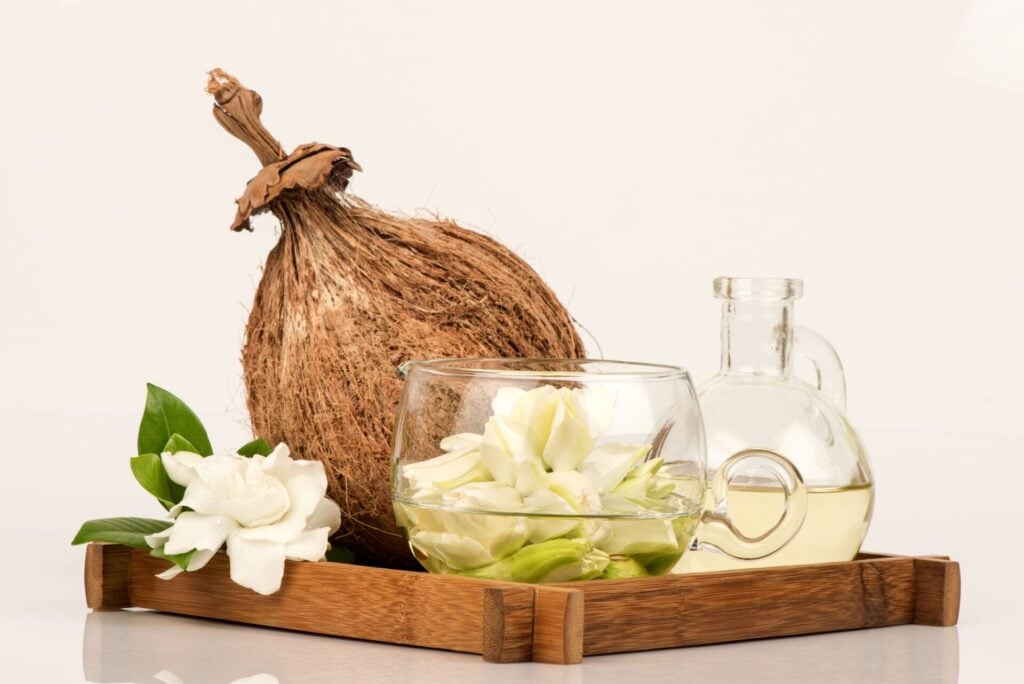
Monoi is a beauty product native to French Polynesia, made by macerating Tiaré flowers in copra oil. Traditional artisan recipes also call for the addition of freshly grated coconut flesh.
Tiaré tahiti (or Tahitian flower) is the tropical shrub that provides the flowers needed to make monoi. They must be harvested as buds or young blooms and used quickly to give the maceration its incomparable fragrance. It’s also worth noting that this maceration must last at least 10 days, using a minimum of around ten flowers per litre of oil.
As for copra oil, it is made from dried coconut flesh, hot-pressed, refined and deodorised. It is therefore different from virgin coconut oil, which is cold-pressed from fresh coconut flesh.
What are the skin benefits of Tahitian monoi?
In Europe, monoi oil is mainly used as a “tanning” oil, since like all oils, it helps prevent skin dehydration. However, it does not protect against the harmful effects of the sun, despite what many people believe. In Polynesia, monoi is more commonly used as a massage oil and hair treatment. But what are its real qualities for the skin?
Let’s start with the Tiaré flower. It produces an essential oil primarily used in perfumery, prized for its subtly vanilla-like scent that evokes sun-soaked holidays. Yet tiaré essential oil also contains methyl salicylate — a somewhat technical name for a compound often used in cosmetics for its so-called soothing and purifying properties.
What about copra oil? Its composition is unique, containing no fewer than 9 different fatty acids, including:
- oleic acid, also found in the skin’s own sebum, which penetrates easily into the epidermis, helps maintain its hydration and leaves skin soft and supple;
- lauric acid, very common in so-called “tropical” oils, known for helping the skin maintain its natural balance;
- myristic acid, easily absorbed by the skin and valued for the softness it leaves on the skin;
- palmitic acid, which helps preserve the skin’s protective film;
- caprylic acid, which supports the penetration of antioxidant compounds into the epidermis, helping the skin better cope with everyday aggressors;
- linoleic acid, which encourages the passage of nutrients into the epidermis and helps preserve skin suppleness.
Add to these benefits those of vitamins E and K, also present in copra oil. Vitamin E is naturally antioxidant and helps the skin defend itself against external aggressors, while vitamin K rounds out this composition.
In short, monoi oil has many benefits for the skin: it contributes to its protection and helps maintain its suppleness and resilience.
Can monoi oil be used on areas prone to stretch marks?
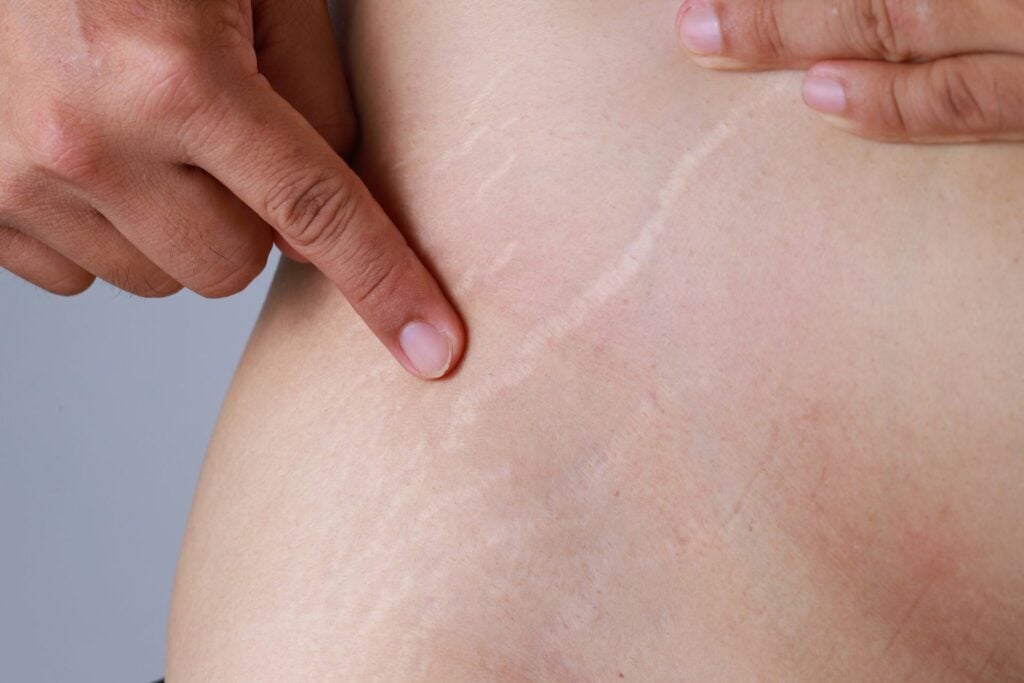
It can definitely find a place in a care routine for areas prone to stretch marks. Stretch marks are the result of micro-tears in the skin’s elastic fibres. They are caused by sudden, rapid stretching of the skin… They tend to appear more often when the skin is poorly protected (by moisturising treatments, for example). Weakened, dry and/or dehydrated, it loses its elasticity. The result: at the slightest stretch, it “gives way”. Small streaks then appear on the surface of the skin, often coloured at first, then fading to white over time.
Monoi oil, an exceptional emollient, can support the care of areas prone to stretch marks. It helps limit the skin’s water loss and keeps it supple and elastic. It can also be applied to existing stretch marks, including white stretch marks, to nourish the skin and protect the skin barrier, without claiming to make them disappear.
Monoi oil and pregnancy: what precautions?
Can you use monoi when you are pregnant? First, it’s worth remembering that monoi is not simply a plant oil: it is scented through the maceration of tiaré flowers, whose essential oil contains methyl salicylate. During pregnancy and breastfeeding, ask your doctor or midwife for advice before applying monoi or any other scented skincare product.
If you are looking for a product you can use during this period, our Anti-Stretch Mark Oil can be used every day, including during pregnancy or breastfeeding.
What other oils can be used on stretch marks?
Natural plant oils can help nourish, moisturise and soften the skin. Choosing your preferred oil is ultimately a matter of personal taste — whether you prefer rich or lightweight textures, dry-finish or more nourishing formulas. That said, a few stand out:
- jojoba oil, highly penetrating with a dry finish, is very well suited to caring for areas prone to stretch marks, especially for naturally dry skin;
- rosehip oil, often chosen for very damaged skin marked by mature stretch marks, as it is exceptionally rich in antioxidant compounds;
- wheat germ oil, rich and nourishing, particularly well-suited to sensitive skin, and can be blended with a lighter oil (hazelnut, perilla);
- calophyllum oil, striking for its dark colour, traditionally valued for caring for weakened skin and restoring its comfort;
- macadamia oil, nourishing and pleasant to massage in, ideal for maintaining the suppleness of areas prone to stretch marks;
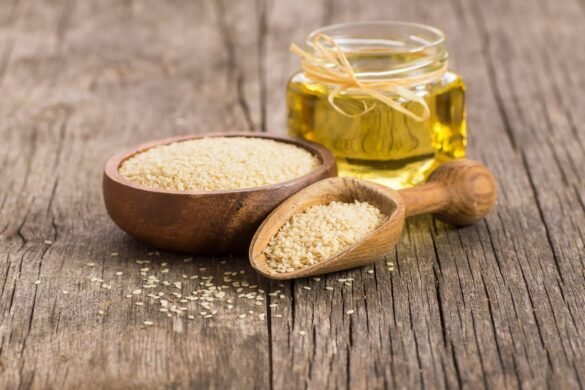
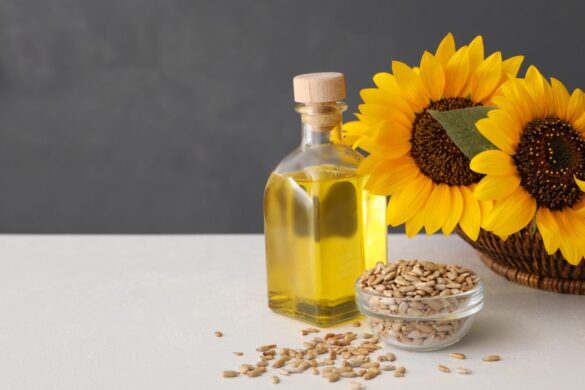
- and of course, our Anti-Stretch Mark Oil, a blend of 5 natural plant oils (sesame, sunflower, olive, jojoba, avocado), combining the benefits of each in a single formula! Suitable for all skin types and all areas (stomach, buttocks, thighs, back or calves), it can be used every day, including during pregnancy or breastfeeding.
The massage oil that helps prevent stretch marks from appearing*, during pregnancy and beyond
*User test on 21 volunteers over 3 weeks, based on participants' feedback.
- Why does it work?
Related articles
- Black seed oil and stretch marks: what you need to know
- Castor oil: an alternative against stretch marks?
- Avocado oil and pregnancy stretch marks: how to use it
Useful categories: Stretch Mark Care, Stretch Mark Solutions.