
If, like many people, you pay attention to your weight, you may already know what your “feel-good weight” is… or you might have the wrong idea about it! What does it actually mean — is it the weight you want to be, your usual weight, or the recommendations you see everywhere? Here’s everything you need to know about your feel-good weight, and how to get back to it!
What is your feel-good weight?
1- The difference between your feel-good weight and your “ideal” weight
Contrary to what you might think, your feel-good weight is not the same as your “ideal” weight. The “ideal” weight is a kind of reference point, a health indicator. It is estimated very simply using an index you are probably familiar with: the Body Mass Index (BMI). Easy to calculate, it is the standard reference for estimating weight. The formula is your weight in kilograms divided by your height in metres squared. For example: if you are 1.65 m tall and weigh 53 kg, your BMI is 53 / (1.65 x 1.65) = 19.47. Your BMI would then be considered normal. Bear in mind, though, that BMI is only a general guide. For a personal interpretation, it’s best to ask a healthcare professional.
The BMI is interpreted according to a precise classification defined by the World Health Organization:
- If BMI is below 16, this is described as severe thinness, and medical advice is needed
- If BMI is between 16 and 18.5, the person is considered underweight
- Between 18.5 and 25, weight is considered normal
- Between 25 and 30, the person is considered overweight
- If BMI is between 30 and 35, this is classified as moderate obesity
- Between 35 and 40, this is classified as severe obesity
- Finally, if BMI is above 40, obesity is classified as morbid or massive
2- So, what exactly is your feel-good weight?
This is where the nuance lies: your feel-good weight is entirely subjective. It is defined more by a feeling — it is the body weight at which you feel your best. Your feel-good weight is the weight at which movement, endurance and well-being are at their peak. Athletes understand this best: they generally know exactly at what weight they perform best. They track their weight closely and can easily draw a correlation between their body mass and their physical performance. Your feel-good weight is not a norm, a fantasy, or a body type — it is a feeling… the feeling of being comfortable in your own skin.
Our tips for getting back to your feel-good weight
Tip one: eat a balanced diet
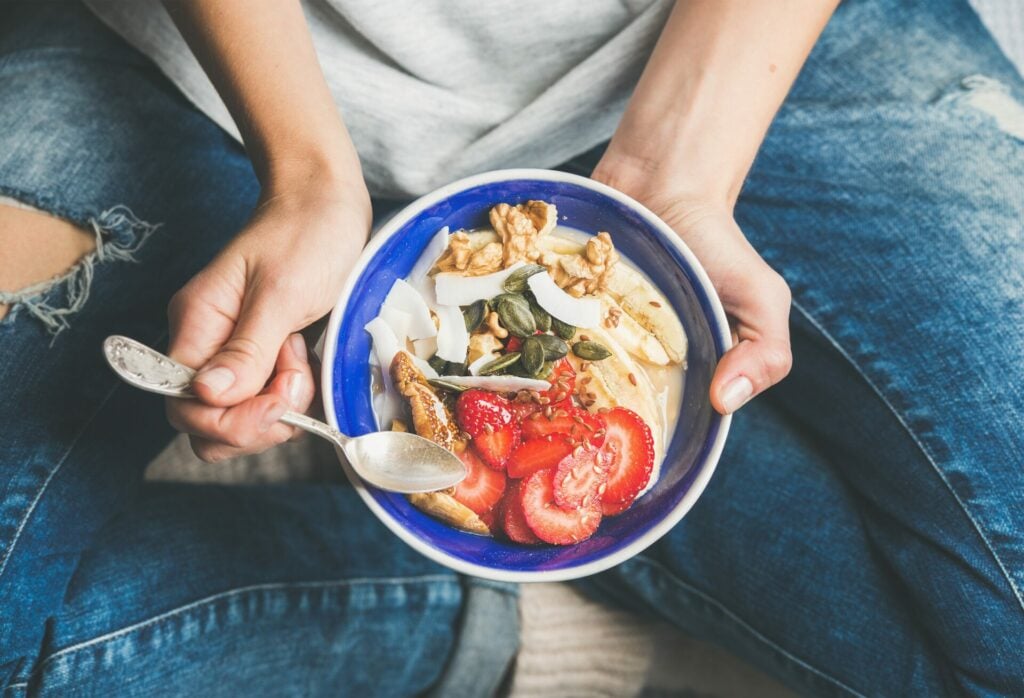
Sounds simple, but what does it actually mean? Simply eating a bit of everything, in reasonable amounts! Of course, a balanced diet is built on variety and wholesome foods — eating everything doesn’t mean having a burger on Monday,pizza on Tuesday, a bagel on Wednesday… and so on. Eating well comes down to a few key principles:
- Every food group has its place on your plate: a portion of carbohydrates (preferably complex, low-GI ones), a portion of protein (animal or plant-based), plenty of varied vegetables, a dairy product, and a piece of fruit.
- Home-cooked meals will always beat any ready-made dish: you know exactly what’s in them, you enjoy the process of preparing your food, and the taste is simply incomparable!
- Don’t forget pleasure: eating is a vital act, yes, but also an emotional one. If you fancy a little treat at the end of a meal (we did say little!), go ahead and have it. The enemy of your feel-good weight is excess, not the food itself.
- Common sense is your best ally: you know perfectly well that very sugary, very fatty or very salty foods are best kept to a minimum. So avoid eating them every day. There’s nothing wrong with a handful of crisps on a Saturday. Just be mindful of eating them daily and in large amounts!
Tip two: reconnect with your body’s signals
Getting back to your feel-good weight means eating a balanced diet, but also listening to your body’s natural cues, starting with hunger and fullness. Rather than counting calories, trust your inner “barometer”, because it generally works very well! Learn to recognise the signals your body sends you when hunger sets in. And when you’re hungry, you eat! Once at the table, eat slowly, savour each bite, and pause between mouthfuls. When you start to feel less drawn to the food and it no longer tastes as good, it’s time to put your fork down. You’re satisfied.
It’s also worth paying attention to your emotions. Why the sudden urge to snack? Is it because you’re hungry or thirsty, or is it because you’re feeling sad, frustrated or tired? By becoming more aware of the emotions running through you, you’ll gradually learn to tell real hunger apart from the simple urge to eat, without feeling guilty. And if your relationship with food becomes difficult, talk to your GP or a healthcare professional: support is available, and there’s no shame at all in asking for it.
Tip three: move every day

We often recognise our feel-good weight through physical effort, in how comfortable we feel when we move. If you find yourself out of breath after climbing the stairs, feel heavy on your bike, or find the slightest exertion tiring, and this is new or unusual for you, speak to your GP. That said, getting back to your feel-good weight doesn’t mean running a marathon. It’s more about moving every day, building at least 30 minutes of physical activity (walking, cycling, a home workout) into your daily routine. If you’d like to add a regular sport on top of that, even better! And there’s no shortage of options to find what you love. From Zumba to skiing, from hiking to boxing, there really is something for everyone!
Tip four: be patient!
To get back to your feel-good weight, there’s one thing you need to accept: it takes time. It’s best not to rush things, especially if it’s to match some idealised image. There’s no point following a restrictive diet to hit a completely arbitrary number on the scales. You may well pay for it later, with the infamous yo-yo effect. Getting back to your feel-good weight has nothing to do with any of that: it’s far better to take things one step at a time, at a pace that respects your body. Which means those quick-fix diets promising rapid changes on the scales are best forgotten. If in doubt, ask your GP or a healthcare professional for advice.
Final tip: love yourself!

Finally, getting back to your feel-good weight means accepting. Accepting your age, your body shape and your “natural” build — which may not match current beauty ideals, but which is simply who you are. If your figure is naturally curvaceous, à la Monica Bellucci, there’s no point torturing yourself to look like Kate Moss! Not only will you cause yourself physical harm, but you’ll also do real damage mentally. The same goes if you’re 40 and have had 2 beautiful children, yet desperately want to recapture the figure you had at 20. Bodies change — you may as well make peace with yours once and for all. The key to getting back to your feel-good weight is learning to love yourself, know yourself, trust your instincts, and recognise when you feel good. Simply being at peace with who you are.
Related articles
- Gaining weight for no reason: 8 common causes
- Essential oils for the body: uses and precautions
- Motivation to lose weight: our tips to stay motivated!
Useful categories: Slimming Tips, Weight Management.
To go further, explore the Cellublue shop: our body care products.