You may have heard about red vine leaf and its benefits for fighting cellulite — but what exactly is it? Here’s everything you need to know.
What is red vine leaf?
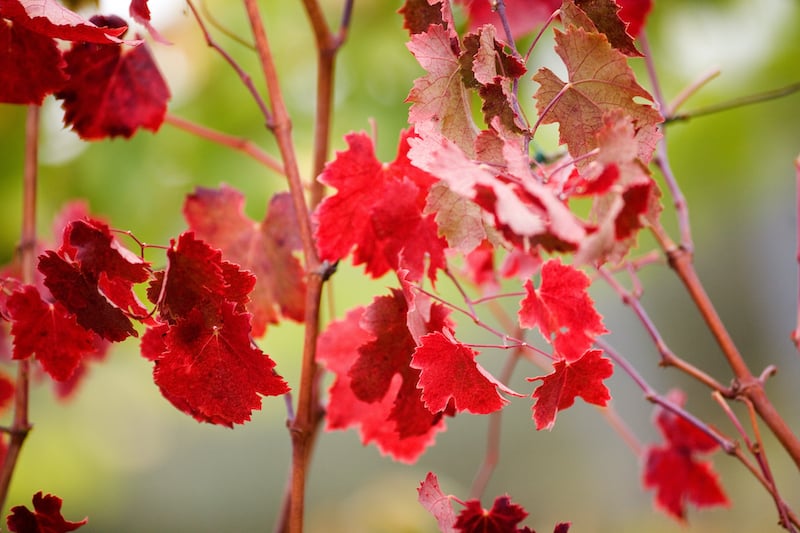
Vitis vinifera var. tinctoria, its Latin name, is a plant used in herbal medicine. It is a particular type of vine, native to Europe, that produces dark grapes and whose leaves turn red in autumn — hence the plant’s name.
The leaves, seeds and skin are all used, each with different applications depending on the part.
The red-leafed “Vitis vinifera” vine leaf has been used in medicine since Antiquity and features in many treatments.
The leaves of this plant are harvested in autumn, between October and November.
The leaves of this vine variety contain anthocyanosides (which have “Vitamin P” properties — meaning they act on small blood vessels, making them more resilient), flavonoids (antioxidants), and tannins (also antioxidants, as well as anti-inflammatory and artery-protective).
The benefits of this plant are therefore numerous, and it is used in many pharmaceutical and herbal medicine products with excellent results.
Grapes and seeds, meanwhile, contain polyphenols (antioxidants), tannins, and also resveratrol. Resveratrol has been studied for many years for its potentially anti-cancer effects: since cancer is a disease linked to inflammation, resveratrol may be involved in limiting the inflammatory response, which could explain its protective effect.
What are the benefits of red-leafed “Vitis vinifera”?
This plant has had many applications throughout history, as demonstrated by numerous scientific studies (1).
It supports healthy blood circulation
Thanks to its compounds with “Vitamin P” properties, as mentioned above, it can help address circulation issues, improve venous return, strengthen blood vessels, and thus help combat heavy legs and varicose veins.
Our sedentary lifestyles are partly to blame for these issues: the muscles in our legs don’t pump as much blood back to the heart when we don’t get enough physical activity.
It may therefore be helpful to adjust our habits or, where appropriate, to modify our diet and/or incorporate preparations that help improve microcirculation.
Red vine leaf and blood circulation are closely linked: the former has a genuinely proven effect on the latter.
Your new anti-cellulite ally
Among the many uses of red vine leaf, one standout application is harnessing its properties to effectively fight cellulite.
Cellulite is the fat that accumulates in certain areas of the body — particularly the hips, thighs, and buttocks — giving the skin a “orange peel” appearance, especially in women.
Red-leafed vine can be used as a decoction. A decoction is an age-old method of extracting the active compounds from a plant by boiling it in water.
To make a vine leaf decoction, simply add fifty grams of leaves to one litre of boiling water to obtain an infusion to drink in a quantity suited to the desired effect.
You can also prepare an infusion combining vine leaves, blueberry, and blackberry. This blend has a fruity, delicious flavour that makes it easy to enjoy, and it helps to revive circulation effectively for lighter-feeling legs.
The benefits of red “Vitis vinifera” are also used in firming gels designed to fight cellulite. Thanks to the properties of vine leaves, fat metabolism is altered and microcirculation is activated, gradually reducing the orange peel effect.
Apply the gel to the area affected by cellulite and massage in circular motions to help it absorb. The first results are generally visible after a few weeks of daily use. Skin becomes more elastic — and stays that way.
Vitis vinifera capsules can also help fight cellulite while visibly restoring smoother, more elastic skin.
These capsules most often combine vine leaf extracts with grape seed extracts and other beneficial active ingredients such as dandelion, which supports body detoxification.
Capsules are generally taken 3 times a day, as a course of treatment, until the skin regains its normal appearance, free from cellulite.
This plant is also found in pharmaceutical or cosmetic preparations in the form of lotion or balm.
As a natural approach to combating heavy legs, vine active compounds are used in many pharmaceutical products. There are also several cosmetic products featuring grape seeds that act against heavy legs as well as cellulite.
Indeed, red-leafed vine is well known for boosting blood microcirculation. It’s worth knowing that blood circulation and cellulite are connected: the latter is partly caused by insufficient venous return, which is why improved microcirculation can help reduce cellulite.
Vine leaf contains flavonoids, as we’ve seen, and these compounds can help reduce the “orange peel“ effect.
The key takeaway is that red vine leaf and cellulite work well together: this plant has long been valued for fighting the effects of fat accumulation beneath the skin.
Another simple use of red-leafed vine is the grape cure. No equipment or preparation is needed — it’s accessible to everyone: simply buy grapes in season and consume 500 grams every day, including the skin and seeds, one hour before each meal.
 COACH’S TIP
 COACH’S TIP
 There are no particular precautions for using vine leaves and the active compounds found in the grapes, skin, or seeds of red Vitis vinifera, except that the plant is not recommended for pregnant or breastfeeding women.
Red “Vitis vinifera” vine leaves are particularly indicated for venous disorders, and since poor microcirculation is partly responsible for cellulite, the plant also has an ultra-effective action against orange peel skin.
The Cellublue Anti-Cellulite Capsules are an excellent anti-cellulite ally, with intensive action on dimpled skin. Take 4 to 6 capsules per day.

Sources and references
(1) https://www.ncbi.nlm.nih.gov/pubmed/12854360