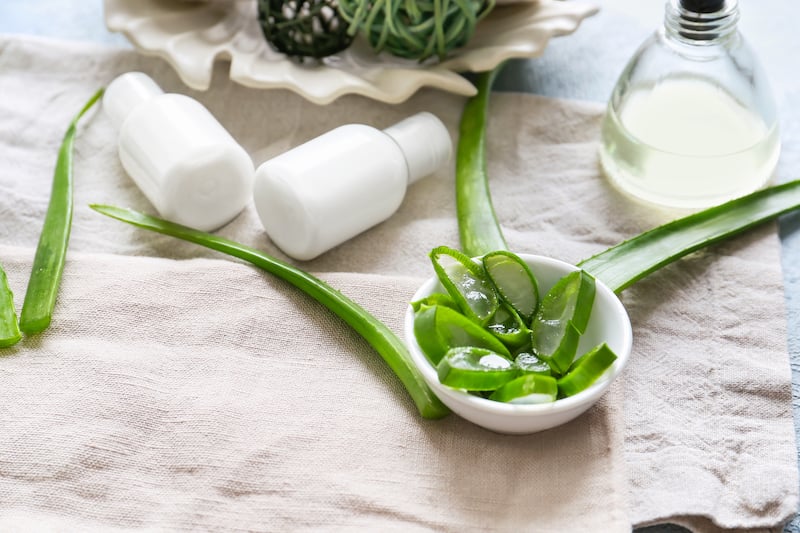
Aloe vera (or aloe) has always been regarded as a miracle plant. Thanks to its countless benefits, it addresses a wide range of concerns — both inside and out. Its scope of action is broad, and even cellulite is no match for it: “Aloe vera and cellulite” — that’s exactly what we’ll be exploring in this article.
What is aloe vera and what are its properties?
Belonging to the Aloaceae family, aloe resembles a cactus (but isn’t one!). Thanks to its medicinal and therapeutic virtues, it has earned several nicknames across cultures: “harmonious remedy” for the Chinese, “elixir of longevity” for the Greeks, and “silent healer” for the Indians.
This speaks volumes about the well-established benefits of aloe on health and wellbeing. From its leaves — thick, serrated and narrow — two key substances are extracted: latex (a powerful laxative) and gel (or pulp). The gel is a clear mucilage containing over 200 components, including 75 nutrients.
Topically, it is used to treat psoriasis, inflammation, infections and skin lesions; it is highly effective against genital herpes and even accelerates the healing of burns. (1)
Taken internally, the latex of the silent healer is considered an excellent laxative. But it is the gel that gives this miracle plant its most celebrated powers: it is hypocholesterolaemic (it lowers cholesterol levels and has a positive effect on type 2 diabetes); hypoglycaemic (it lowers blood sugar levels); and it supports the gastrointestinal tract by relieving bloating and occasional constipation. Above all, aloe vera gel is renowned as a powerful antioxidant that promotes cell regeneration.
Applied externally, aloe vera gel addresses a variety of skin concerns: burns, acne, boils, psoriasis, eczema, to name just a few. Moisturising, healing, antiseptic, anti-inflammatory, antiallergenic, cell-regenerating — it is even effective for reducing cellulite and the appearance of orange peel skin.
Aloe vera and cellulite: how does it work?
Aloe vera and cellulite are natural adversaries — and for good reason: aloe vera gel is both a fibroblast multiplier and a biogenic stimulator. Orange peel skin is caused not only by weight fluctuations, but also by the loss of elasticity and instability of connective tissue — and above all by elevated oestrogen levels. It is a phenomenon affecting around 9 in 10 women. Fortunately, thanks to its cell-regenerating properties and its deeply moisturising effect on the skin, aloe helps smooth the uneven texture that characterises orange peel skin.
What’s more, combined with exercise and a rich, balanced diet (aloe gel is packed with nutrients and vitamins), this harmonious remedy helps refine body contours and improve skin texture — purifying the skin and restoring its vitality.
How to use aloe vera?
The aloe leaf contains both latex and gel, which are extracted for various nutritional and dermatological uses. In cosmetics and dermatology, it is the gel that is most widely used. It comes in several forms: capsules, drinks, creams, lotions, gel and more.
Aloe vera-based creams are formulated from the gel and are widely used in skincare, including for targeting cellulite. Massage is the preferred application method: apply thin layers of the cream and gently massage the areas affected by uneven skin texture (typically the stomach, thighs and buttocks).
As one might expect, the battle between aloe vera and cellulite is a long one — it takes time before results become visible. But with a healthy lifestyle (regular exercise, a rich and balanced diet, and consistent use of an aloe vera anti-cellulite gel), it is possible to see real improvement and achieve firmer, clearer-looking skin.
Sources and references
1) https://www.ncbi.nlm.nih.gov/pubmed/23894900