
The cellulite, or superficial lipodystrophy, is caused by a change in the structure of adipose tissue. Adipose tissue consists of cells that store fat. Sometimes, toxins and water in the body are not properly eliminated, forming fatty deposits that give the skin a bumpy, dimpled appearance — commonly known as orange-peel skin. Cellulite affects almost exclusively women. In this article, we explain why cellulite is a typically female concern, how it develops, and what the three main types of cellulite are.
Why are women more affected by cellulite than men?
As we just mentioned, cellulite is an almost exclusively female concern. Several factors explain this. First and foremost, a woman’s body contains twice as many adipocytes[1] as a man’s. These adipocytes are the cells dedicated to fat storage and are found mainly in the thighs, buttocks and hips — the areas most commonly affected by cellulite.
In addition, a woman’s body is subject to greater hormonal fluctuations than a man’s. Periods of intense hormonal activity — such as puberty, pregnancy, breastfeeding, menopause, or even menstruation — are particularly conducive to fat storage due to increased oestrogen production. The female body is naturally designed to build up fat reserves during key life stages in preparation for a potential pregnancy and breastfeeding, which is obviously not the case for men.
Another factor to consider when understanding why women are far more affected by cellulite than men is the structure of adipocytes themselves — the cells responsible for fat storage. While men have fewer, smaller and more tightly bound adipocytes, women naturally have a greater number of adipocytes that are highly expandable and loosely packed. This means the risk of these fat cells expanding and clumping together is significantly higher in women.
One final point: cellulite is more visible in women than in men. The cellulite process begins deep beneath the skin. However, because women’s skin is thinner than men’s, the fatty deposits that form in the tissue are more easily visible through the dermis. The difference in body hair between men and women also plays a role in how visible the dimpling appears at the skin’s surface.
The subcutaneous structure in women
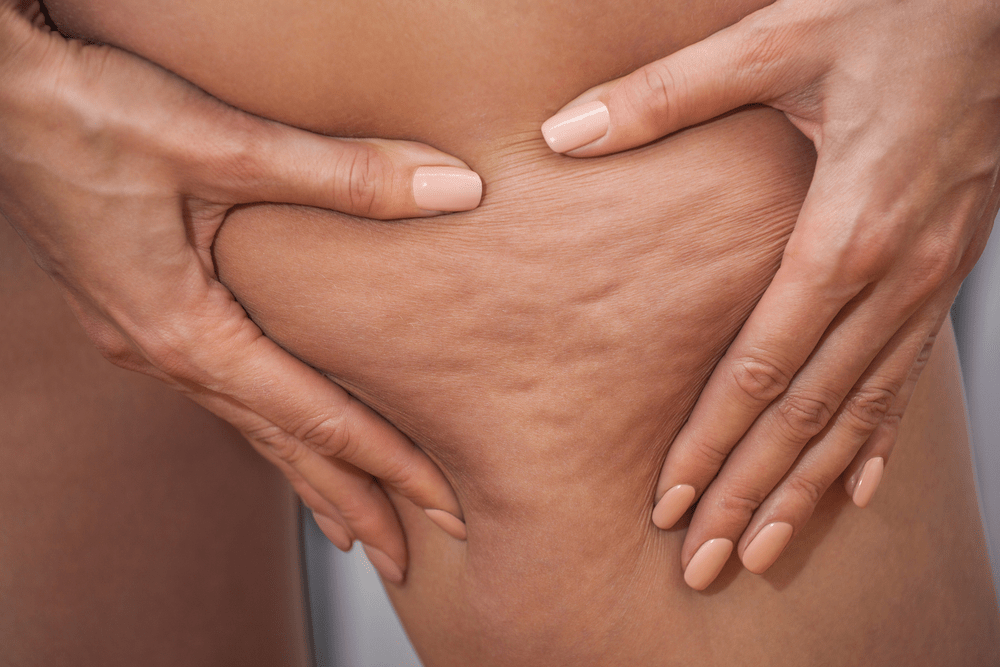 To understand how cellulite develops, it helps to know the structure of the skin. The skin is an organ made up of 3 layers: the epidermis, the dermis and the hypodermis[2].
The epidermis is the outermost layer of the skin — the one we can see. The dermis is the middle layer, and the hypodermis is the deepest layer. To understand cellulite, we need to focus on this deepest layer — the hypodermis. The hypodermis is composed of adipose tissue, threaded with blood vessels and nerves. It serves several functions:
- Protects bones and tendons
- Defines the body’s silhouette — it plays a morphological role
- Regulates body temperature through its role as a thermal insulator
- Plays an energy role by storing fat
We will focus in particular on the energy role of the hypodermis. This layer is made up of adipose tissue, which varies in thickness depending on the individual and its location on the body. For example, it tends to be naturally thicker around the thighs and buttocks, but thinner around the knees or elbows in women. The hypodermis contains fat cells known as adipocytes.
Adipocytes are cells dedicated to storing fat in the form of triglycerides. They can be brown (“multilocular”) or white (“unilocular”). Their number increases from birth and rises sharply during adolescence. Adipocytes are 8 times larger than an average human cell. They have the capacity to multiply that size by 50 — this is known as the hypertrophic phase. Once they reach their maximum size, they can multiply in number — this is the hyperplastic phase. It is therefore within the hypodermis that fatty deposits form, which, as we will see, are responsible for cellulite.
How does cellulite develop?
Cellulite is the result of excessive fat storage within adipocytes. Our body needs fat to function properly — fat is what provides it with energy. This fat is stored in the hypodermis, within the adipose tissue that contains the adipocytes. The fat we consume through our diet is therefore stored in adipocytes until it can be converted into energy by the body. This storage process is called lipogenesis. During lipogenesis, and in order to accommodate all the fat being stored, adipocytes can expand or — once they have reached their maximum size — multiply. As a reminder, an adipocyte is already 8 times larger than a standard cell, and can multiply that size by 50[3].
To function optimally and meet our energy needs, the body then draws on these fat reserves — a process known as lipolysis. During lipolysis, adipocytes empty, either fully or partially, but are not destroyed. If adipocytes have multiplied to store more fat, they will never disappear entirely, but they can be emptied. These are referred to as atrophied adipocytes.
The appearance of cellulite is the result of an imbalance between lipogenesis and lipolysis. When the amount of fat stored in adipocytes exceeds the amount used by the body, fat cells grow and multiply continuously. It is these enlarged, proliferating adipocytes that form fatty deposits and the dimpling visible at the skin’s surface, at the level of the epidermis.
The different types of cellulite
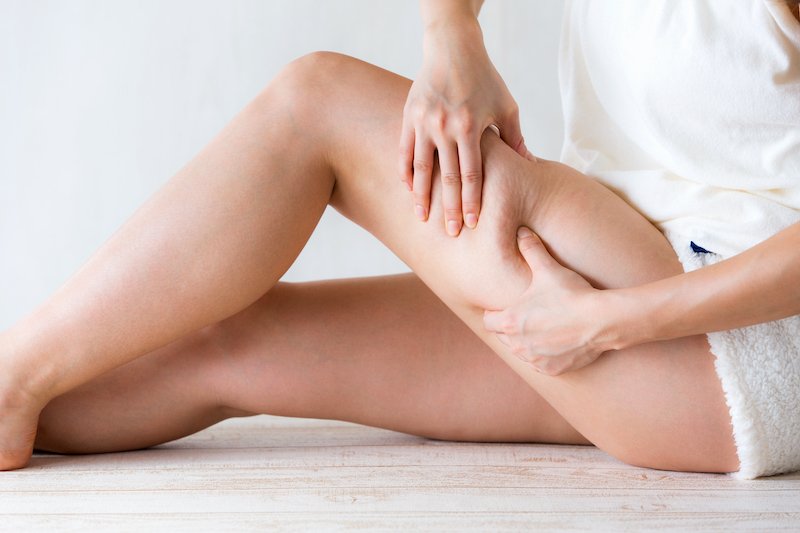
Cellulite is therefore linked to the multiplication and deformation of adipocytes within the hypodermis. However, it is important to distinguish between 3 main types of cellulite[4], which can appear individually or in combination.
Aqueous cellulite
Aqueous cellulite is often associated with slimmer women and is also known as hydrolipodystrophy or infiltrated cellulite. This type of cellulite is linked to poor water elimination from the body. Absorbed water stagnates in the tissues, accumulates and prevents blood and lymph from circulating properly between fat cells to drain their contents. This excessive tissue congestion causes swelling, inhibits the release of fat and toxins, and leads to the appearance of dimpling at the skin’s surface.
Water retention — and the cellulite it causes — is an overwhelmingly female concern. Several factors can trigger this phenomenon:
- Prolonged sitting or standing in a static position
- Certain medications
- Hormonal contraceptives
- Pregnancy and breastfeeding
- Nutritional deficiencies (magnesium, vitamins, etc.)
- Dehydration
- Heat
- Menstruation
- A diet high in salt
- Hereditary venous conditions
Aqueous cellulite is recognisable by the swelling that accompanies it and its soft feel to the touch. It is mainly found on the calves, knees, ankles and thighs.
Adipose cellulite
Adipose cellulite, also known as lipothrystrophy, is another form of cellulite that is very common in women. This type tends to affect women who are overweight. The term “adipose” comes from the word “adiposis”, defined as a condition caused by excessive fatty deposits in the cellular tissue. In practical terms, adipose cellulite results from an excessive accumulation of adipocytes in the hypodermis.
When we consume more fat than we burn on a daily basis, adipocytes deform to reach their maximum size in order to store the excess. When that is no longer sufficient, new adipocytes form and are added to the existing ones. Gradually, the swollen fat cells become compacted and impede blood and lymphatic circulation. Toxins then accumulate in the tissues. This build-up of adipocytes and toxins creates deposits responsible for the dimpling visible at the skin’s surface.
Adipose cellulite is easy to identify: it is visible at all times, but becomes even more apparent when the skin is pinched. This type of cellulite is soft and painless. It is mainly found on the thighs, stomach, hips and buttocks.
Fibrous cellulite
Fibrous cellulite, or fibrolipodystrophy, is a progression of the two types of cellulite described above. It is the result of long-standing cellulite that has been present for several years. Fibrous cellulite is a consequence of fibrosis. Adipocytes are surrounded by collagen fibres, which are normally fine and supple. However, in women who already have cellulite, lead a sedentary lifestyle and do not follow a balanced diet, these collagen fibres tend to multiply, thicken and become rigid. The adipocytes become trapped, fat remains stored and can no longer be used by the body during lipolysis. This hardening of the collagen fibres and the inability of fat cells to be drained leads to the appearance of dimpling in the form of fibrous cellulite.
While aqueous and adipose cellulite are painless and soft to the touch, fibrous cellulite is hard and often tender. In the most deeply embedded cases, the skin may even take on a reddish or purplish hue. Fibrous cellulite is mainly found on the buttocks and thighs, and is the most difficult type to eliminate.
Women affected by cellulite may experience several types at once — this is known as mixed cellulite. Addressing it effectively will require solutions tailored to each specific type.
While cellulite is a widespread phenomenon closely tied to the way the female body works, it is still entirely possible to tackle it by adopting good dietary habits, staying active and using targeted treatments.
[1] Source: connective tissue and adipose tissue – Sorbonne University Medicine
[2] Source: the skin – Futura Santé
[3] Source: adipose tissue – Biologie de la peau
[4] Source: cellulite (lipodystrophy) – Wikipedia