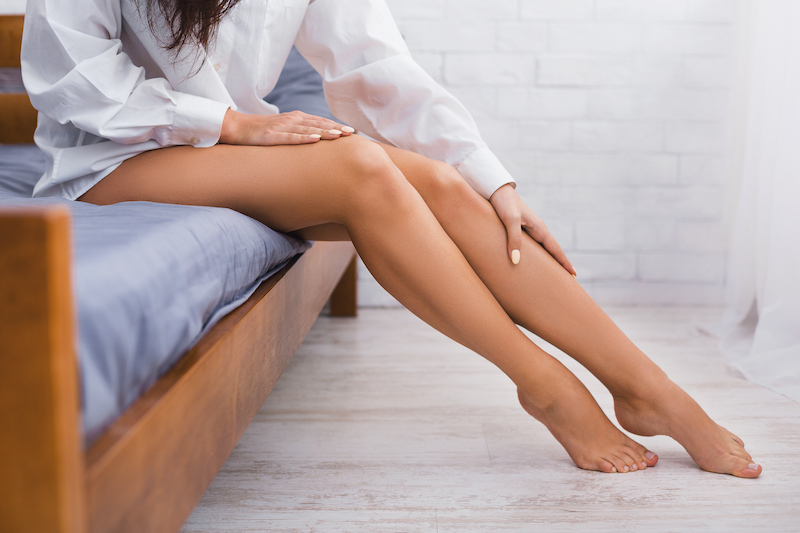
Do your legs feel heavy and swollen, especially at the end of the day or in warm weather? You may be experiencing poor venous circulation. What are the different causes behind this sensation of heavy legs?
Sommaire
1- Excess Weight
It’s easy to overlook the negative impact excess weight has on the feet, which must bear the extra load. Just as it places compression on the entire body, carrying excess weight simultaneously slows venous return and leads to heavy, swollen legs. Because blood flow back to the heart is less efficient, people who are overweight often experience swollen legs, and may even develop oedema, cramps or tingling sensations in the legs.
2- Age
Age tends to worsen heavy leg symptoms. As we get older, we become more prone to venous insufficiency. Over time, veins lose their tone and elasticity, and the valves responsible for venous return become less effective. These valves grow tired and are no longer able to push blood back towards the heart efficiently — which hampers healthy circulation in the lower body and can lead to a sensation of heaviness in the legs.
3- Sex
Poor leg circulation affects women far more than men — roughly four women for every one man. This comes as no surprise, given that hormonal fluctuations play a major role. Women are particularly prone to venous insufficiency during their period, pregnancy or menopause, as the body undergoes changes that can lead to water retention.
4- Fatigue
When someone has a circulation issue, it can lead to a general sense of fatigue. They feel heavier, find it harder to walk, and their swollen legs are often a source of discomfort. This fatigue also affects circulation itself, as tired individuals tend to move less — creating a vicious cycle, since a sedentary lifestyle encourages the development of oedema and heavy legs.
5- Heat
Heat is the enemy of heavy legs. It causes significant dilation of the superficial venous system, which then struggles to function as normal. Blood flow back to the heart slows as a result. In summer, prolonged sun exposure, underfloor heating, excessive indoor heating or hot wax hair removal are all best avoided when heavy legs are a concern. Staying well hydrated throughout the year is always recommended — and even more so during heatwaves.
6- Standing for Long Periods
You are more likely to experience heavy legs if you spend most of your day on your feet or standing in one spot. This sensation is particularly common in certain professions — nurses and hairdressers, for example. Walking helps tone the muscles, which in turn support the venous system and assist blood in travelling back up towards the heart.
7- Sitting for Long Periods
Heavy legs can equally affect those who spend their days sitting down. Prolonged sitting and a sedentary lifestyle both contribute to poor venous circulation. Crossing your legs also restricts venous return and increases the risk of swelling. Many muscles remain inactive for extended periods, which leads to circulation problems.
When walking or running, the leg muscles work actively and support blood flow. When these muscles are inactive or barely used, blood circulation slows and swelling can appear.
8- Family History
Hereditary factors are frequently found in people who suffer from poor blood circulation. Several members of the same family may share the same symptoms. As a general rule, if one of your parents has venous insufficiency, your own risk of experiencing the same issue is higher. That risk increases further if both parents are affected by poor circulation.
9- Varicose Veins
Varicose veins are also one of the causes of swollen legs. In general, varicose veins involve difficulties with venous return, superficial or deep venous insufficiency, blood “pooling” and water retention.
Veins enlarge and swell as they accumulate blood that cannot be drained away. To relieve this excess, varicose veins develop — essentially new “channels” through which the overload can be redirected.
This is often the point at which many people begin to notice visible varicose veins alongside the sensation of heavy legs.
10- Poor Circulation
Poor blood circulation affects the feet and legs long before any visible signs appear. It causes fluid to accumulate in the lower limbs when standing or sitting for extended periods. This abnormal build-up of fluid in the ankles, feet or legs is known as oedema.
In summer, symptoms tend to worsen, as higher temperatures cause the walls of the veins to dilate. If these walls lack sufficient elasticity, blood flow back to the heart slows, resulting in heavy legs.
11- Pregnancy
Pregnancy brings about changes that manifest in a variety of ways — one of which is the appearance of swollen legs.
As the baby grows inside the womb, its nutritional needs increase. In fact, 25% of the mother’s blood volume is directed to the placenta, through which the foetus feeds. As the foetus grows, blood volume also increases, making it harder for blood to circulate back up to the heart. This condition, which causes swollen legs, is further compounded by the hormones produced during pregnancy, which raise the risk of water retention in women — another aggravating factor for heavy legs.
12- Unsuitable Footwear
Certain types of shoes can hinder proper blood circulation — this applies to both flat shoes and very high heels. In either case, the foot is unable to perform its natural movement, which allows the calf to act as a muscular pump. This pumping action is inhibited when wearing heels, while flat shoes fail to properly support the arch of the foot. In both cases, circulation is compromised. It is therefore advisable to vary your footwear regularly. Additionally, narrow or uncomfortable shoes restrict blood flow, causing fluid to accumulate in the legs.
13- Tight Clothing
Socks that are too tight can compress the blood circulation in your legs. Similarly, overly tight trousers can slow the return of blood to the heart. Loose-fitting clothing is therefore preferable, particularly in hot weather, to avoid a tourniquet effect that is especially unwelcome when heavy legs are a concern.
How to Reduce the Sensation of Heavy Legs?
Apply the Cryo Thigh Slimming Gel by Cellublue. The gel contains menthol, which delivers an immediate cooling sensation and helps tone the skin. It soothes tired legs and helps refine their appearance through the power of cold.
