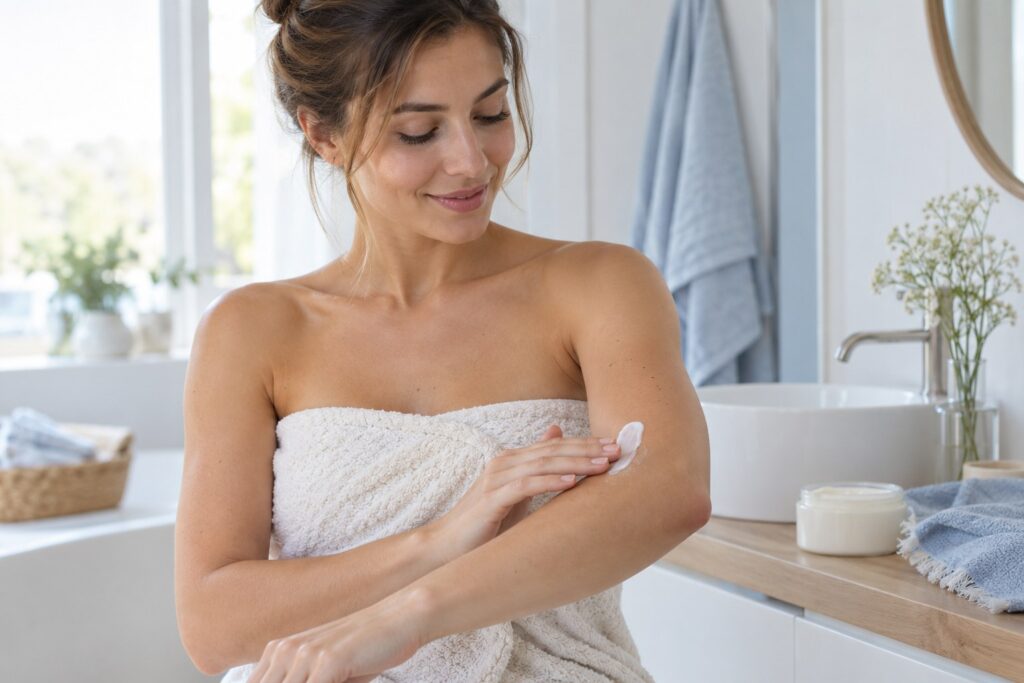
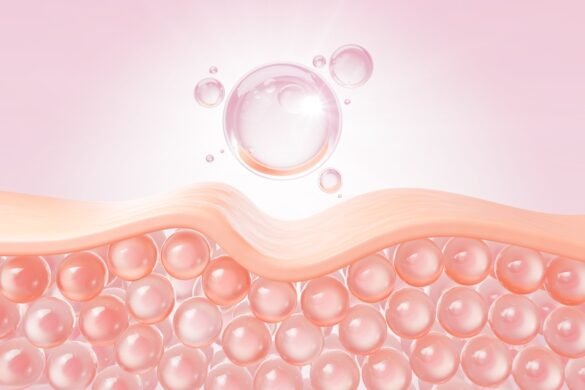
The skin barrier protects your skin by limiting water loss and slowing the entry of substances from outside. On the body, it relies largely on the stratum corneum, the outermost part of the epidermis. To understand how it works, picture a brick wall held together with mortar: the bricks are cells called corneocytes, while the mortar is made up of lipids.
The stratum corneum: bricks and mortar
The skin has three main layers: the epidermis on the surface, the dermis beneath it and the subcutaneous tissue deeper down. The stratum corneum is the outermost part of the epidermis, forming the direct interface between your body and its environment.
Corneocytes: protective cells
Corneocytes are cells that have completed their transformation in the epidermis. Flattened and lacking a nucleus, they form several layers that gradually renew themselves. Their role is not limited to being “dead skin” to remove: they actively contribute to protecting the skin.
The cohesion of these cells and the thickness of the stratum corneum influence how molecules pass through the skin. The outermost cells naturally shed as the skin renews itself.
Lipids: organised mortar
Between the corneocytes, lipids form a structure arranged in layers. This is not simply a greasy coating sitting on the skin. Their organisation helps slow exchanges through the epidermis.
The “bricks and mortar” model, described by DermNet in its explanation of skin barrier function, helps explain why the corneocytes and the lipids surrounding them work together. The structure depends on both the cells and the way they are joined.
Protection that works in both directions
From inside to outside: retaining water
Water in the tissues can pass through the epidermis and then evaporate at the surface. The stratum corneum slows this movement. It therefore helps maintain the skin’s water balance without making the skin completely waterproof.
This natural loss has a name: transepidermal water loss. The common abbreviation TEWL stands for transepidermal water loss in English. A less effective barrier may allow more water to escape.

The cupping tool that replicates pinching and rolling, 3 minutes per zone
- The professionals' technique, at home: you lift, glide, and release, and the tool grips the skin fold like a manual pinching and rolling
- Soft silicone that fits thighs, buttocks, stomach, and arms
- 3 minutes per zone, every day, always with a massage oil so the tool glides
From outside to inside: limiting external stressors
In the other direction, the skin helps protect against mechanical, chemical and microbial stressors. The stratum corneum also controls the diffusion of molecules coming from the environment.
This is selective protection, not an absolute shield. Some substances can pass through the skin; their ability to do so depends, among other things, on their characteristics and the condition of the barrier.
Water loss and sweating: two different processes
You can lose water through the epidermis even when your skin looks completely dry. This passive diffusion is different from sweat produced by the sweat glands, notably to regulate body temperature.
| Process | How does the water leave? | What do you observe? |
|---|---|---|
| Transepidermal water loss | Water passes through the epidermis and evaporates. | It is generally invisible. |
| Sweating | The sweat glands secrete sweat. | It may dampen the skin or form droplets. |
Skin that sweats heavily does not necessarily have a damaged barrier. Conversely, the absence of visible sweat does not mean that all the water remains in the skin.
What this means for your body-care routine
Understanding the skin barrier helps you avoid treating the surface of your skin as an unnecessary layer to scrub away. If you are interested in natural body scrubs, remember that exfoliation removes surface cells: scrubbing more does not automatically improve skin protection. Avoid exfoliating irritated areas.
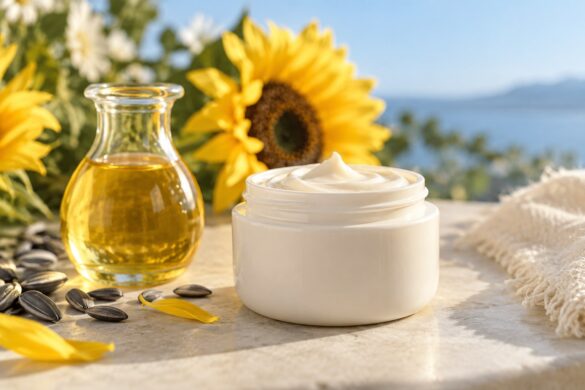
Another useful distinction: the lipids naturally organised between corneocytes are not interchangeable with an oil applied to the surface. Our article on plant oils in body care covers these cosmetic ingredients, which remain distinct from the anatomical structure of the skin barrier.
For reference, you can view Cellublue’s Crème Hydratante Monoï product page on the French market (French site). This is not an English-market product offer. Cellublue presents it as a cream that moisturises, nourishes and leaves the skin feeling soft and supple. These benefits stated by the manufacturer do not, on their own, measure transepidermal water loss.
Likewise, knowing the role of a cosmetic active ingredient can help you understand a skincare product, but it does not by itself describe its effect on the entire skin barrier.
FAQ
Can you see the skin barrier?
You can see the surface of your skin, but not its barrier function directly. Its effectiveness cannot be determined simply from whether the skin looks smooth or shiny.
Is the hydrolipidic film the whole skin barrier?
No. This surface film contributes to the skin’s protective environment. The barrier also relies on the structure of the epidermis, particularly the corneocytes and the lipids in the stratum corneum.
Does tightness prove that the barrier is damaged?
A feeling of tightness indicates discomfort, but does not identify its cause on its own. If redness, cracks or itching persist, seek advice from a healthcare professional.
Sources: DermNet, “Skin barrier function”, for skin anatomy and exchanges through the skin; Cellublue’s French-market product page for Crème Hydratante Monoï, consulted on 2 October 2026, for the manufacturer’s stated product characteristics.

The scrub that leaves skin smooth and skin texture refined*
*User test on 21 volunteers over 4 weeks, based on participants' feedback.
- Olive & apricot kernels: these natural grains gently sweep away dead skin cells
- Caffeine & monoi scent, so your shower instantly smells like a holiday
- In the shower, two to three times a week, massaging your thighs, bottom and stomach


Comments (0)