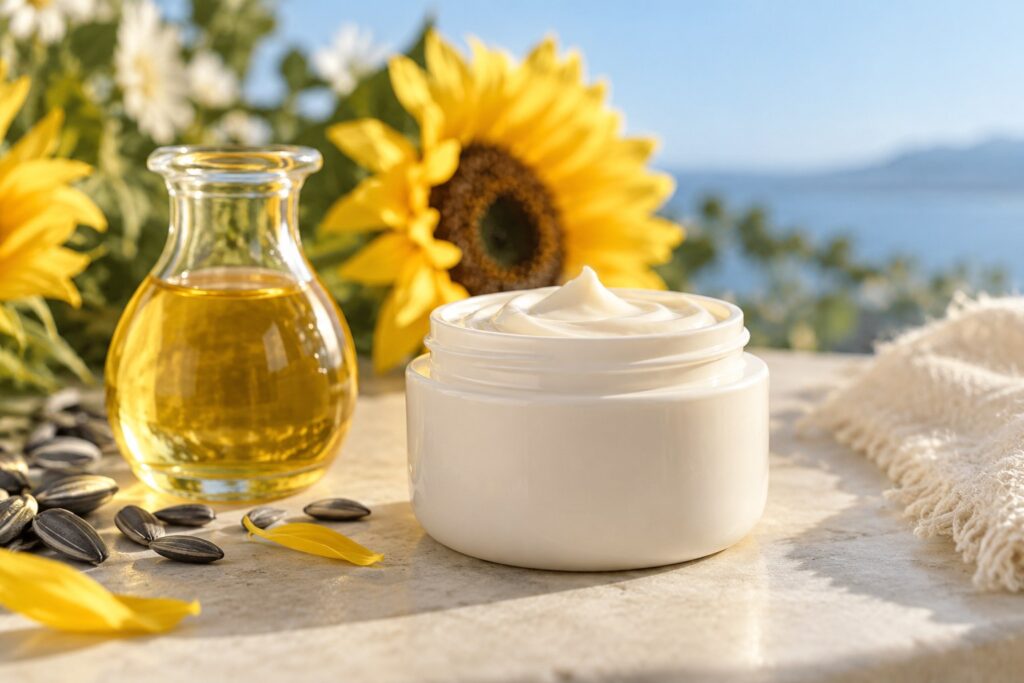
Tocopherol is the name of a form of vitamin E in a cosmetic ingredient list. In body care, this vitamin can act as an antioxidant to help protect the formula. That is the specific role stated for the Crème Hydratante Monoï: helping preserve the formula from oxidation, rather than claiming an action on stretch marks.
To understand this ingredient, the useful question is therefore: does vitamin E protect the ingredients in the product, or is it being credited with a particular skin benefit? These two roles should be considered separately.
Tocopherol: vitamin E supporting the formula
What does an antioxidant do in a cream?
Oxidation is a chemical reaction that can alter certain ingredients, particularly components of oils. An antioxidant helps limit this reaction. Its role is therefore related to the formula itself, even though its action remains invisible when you apply your cream.
In the case of the Crème Hydratante Monoï, the manufacturer’s product information is explicit: under “Vitamin E”, it states, “It protects the formula from oxidation.” This specific function explains why TOCOPHEROL appears in the ingredient list.
This also helps clarify the difference between a cosmetic active ingredient and its role in a skincare product: an ingredient can support the balance of a formula without, by itself, producing a visible change in the skin.
Antioxidant and preservative: two different functions
Protection against oxidation is different from antimicrobial preservation. Preservation concerns the growth of microorganisms such as bacteria or mould. Vitamin E therefore does not replace a suitable preservation system.
Keep this distinction in mind when you read “antioxidant” on a body care product: the word describes a property, not universal protection for the product or your skin.

The cupping tool that replicates pinching and rolling, 3 minutes per zone
- The professionals' technique, at home: you lift, glide, and release, and the tool grips the skin fold like a manual pinching and rolling
- Soft silicone that fits thighs, buttocks, stomach, and arms
- 3 minutes per zone, every day, always with a massage oil so the tool glides
What does this have to do with skin benefits?
Tocopherol has antioxidant properties. To discuss a specific effect on the skin, however, you also need to consider its concentration, how it is formulated and the assessments carried out on the finished product.
A cream containing vitamin E can therefore be described as moisturising or nourishing without these benefits relying on this ingredient alone. The plant oils used in body care and the other ingredients also contribute to the product’s characteristics.
| What you read | The key point |
|---|---|
| Tocopherol | A form of vitamin E is included in the formula. |
| Protects the formula from oxidation | The stated benefit concerns the formula. |
| Moisturises and nourishes the skin | These are benefits of the finished skincare product. |
| Antioxidant | This property is different from sun protection or an action on stretch marks. |
What if your skin has stretch marks?
You may be looking for more softness, suppleness or comfort on an area with stretch marks. These are different goals from visibly reducing the marks. The presence of Tocopherol alone does not allow you to conclude that it can prevent or remove them.
When you read our article on plant oils and stretch marks, make the same distinction between the comfort provided by a skincare product and changes in the stretch marks themselves.
A practical example: Crème Hydratante Monoï
The Crème Hydratante Monoï does contain TOCOPHEROL, according to its INCI list. Its product information presents vitamin E as an antioxidant for the formula and describes the cream as a moisturising and nourishing product for soft, supple skin.
In practice, the product information recommends applying it daily to clean, dry skin, using circular movements over the whole body. The product is intended for adults. Avoid contact with the eyes; if contact occurs, rinse thoroughly with clean water.
The right reason to choose this product is therefore its moisturising and nourishing use. The mention of vitamin E explains part of the formulation, but it does not turn the cream into a treatment for scars or stretch marks.
Frequently asked questions
Are Tocopherol and Tocopheryl Acetate the same?
They are two distinct names associated with vitamin E. Tocopheryl Acetate is an esterified form of tocopherol. In the Crème Hydratante Monoï, the listed ingredient is TOCOPHEROL.
Does a cream containing vitamin E protect against the sun?
The mention of Tocopherol does not indicate any level of sun protection. For sun exposure, choose suitable sun protection: antioxidant properties do not replace an SPF rating.
Should you add vitamin E to your cream?
Use your skincare product as it has been formulated. A homemade addition changes its composition without telling you what result to expect or whether the product will remain stable.
Source for the composition, the stated role of vitamin E and the product’s directions for use: Cellublue manufacturer’s product information for Crème Hydratante Monoï, consulted on 2 October 2026.

The scrub that leaves skin smooth and skin texture refined*
*User test on 21 volunteers over 4 weeks, based on participants' feedback.
- Olive & apricot kernels: these natural grains gently sweep away dead skin cells
- Caffeine & monoi scent, so your shower instantly smells like a holiday
- In the shower, two to three times a week, massaging your thighs, bottom and stomach





Comments (0)