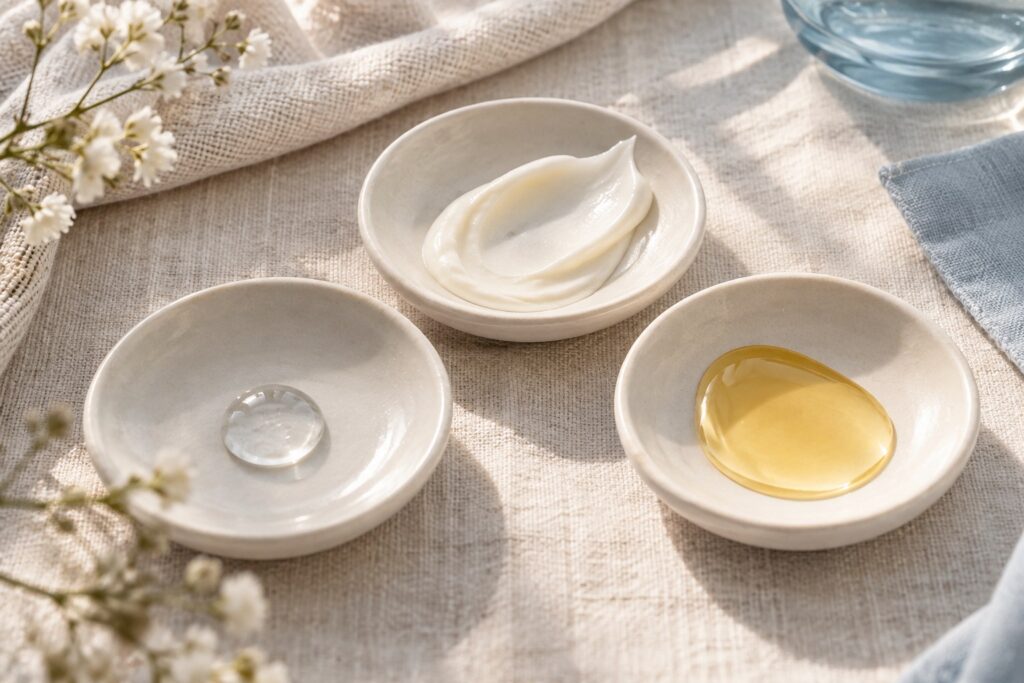
A humectant attracts and retains water, an emollient softens the skin, and an occlusive reduces water loss by forming a film on its surface. In a body care product, these three functions can work together. They are not three levels of quality, nor three products you have to apply one after another.
To understand a cream, you need to distinguish what its ingredients do from what the complete formula delivers. Here are the key differences, with examples of names you may come across in an INCI ingredient list.
Three different functions in one body care product
The dermatology resource DermNet identifies humectants, emollients and occlusives among the components of moisturisers. They act mainly on the stratum corneum, the outermost layer of the epidermis.
| Function | Main role | INCI examples | What it does not mean |
|---|---|---|---|
| Humectant | Attracting and retaining water in the stratum corneum. | Glycerin, Urea. | Necessarily forming a protective film. |
| Emollient | Softening and smoothing the skin, and improving its suppleness. | Glyceryl Stearate, Prunus Amygdalus Dulcis Oil. | Always preventing water loss. |
| Occlusive | Forming a layer that reduces water evaporation. | Petrolatum, Paraffinum Liquidum, Dimethicone. | Adding water to the skin itself. |
These examples are useful pointers, not a list of essential ingredients. A substance can contribute to several functions, depending on its properties and the formulation.
Humectants: retaining water rather than “nourishing”
Humectants have an affinity for water. DermNet lists glycerine and urea among its examples: they help attract and retain water in the stratum corneum. On a label, glycerine appears under the name Glycerin.
The word “humectant” therefore describes a mechanism involving water. It does not mean that the ingredient supplies lipids, or that it can provide all the comfort of a cream on its own.
Emollients: softening and smoothing the surface
An emollient helps make the skin softer and more supple. DermNet explains that certain oily substances soften the surface by filling small irregularities in the stratum corneum.

The cupping tool that replicates pinching and rolling, 3 minutes per zone
- The professionals' technique, at home: you lift, glide, and release, and the tool grips the skin fold like a manual pinching and rolling
- Soft silicone that fits thighs, buttocks, stomach, and arms
- 3 minutes per zone, every day, always with a massage oil so the tool glides
Plant oils can contribute to this function. Sweet almond oil, for example, has the INCI name Prunus Amygdalus Dulcis Oil. However, “nourishing”, a term often used for lipid-rich skincare, is not a fourth technical function equivalent to the three categories in the table.
Occlusives: slowing water loss
An occlusive agent forms a water-repellent layer on the skin’s surface. This reduces water loss through evaporation. DermNet gives petroleum jelly, paraffin, mineral oil and dimethicone as examples.
“Occlusive” does not mean that the skin becomes completely watertight. It describes a reduction in water loss, the extent of which depends in part on the finished product.
Emollients and occlusives: why are they often confused?
Both functions can involve oily substances, and a single ingredient can perform both. But their main purposes differ: emollience is about softness and suppleness; occlusion is about reducing evaporation.
An oil can soften the skin while also contributing to a surface film. That does not automatically make every cream containing that oil “highly occlusive”.
How a product feels is not a reliable measure either: a rich, light or non-greasy feel describes your perception when applying it, not, on its own, the degree of occlusion. Similarly, in dermatology, the word “emollient” can refer to a moisturising product as a whole rather than just one ingredient function.
A practical example: Crème Hydratante Monoï
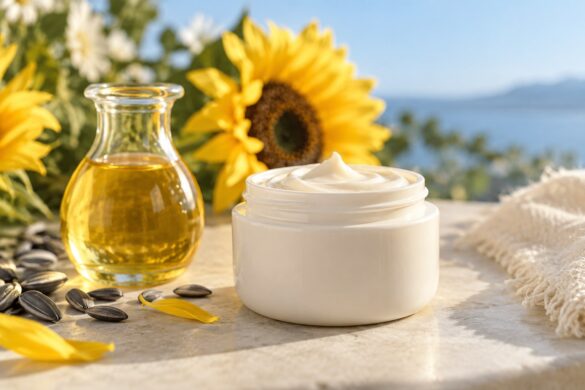
Crème Hydratante Monoï illustrates how different functions can be combined. Its French manufacturer’s product page, consulted on 2 October 2026, lists Glycerin, Helianthus Annuus Seed Oil and Prunus Amygdalus Dulcis Oil among its ingredients.
- Glycerin: glycerine is a useful example of a humectant ingredient.
- Helianthus Annuus Seed Oil: sunflower oil contributes to the oily component of the formula.
- Prunus Amygdalus Dulcis Oil: sweet almond oil illustrates the emollient function; the manufacturer states that it helps keep the skin supple.
The product page describes this cream as moisturising and nourishing, with a texture that melts into the skin without feeling greasy. This information is not enough to establish its degree of occlusion, so it would be unjustified to call it occlusive solely because it contains oils.
What these terms can really help you choose
They help explain how a skincare product works, but they are not a ranking of effectiveness. Identifying a humectant or emollient ingredient does not, on its own, tell you how well the formula performs or how your skin will tolerate the product.
To understand how these functions fit alongside other ingredients, read our explanation of the role of a cosmetic active ingredient. For application habits, our article on moisturising your body covers another side of the topic.
If your question is more about skin discomfort, explore our suggestions for caring for dehydrated skin. If dryness or irritation persists, advice from a dermatologist remains preferable to choosing a product based solely on these three terms.
Frequently asked questions
Do you need three products to cover all three functions?
No. A single formula can combine humectant, emollient and occlusive ingredients. These categories do not require you to layer skincare products.
Do these functions have an anti-cellulite effect?
No. They do not demonstrate any anti-cellulite, slimming or anti-stretch mark effect. They describe mechanisms that hydrate and soften the skin, not an action on body fat.

The scrub that leaves skin smooth and skin texture refined*
*User test on 21 volunteers over 4 weeks, based on participants' feedback.
- Olive & apricot kernels: these natural grains gently sweep away dead skin cells
- Caffeine & monoi scent, so your shower instantly smells like a holiday
- In the shower, two to three times a week, massaging your thighs, bottom and stomach


Comments (0)