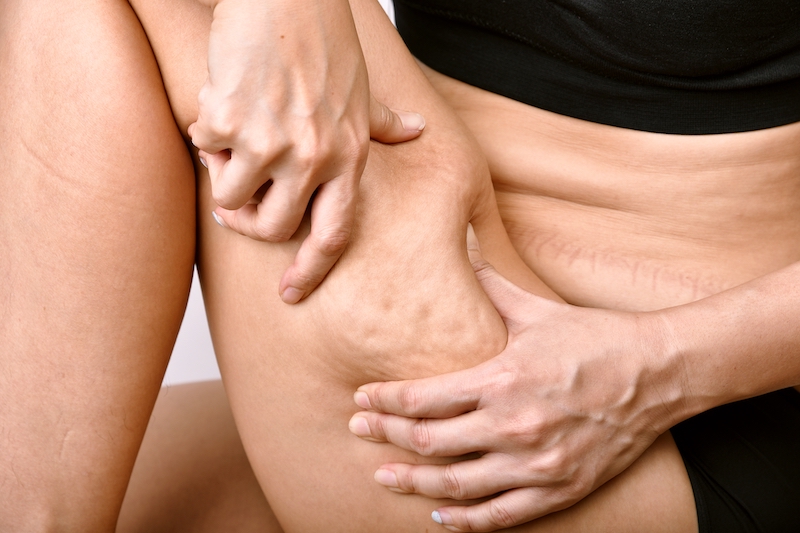
Lipedema and cellulite can look similar at first glance, especially when the legs seem swollen, tender or persistently marked. This guide helps you spot the most useful signs, know what may justify medical advice and avoid losing time with the wrong conclusion.
Contents
When this subject is really useful
This subject becomes useful when you feel that the word cellulite is no longer enough to describe what you observe, especially if there is pain, unusual sensitivity or a persistent feeling of heavy legs.
The correct diagnosis before taking action
The goal is not to make a medical diagnosis alone. The goal is to recognize the signals that justify either a classic anti-cellulite routine, or a legitimate doubt that merits health advice and a more cautious approach. The most useful thing is to relate the symptoms to their real rhythm: variations over the day, over the cycle, over several weeks or according to the method used.
- Very symmetrical or very particular distribution of the areas concerned.
- Tenderness to touch, lasting discomfort or pain that does not feel like simple massage discomfort.
- Feeling of heavy legs or tension which does not only depend on the anti-cellulite routine.
- Difference between a dimpled skin appearance and deeper tissue distress.
Four-step analysis framework
This framework helps to compare consistent weeks, to keep a real signal of progress and to see more clearly what suits you best.
Step 1
Establish a starting state with comparable photos, sensations and areas most concerned. Keep the same monitoring benchmark during this phase: same photos, same area, same observation frequency.
Step 2
Observe two to four weeks without changing method every three days. Keep the same follow-up cue during this phase: same photos, same area, same frequency of observation.
Step 3
Test a simple, non-aggressive routine to see what is a classic response to massage, movement and healthy living. Keep the same monitoring cue during this phase: same photos, same area, same frequency of observation.
Step 4
Check whether atypical, painful or persistent signals remain dominant despite a cleaner reading. Keep the same monitoring benchmark during this phase: same photos, same area, same frequency of observation.
Action plan over 2 to 4 weeks
The logic is not to do everything at the same time. It involves choosing a realistic order of action, then sticking with that framework long enough to see what really helps.
- Keep a gentle routine: walking, hydration, observation and progressive local techniques.
- Note separately the visual appearance, sensitivity and feeling of heaviness.
- Avoid intensifying a painful protocol just to “test”.
- Use the cellulite guide as a basis, then adjust only if the signs move away from this framework.
What you can do this week
If you want to turn the reading into a concrete plan, keep the format minimal: a main objective, two or three realistic time slots, a single follow-up benchmark and a mini-assessment at the end of the week. This simplicity avoids reloading the subject unnecessarily.
- Choose only one question to decide during the week, not three at the same time.
- Keep the same observation frequency to avoid false deviations.
- Note what really facilitates adherence instead of just following the motivation of the day.
- Decide at the end of the week whether to extend the same protocol or test another, more suitable approach.
How to know if you are going in the right direction
With cleaner sorting, you especially avoid aggressive or unnecessary routines and you gain a much clearer reading of what is tissue, pain and real progress. The right signal is not a sudden transformation. It is a routine that is more readable, better tolerated and easier to maintain from one week to the next.
- A single main objective, measured using comparable criteria.
- A routine frequency actually maintained, and not just planned.
- Less hesitation between several contradictory methods.
- A better idea of what method or reading to pursue next.
Frequent mistakes to avoid
- Assimilate all pain to the same subject as aesthetic cellulite.
- Compare your situation to social media photos without context.
- Multiply use strong techniques without prior clarification.
- Postpone a consultation when atypical signs persist.
What this comparison helps to clarify
The most useful thing about this reading is knowing when to return to Cellulite: definition, types, causes and solutions to reduce it for the general strategy, when to dig into the hormonal context with Hormonal cellulite guide: hormones, signals and adapted routine and when to check if swelling or heaviness also confuses the situation with Water retention guide: causes, diagnosis and solutions.
Frequently asked questions
Can we combine cellulite and lipedema?
Yes, mixed situations exist. This is precisely why sorting out the signals remains useful before choosing a routine.
Can a classic anti-cellulite routine still help?
Sometimes yes on comfort or tissue mobility, but it must remain progressive and not replace medical advice if doubt persists.
What first benchmark should you follow?
Always separate visual, pain, heaviness and exercise tolerance. Mixing these criteria makes the reading much too vague.
Guides to consult next
These pages allow you to go further with a more complete or more precise angle, depending on the point you want to explore in more depth.
- Cellulite: definition, types, causes and solutions to reduce it
- Heavy legs guide: causes, relief and circulation routine
- Water retention guide: causes, diagnosis and solutions
- Hormonal cellulite guide: hormones, signals and adapted routine
Additional articles
This content completes the reading with a more practical or more comparative angle, depending on the point you want to clarify next.
- Hormonal cellulite: how to recognize it?
- Water retention or fat: how to know which is really swelling?
- 21-day anti-cellulite routine: the complete plan