
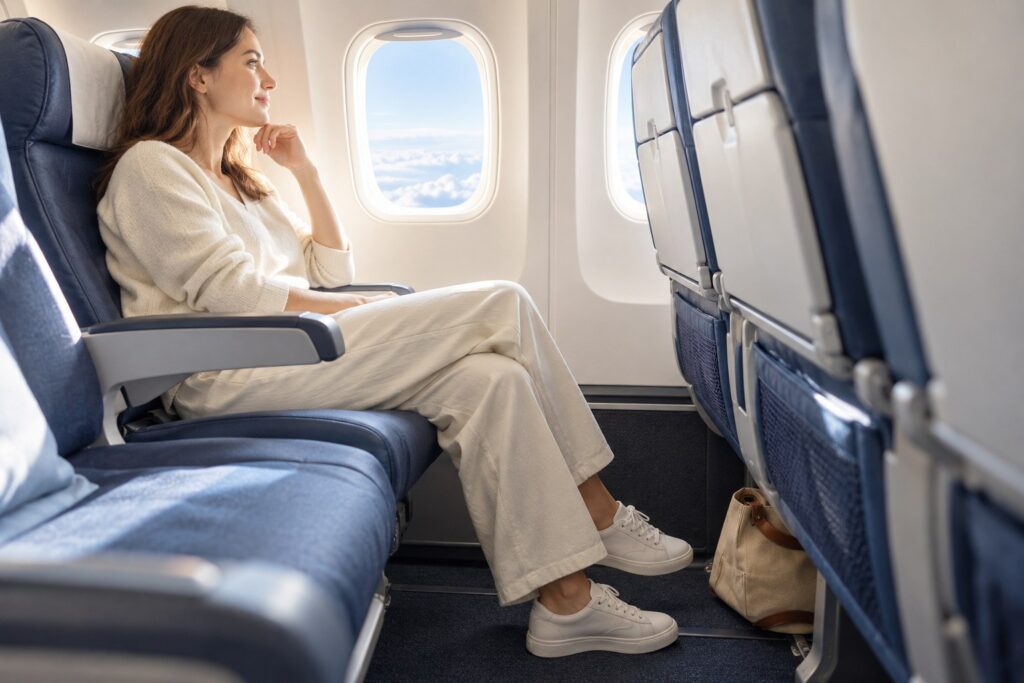
To help prevent heavy legs on a long-haul flight, focus on ways to break up long periods of inactivity: wear loose clothing, leave room for your feet, move your ankles while seated and walk when cabin rules allow it. If you are at risk of thrombosis, seek medical advice before travelling so that suitable prevention can be planned.
Here are the points to consider before boarding, the movements you can do in the cabin and useful guidelines for when you arrive.
Before departure: prepare your outfit and check your risk
When should you seek medical advice before flying?
According to Ameli’s advice on preventing phlebitis, air travel lasting more than four hours may increase the risk of deep vein thrombosis, mainly because of prolonged immobility while seated.
The risk is particularly high if you have previously had phlebitis or a pulmonary embolism, recently undergone surgery, are pregnant, take hormonal treatment or are undergoing cancer treatment. If you have a history of venous problems or a known risk factor, discuss it with a healthcare professional before you leave.
Tell them the flight duration, any connections and the treatments you take. Time spent sitting also includes transfers and waiting at the airport. If medical compression is prescribed, it must be suitable for your size and situation. Do not start taking preventive medication on your own initiative.
Choose comfortable clothes and shoes
Choose loose clothing and shoes that are easy to adjust. Ameli recommends avoiding shapewear, belts and boots during the flight. The aim is not to add further restrictions to an already prolonged seated position.
If you can choose your seat, an aisle seat can make it easier to move around. Before boarding, you can also use the time available to walk rather than sitting down straight away: small choices like these make it easier to keep moving throughout your travel day.
When you sit down: keep room for your feet
A large bag in front of your legs makes it harder to change position. Store your luggage in the authorised spaces and follow the crew’s instructions. If a small bag remains under the seat in front of you, keep enough room to place your feet on the floor and move your ankles.
Keep water and useful items within reach. You will not have to move your entire bag every time you want a drink or need to retrieve something.
| Travel stage | What to check |
|---|---|
| Before boarding | Choose comfortable clothing and walk if you have the opportunity. |
| Once seated | Clear the space around your feet and avoid crossing your legs. |
| Seat belt required | Keep it fastened and gently move your ankles. |
| When movement is allowed | Walk in the aisle when it is clear. |
| After arrival | Resume gentle walking and watch for any swelling. |
In the cabin: alternate seated movements with walking
Move your ankles without leaving your seat
When your seat belt must remain fastened, stay seated. You can still gently raise your toes, then lower them. Next, lift your heels while keeping your toes on the floor. These ankle flexion and extension movements are among those recommended by Ameli during travel.
Repeat them regularly within a comfortable range, without forcing the movement or causing pain. Keep your legs uncrossed and make sure you do not take up your neighbour’s space. If your airline provides a programme of in-seat movements, you can follow that as well.
Exercises that require you to lie down or need more space can wait until you arrive. Our selection of exercises to mobilise your legs offers ideas for times when you have a suitable environment.
Take the opportunity to stand up
Walk regularly in the aisle when movement is allowed, without getting in the way of the service. The NHS, in its information on deep vein thrombosis, generally advises avoiding long periods of immobility and standing up about once an hour. On board, safety instructions always come first.
Drink water regularly and avoid alcohol. Ameli also advises against taking sleeping pills during the flight: sleeping heavily for a prolonged period may leave you immobile for longer. If you already take prescribed medication, ask for advice before changing when or how you take it.
After arrival: get moving again
At the airport and once you reach your destination, resume gentle walking according to how tired you feel. If both legs are slightly swollen and there are no warning signs, you can raise them on a comfortable support. Gentle walking and elevation are among the measures suggested by the NHS for swollen legs and ankles.
If your skin feels tight after washing, you can also read our advice on how to moisturise your body properly. This is separate from venous comfort.
Signs that require medical attention
Do not automatically blame swelling on the flight. One swollen leg with no known cause, pain in the calf or thigh, a red or warm area, or sudden and significant swelling requires urgent medical attention. Do not massage the area or take a diuretic in an attempt to reduce the swelling.
If you experience shortness of breath or chest pain, call 15 or 112 immediately in France. On board, alert the crew without delay. Abroad, contact the local emergency services.
Swelling in both legs that lasts for several days or gets worse also warrants a medical consultation. If these sensations return outside travel, our guide to heavy legs in everyday life looks at this broader context.
FAQ: practical questions before a long-haul flight
Can ordinary socks replace medical compression?
No. A tight-fitting sock is not equivalent to properly fitted compression. Ameli explains that the size and level of compression must match your situation. If you have a risk factor, ask before departure what is suitable for you.
How much should I drink during the flight?
Ameli gives a guideline of one litre every four hours, in the form of non-alcoholic drinks. Spread your drinks throughout the journey. If you have a medical restriction on fluid intake, follow the amount you have been given.
Do these recommendations also apply to train or car journeys?
Yes. The NHS also refers to journeys lasting more than four hours by train or car. Adapt your opportunities to move to the type of transport: walk when possible on the train, and take breaks by stopping the vehicle when travelling by car.
To go further, explore the Cellublue shop: our anti-cellulite products.


 -27%
-27%Your evening cuppa, ten dried botanicals
- Peppermint contributes to digestive function, and green anise helps support digestion
- Couch grass brings its gentle sweetness, hibiscus its tangy note and meadowsweet its floral touch
- Linden, for its part, adds a soft, floral note and aids digestion



Comments (0)