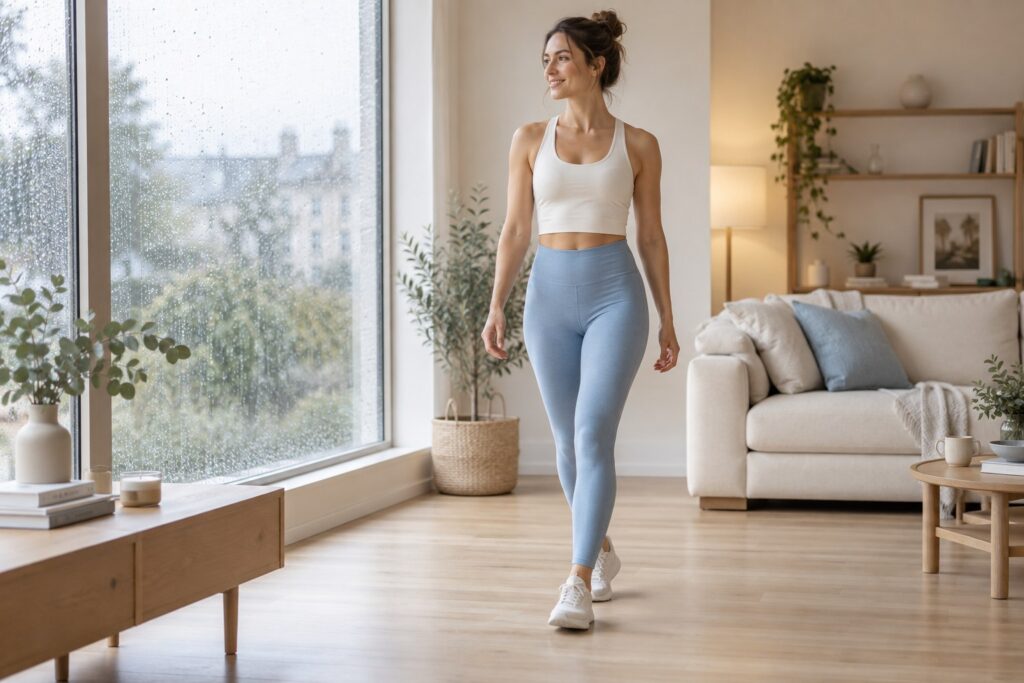
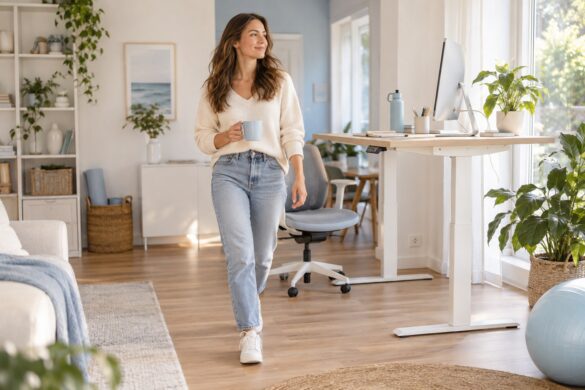
When rain keeps you inside, walk back and forth along a hallway, make a short loop between two rooms or walk on the spot. You do not need a treadmill. Choose a non-slip floor, clear the route and settle into a comfortable pace. The aim is to keep moving, not to recreate your usual walk perfectly.
Clear a route before you start
Walk the route slowly before you begin. Move cables, toys, shoes and rugs that could catch your feet, fold or slip. Check that doors will stay open as you pass, and leave plenty of room around table corners.
Wear comfortable shoes that fit securely and grip the floor. The NHS, the UK’s public health service, recommends walking shoes that offer suitable support and do not cause blisters. Avoid socks on a smooth wooden floor, as well as loose slippers that could come off.
You should be able to look ahead rather than watch your feet the whole time. If the route is cluttered, walking on the spot in a clear area is safer and easier than making repeated tight turns.
Three ways to walk at home
Walk back and forth along a hallway
Walk to the end of the clear section, slow down and turn with several small steps. Do not pivot sharply on one foot. A short hallway is fine; there is no need to rush through it. Keep each turn comfortable.
Look ahead and let your arms move naturally. If turning around feels awkward, walk on the spot instead.
Follow a loop between two rooms
If your home allows it, make a simple loop, such as walking from the entrance to the living room and back. Choose a route with wide curves rather than weaving between chairs. Slow down before changing direction.
Do not use the kitchen while preparing a meal or a bathroom with a wet floor. A shorter, dry and clear route is better than a larger loop with obstacles.
Walk on the spot in a small space
Stand where your arms can move without touching furniture. Lift one foot at a time and place it gently beneath you. Keep your steps low; you do not need to raise your knees very high.
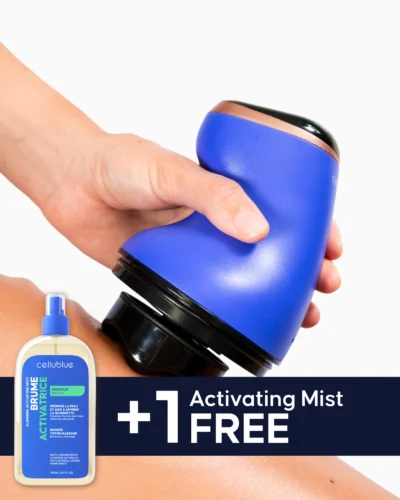 -26%
-26%The cordless massager: 2 900 rotations per minute to stimulate your skin
- A deep mechanical massage: rotations and vibrations, up to 2 900 turns per minute, knead the skin on your thighs, stomach, arms and bottom
- 2 complementary heads: the ball head kneads deep down, then the wave head smooths and tones the surface
- 5 intensity levels on a touchscreen, a blue light, cordless and quiet
If you have more room, take a few steps forwards, then turn calmly and come back. Do not walk backwards if you cannot see the route.
Vary your steps without jumping or slipping
Walking the same way can get monotonous. For a little variety without turning it into a fitness circuit, try one of these:
- Take slightly shorter or longer steps, as long as you have enough room and can keep your balance.
- Add a gentle arm movement, keeping your shoulders relaxed and your hands away from nearby furniture.
- Take a few side steps: move one foot to the side, bring the other foot to meet it, and keep your legs uncrossed and your feet on the floor.
- Alternate a comfortable pace with a slightly brisker pace, provided you can stay in control of the route.
In a flat, place your feet down quietly rather than stamping. There is no need for jumps, weights or obstacles. They would only make this rainy-day option harder to manage.
Choose a duration and pace that suit you
Start with a few minutes to test the route and see how you feel. Continue while you are comfortable, or stop and try again later. A song or a short break between two tasks can prompt you to move, but neither determines how long you should walk.
For a guide to moderate intensity, the NHS offers a simple guide: you should still be able to talk, but not sing. Your indoor walk can be gentler. Slow down if turning and finding your way around the room becomes difficult.
These recommendations also encourage breaking up long periods of sitting. You do not have to complete your whole walk in one session. Stop if you feel pain, dizziness or generally unwell. If you are returning to activity after a long period of inactivity and have a health condition, ask for advice before increasing the effort.
Keep your rainy-day plan simple
Choose your route in advance and keep a suitable pair of shoes nearby. A podcast or music may make the time more enjoyable, as long as you stay aware of your surroundings. Avoid reading your phone while walking.
To see how this fits into your wider habits, read our article on the benefits of walking. If getting started is the hard part, our advice on getting back into sport gradually looks at choosing an activity that suits your preferences.
What if you would like to try a different activity at home?
Indoor walking can be an occasional solution. If you would like to try something else, see our ideas for short home workouts you can do in a limited amount of time. The PDF programme French programme “3 mois pour un corps tonique” offers, according to its French product page, 12 weeks of coaching divided into four phases, with 33 exercises suitable for beginners, requiring no equipment and designed to be done at home. It is another way to organise your activity, not equipment you need for walking.
A common question
Does walking on the spot exactly replace going for a walk?
No. You do not cover the same distance, and the movements are different. It is still a useful way to move when going outside is not practical. Do not automatically convert time spent walking on the spot into kilometres. Pay attention instead to how long you have been moving and whether you feel comfortable.
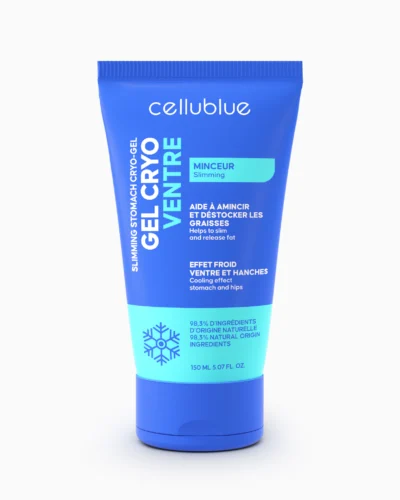
The cooling gel that leaves the skin on your stomach firmer
- Arctic Algae, Prosveltyl® & Menthol, combined in a formula designed for the stomach and hips
- Sorbet texture: it absorbs faster and makes the fresh sensation last longer
- 🍃 98.3% natural-origin ingredients

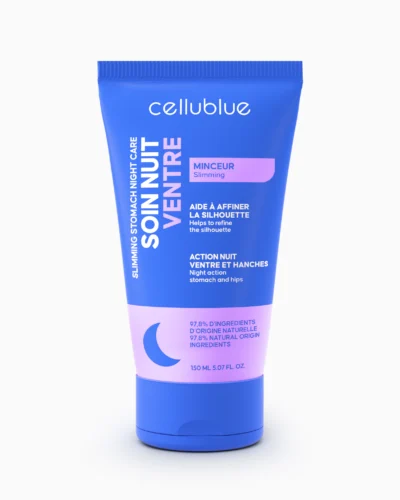
The evening treatment with Ginger & Slimsize® for the belly and hips
- Targeted night treatment for belly & hips, to massage in every evening before bed
- Ginger & Slimsize®, with a patented active ingredient at the heart of the formula
- Helps smooth and firm the skin
Comments (0)