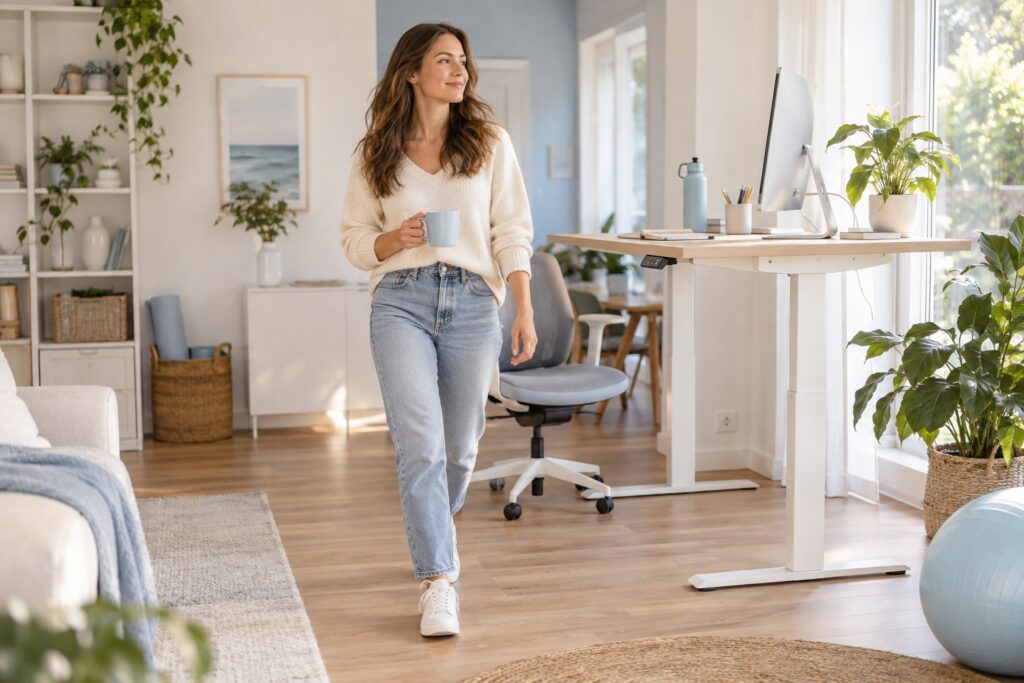
No, a standing desk is not enough to make your day active. It can reduce the time you spend sitting and help you change position, but standing still while you work does not replace walking or physical activity. The most useful approach is to alternate between sitting, standing and short movement breaks, depending on your tasks and comfort.
Less time sitting does not necessarily mean more movement
An adjustable desk changes the position in which you work. It does not automatically change what you do: you can still read, write or join a meeting while remaining almost completely still.
Sedentary behaviour and lack of activity are two different things
The World Health Organization defines sedentary behaviours as periods of wakefulness with low energy expenditure while sitting, reclining or lying down. It defines physical activity as body movement produced by muscles that requires energy expenditure.
Under this definition, standing stops you from sitting, but it does not turn that time into physical activity. An hour in front of a screen does not become an hour of moderate-intensity physical activity simply because you spend it standing. You can also exercise and spend the rest of your day sitting for long periods: these are two separate aspects that both deserve attention.
Standing still and walking are not the same
Changing position and moving around serve different purposes. A standing desk is mainly a tool for varying your posture. A break in which you actually leave your workstation adds movement.
| Situation | What changes | What it does not replace |
|---|---|---|
| Working while seated | You can complete your tasks in a comfortable position. | Breaking up long periods of sitting. |
| Working while standing still | You change position and reduce the time spent sitting. | A walking break or a physical activity session. |
| Walking between tasks | You leave a fixed position and add movement. | All your physical activity needs on its own. |
How can you alternate positions without following a rigid schedule?
You do not have to choose between sitting all day and standing all day. Instead, look for opportunities to vary your position without staying in one posture for so long that it becomes uncomfortable.
 -26%
-26%The cordless massager: 2 900 rotations per minute to stimulate your skin
- A deep mechanical massage: rotations and vibrations, up to 2 900 turns per minute, knead the skin on your thighs, stomach, arms and bottom
- 2 complementary heads: the ball head kneads deep down, then the wave head smooths and tones the surface
- 5 intensity levels on a touchscreen, a blue light, cordless and quiet
Match position changes to your tasks
For example, you might stay seated for writing that requires deep concentration, then raise the desk to proofread a document or listen to a presentation. These are organisational ideas, not a mandatory schedule.
Once you are standing, do not try to stay there for as long as possible. If your legs become tired or you lean towards the screen, change position and check that your workspace is still comfortable. Persistent pain deserves professional advice rather than extra effort to remain standing.
Also plan breaks away from your desk
Changing the desk height can remind you to move, but it should not replace a break. Once you have finished a task, you could refill your glass, walk over to a colleague or take a few steps around a clear area.
For a call that does not require a screen or note-taking, walking may be an option if the environment allows it. If you need to follow a presentation or handle documents, save the walk for after the call or presentation.
For more ideas on moving around away from your workstation, read our article on the benefits of walking in everyday life.
An adaptable example for a working day
Here is one possible framework to adjust to your circumstances. It does not set an ideal amount of time to stand or a universal interval between breaks.
- At the start of a project: choose the position that makes your work easier.
- When you finish a task: stand up if you have been sitting and, if possible, use the opportunity to walk a little.
- For a suitable task: try working at the desk while standing, without forcing yourself to stay there.
- Between two meetings: choose to walk somewhere rather than simply changing the desk height when you can.
- At the end of the day: identify long periods of stillness so you can spot an opportunity for a break the next day.
If your schedule is very busy, start with a moment that is easy to change. A habit linked to the end of a meeting may be more practical than an alarm that repeatedly interrupts your concentration.
Movement breaks are separate from meals at work, which we discuss in our article on avoiding habits that may worsen the appearance of cellulite at work.
A standing desk does not replace activity outside work
The NHS, the UK’s public health service, recommends reducing the amount of time spent sitting and breaking up long periods without movement with some activity. It distinguishes this goal from physical activity guidelines: at least 150 minutes of moderate activity per week, or 75 minutes of vigorous activity, as well as muscle-strengthening activities on at least two days a week.
So you should not count the hours you spend standing as minutes of exercise. To organise this other part of your week, our article on how often you should exercise explores a related question.
For reference, the French-language PDF 3 mois pour un corps tonique contains 12 weeks of coaching divided into four phases, with 33 exercises. It is suitable for beginners and requires no equipment. This French resource is not offered through the English shop and concerns home workouts, not alternating positions at your desk.
Frequently asked questions
How long should you stand for?
The sources cited do not set a universal length of time to spend standing at a desk. Adapt the alternation to your comfort and tasks, while keeping genuine opportunities to walk.
Do you need to buy an adjustable desk to get started?
No. You can already break up some periods of sitting by standing up and moving around. An adjustable desk makes it easier to work in several positions, but it is not essential for adding movement.

The cooling gel that leaves the skin on your stomach firmer
- Arctic Algae, Prosveltyl® & Menthol, combined in a formula designed for the stomach and hips
- Sorbet texture: it absorbs faster and makes the fresh sensation last longer
- 🍃 98.3% natural-origin ingredients

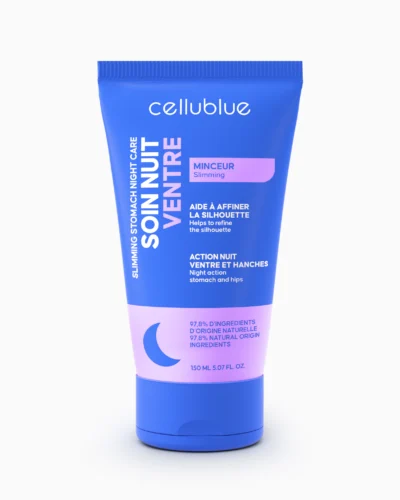
The evening treatment with Ginger & Slimsize® for the belly and hips
- Targeted night treatment for belly & hips, to massage in every evening before bed
- Ginger & Slimsize®, with a patented active ingredient at the heart of the formula
- Helps smooth and firm the skin


Comments (0)