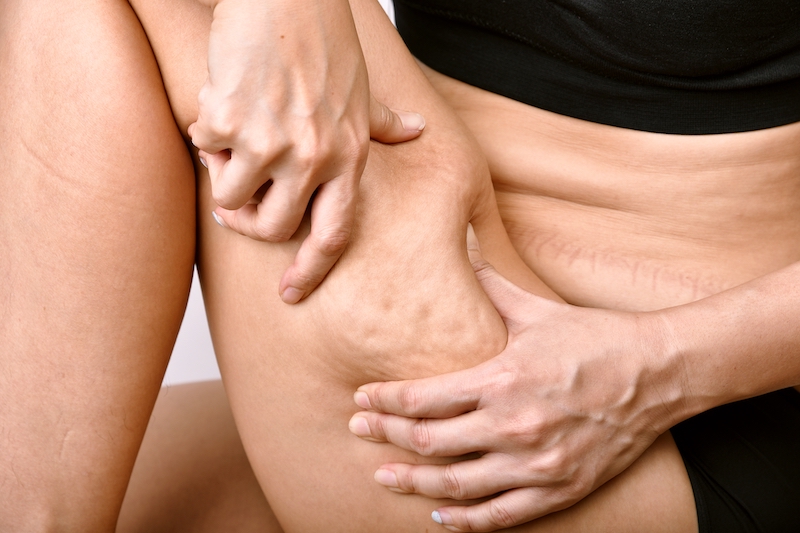
Lipedema and cellulite can look similar at first glance, especially when the legs look swollen, feel tender or remain visibly marked. This guide helps you spot the most telling signs, recognise when it’s worth seeing a doctor and avoid the mix-ups that waste time.
Two very different situations
In this guide, cellulite is treated as a matter of skin appearance and beauty routine, as set out in our cellulite guide. The other situation is a medical matter: only a doctor can confirm it or rule it out.
So the difference can’t be settled on your own in front of a mirror or from a photo. The next section explains which signs are worth getting checked by a doctor.
When it’s worth seeking medical advice
This deserves particular attention when pain, tenderness to the touch, symmetry or heaviness become pronounced.
When doubt merits medical advice
The aim isn’t to diagnose yourself, but to know which signs call for medical advice rather than just a beauty routine.
- A very symmetrical or unusual distribution of the areas affected.
- Tenderness to the touch, lasting discomfort or pain that feels different from ordinary massage discomfort.
- A feeling of heaviness or tightness in the legs that isn’t linked only to your anti-cellulite routine.
- The difference between dimpled-looking skin and deeper tissue discomfort.
When doubt merits medical advice
The aim isn’t to diagnose yourself, but to know which signs call for medical advice rather than just a beauty routine.
- Take stock: establish a starting point with comparable photos, sensations and the areas most affected.
- Seek medical advice without waiting: ask for medical advice if in doubt, particularly if there is pain, tenderness or unusual swelling. There is no need to try a routine for several weeks before seeking advice.
- Don’t use massage as a “test”: avoid trying massage on a painful area to confirm or rule out a diagnosis.
- Follow the advice you receive: follow your healthcare professional’s advice; how an area responds to massage is not enough to make a diagnosis.
Preparing for your appointment without putting it off
A beauty routine should not be used as a diagnostic test. Note your symptoms and the questions you want to raise at your appointment.
- Stick to a gentle routine: walking, hydration, observation and local techniques introduced gradually.
- Record appearance, tenderness and any feeling of heaviness separately.
- Avoid stepping up a painful routine just to ‘test’ it.
- Use the cellulite guide as your starting point, then only adjust if the signs no longer fit that framework.
What you can do this week
If you want to turn what you’ve read into a concrete plan, keep it minimal: one main goal, two or three realistic time slots, a single thing to track and a quick review at the end of the week. This simple format keeps things from becoming unnecessarily complicated.
- Pick just one question to answer over the week, not three at once.
- Observe at the same frequency to avoid misleading variations.
- Note what genuinely helps you stick with it, rather than relying on how motivated you feel that day.
- Don’t put off seeing a doctor just to carry on with a beauty routine.
How to tell if you’re on the right track
By sorting the signs more carefully, you mainly avoid harsh or pointless routines and get a much clearer idea of what concerns the tissue, what relates to pain and what counts as genuine progress. The sign to look for isn’t a dramatic transformation. It’s a routine that’s clearer, better tolerated and easier to keep up from one week to the next.
- One main goal, measured against comparable criteria.
- A routine frequency you actually maintain, not just plan.
- Less wavering between conflicting methods.
- A clearer idea of what to look into next, depending on your needs.
Common mistakes to avoid
- Assuming that every type of pain is simply part of cosmetic cellulite.
- Comparing yourself with social media photos out of context.
- Piling on intensive techniques before you’ve clarified the situation.
- Putting off seeing a doctor when unusual signs persist.
What this comparison helps you clarify
The most useful takeaway is knowing when to go back to Cellulite: definition, types, causes and solutions to reduce it for the overall approach, when to look more closely at the hormonal side with Hormonal cellulite guide: hormones, signals and adapted routine, and when to check whether swelling or heaviness is also muddying the picture with Water retention guide: causes, diagnosis and solutions.
Frequently asked questions
Can you have both cellulite and lipedema?
Yes, it’s possible to have both. That’s exactly why it’s worth sorting through the signs before choosing a routine.
Is a standard skincare routine still worthwhile?
Sometimes, yes, as a beauty and comfort step, but it should be introduced gradually and should never replace medical advice if you’re in doubt.
What should you track first?
Always track appearance, pain, heaviness and exercise tolerance separately. Lumping these together makes the picture far too blurred.
Guides to read next
These guides let you explore further, from a more complete or more structured angle, depending on the question you still have.
- Cellulite: definition, types, causes and solutions to reduce it
- Heavy legs guide: causes, relief and a circulation routine
- Water retention guide: causes, diagnosis and solutions
- Hormonal cellulite guide: hormones, signs and a suitable routine
Related articles
These articles build on this one with a more practical or comparative angle, depending on what you want to clarify next.
- How to recognise hormonal cellulite
- Water retention or fat: how to tell what’s really causing the swelling?
- 21-day anti-cellulite routine: the complete plan
To go further, explore the Cellublue shop: our anti-cellulite products.
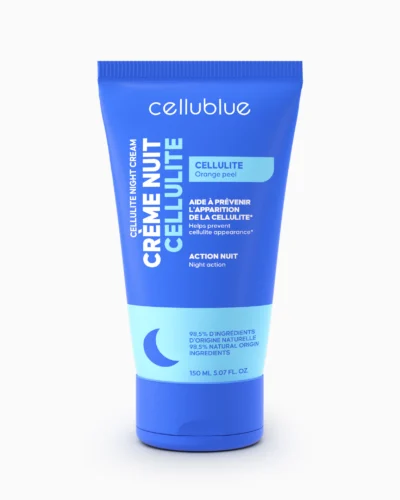
The cream that smooths the appearance of orange peel skin* and tones the skin
*Consumer test on 22 volunteers over 2 weeks, participants' self-assessment.
- Smooths the appearance of orange peel skin on the thighs, buttocks and stomach
- Caffeine & Green Coffee, the two benchmark active ingredients in body care
- Melting texture: absorbs in seconds and leaves the skin feeling comfortable

The scrub that leaves skin smooth and skin texture refined*
*User test on 21 volunteers over 4 weeks, based on participants' feedback.
- Olive & apricot kernels: these natural grains gently sweep away dead skin cells
- Caffeine & monoi scent, so your shower instantly smells like a holiday
- In the shower, two to three times a week, massaging your thighs, bottom and stomach


Comments (0)