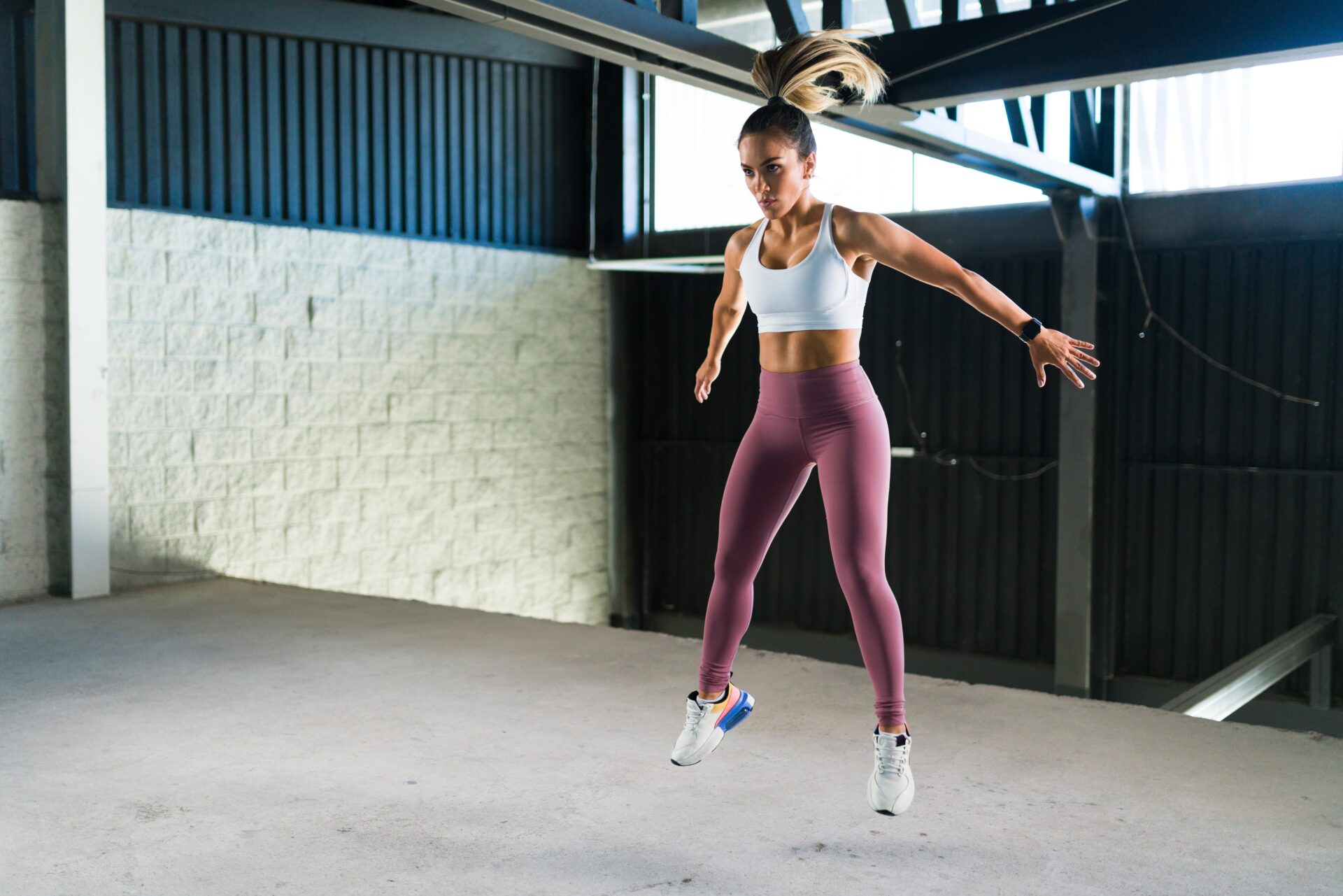
You’ve been tempted by CrossFit, or at least thinking about adding a few exercises to your current workout routine. You’ve always heard that burpees are an excellent, all-in-one exercise — capable of working every muscle in the body and reshaping your silhouette. But as a beginner, you have no idea where to start. Here’s everything you need to know about how to do burpees, even when you’re just starting out!
What are burpees?
The burpee, named after its creator Royal H. Burpee, an American physiologist, is a strength and aerobic exercise. It was originally developed by the researcher to assess athletes’ physical fitness — both from a muscular standpoint (burpees engage every muscle in the body) and a cardiovascular and respiratory one, as the exercise is extremely demanding in terms ofcardio. Being highly effective forburning caloriesand building muscle evenly, it didn’t take long for fitness coaches — particularly in CrossFit andHIIT— to adopt it and incorporate it into their training programmes.
Burpees consist of a sequence of classic fitness positions performed at a fast pace. They combine a plank, a squat and a jumping jack. They simultaneously engage the upper body (arms and shoulders), the lower body (thighs andglutes) and the core. This makes them a truly complete exercise, ideal for shedding body fat and buildinglean muscle. But beyond the physical challenge, they’re also a mental one — they require a fair amount of willpower! That said, burpees are accessible to everyone, even beginners.
What are the steps to doing burpees as a beginner?
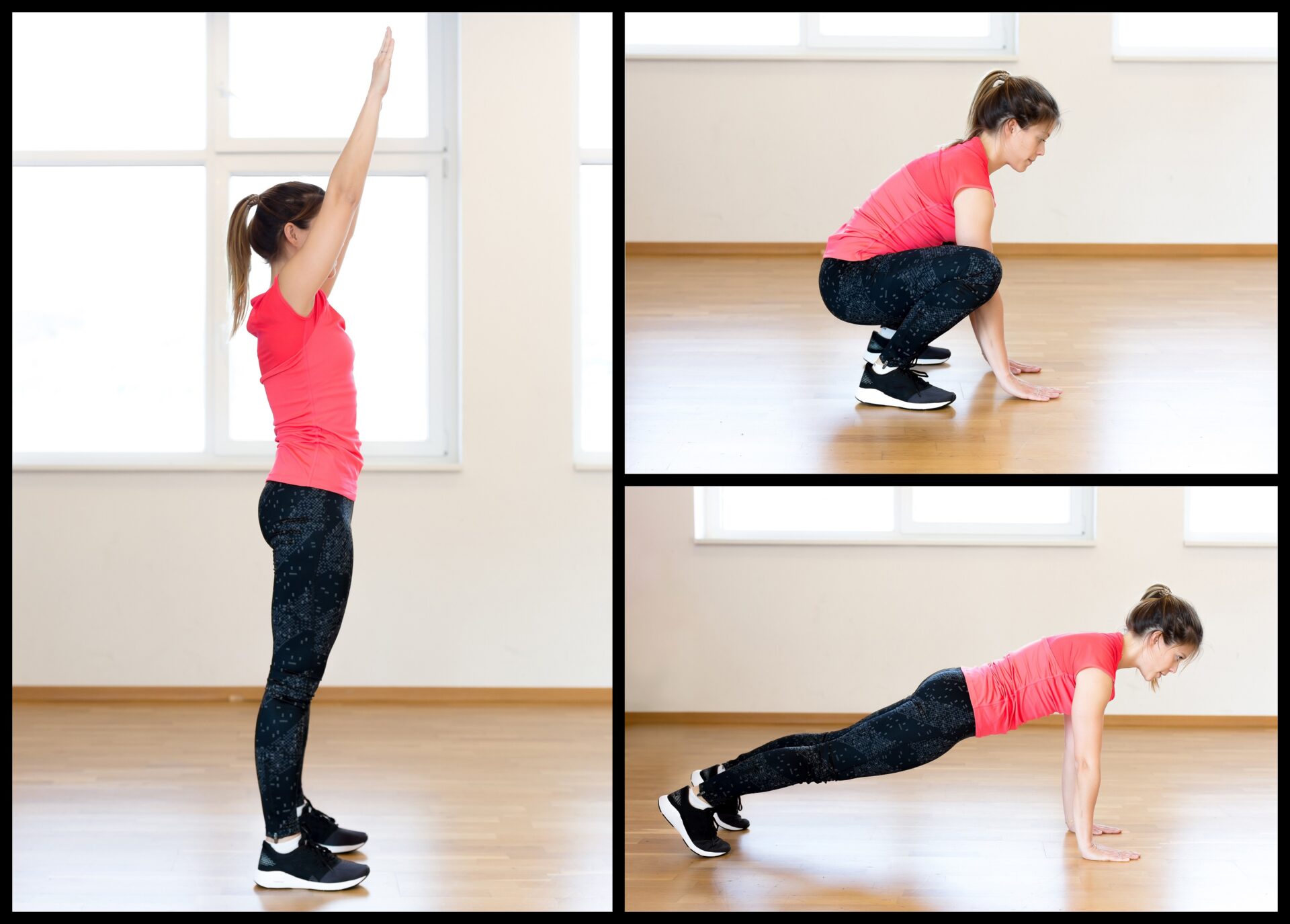
Want to give burpees a go but not sure where to start? No need to worry! The sequence is very easy to learn, even for beginners. Here’s how it breaks down:
- Bend your legs with your hands on the floor — simply squat down, a bit like a frog!
- Thrust your legs back to reach the plank position, resting on your forearms (the classiccore hold).
- Thrust your legs forward again, returning to the initialsquat position (knees bent, hips and glutes pushed back, hands clasped together).
- Jump up into the air with your arms raised and legs apart.
This sequence should be repeated several times — ideally in sets of around 10 burpees.
Are there variations of burpees?
As a beginner, you’ll start by mastering the “basic” burpee — the sequence described above. But once you’ve got it down, you can add extra steps to make it more challenging. These are known as variations, and there are plenty of them!
- Variation no1: Burpees with push-ups. Simply add one or more push-ups at the second step (plank position).
- Variation no2: “Old School” burpees. In the plank step, add a small jumping leg spread and a push-up.
- Variation no3: “Dead Man” burpees. Instead of holding a plank, you lie flat on your stomach. Getting back up for the next movement is much harder, since you’ve lost all momentum…
- Variation no4: Burpees + Lunges. Instead of finishing the sequence with a jumping jack, perform two jumping lunges.
- Variation no5: Burpees withadded weight. The exercise involves adding resistance to your body — such as ankle weights or a weighted vest — to increase the intensity.
- Variation no6: “Tuck Jump” burpees. Instead of a jumping jack at the end of the sequence, perform a tuck jump — jumping up and pulling your knees to your chest, tapping them with your hands.
- Variation no7 : “One Leg” or “One Arm” burpees. In the plank (or plank + push-up) step, perform the movement on one leg or one arm, or alternate between sides. A highly demanding balance and coordination challenge.
- Variation no8 : Burpees + Mountain Climber. Perform a few Mountain Climber movements during the plank step to maximally tone thecore.
- Variation no9 : Burpees with clap push-ups. In the plank step, perform a clap push-up. What’s that? Simply a very fast push-up where you add an explosive upward thrust as you extend your arms — a brief moment where your hands leave the floor — and clap them together mid-air.
- Variation no10 : Cobra burpees. A variation inspired byyoga: during the plank step, transition into the Cobra yoga pose — legs extended, hips on the floor, arms fully extended, chest open and gaze lifted upward.
There are many more burpee variations out there, some more beginner-friendly than others — but they all share one great advantage: keeping your workout routine from feeling monotonous and keeping the energy high!
What are the limitations of burpees?

Some fitness coaches are not particularly enthusiastic about burpees. They even consider the exercise potentially harmful to the body, due to its somewhat intense nature. Burpees can place significant stress on certain parts of the body, particularly the joints (wrists, front of the shoulder,knees, ankles). They tend to recommend working each muscle group separately to reduce the risk of injury:
- Push-ups to strengthen thearms, theback and theshoulders.
- Squats and lunges for the glutes and thighs.
- Crunches for theabs.
- Skipping rope or step for cardio.
As a beginner, now you know what to expect! With or without burpees, one thing is certain: regular physical activity is good for your wellbeing.