UncategorizedCosmetic product ingredients: how to read a label?
Cosmetic product ingredients: how to read a label?
par
With all the information packed onto cosmetic product bottles, it’s easy to feel overwhelmed! But do you know what all of it actually means? How do you read a cosmetic label to tell whether a product is good or not? We explain everything, using our Cellublue labels as examples!
Sommaire
Ingredient list
On every product, you’ll find the list of ingredients that make up the formula. This list is in descending order — meaning the first ingredients are those present in the largest quantities.
This ingredient list, known as the INCI list, is displayed in Latin or English. It is mandatory for cosmetic products and is an international standard.
Fragrance
In most products, you’ll find “parfum” or “fragrance” in the ingredient list. This term indicates the presence of ingredients used to scent the product. Fragrance gives a product its olfactory identity, setting it apart from others and adding a sensory dimension to the experience. The exact fragrance formula is never disclosed, as perfumers keep their recipes secret. Only allergens, if present, are listed in the INCI to help consumers who are sensitive to certain ingredients.
Water, a key ingredient
Water is a major component in cosmetics for several reasons. First, water is a fundamental building block of the skin, which means products blend seamlessly into the epidermis. In cosmetic formulation, water also acts as a solvent, making it possible to create emulsion-based products such as creams and lotions. To achieve an emulsion texture, water and fatty substances must be combined. The more fluid the texture, the higher the water content — and the richer the texture, the more fatty substances it contains.
Weight or volume
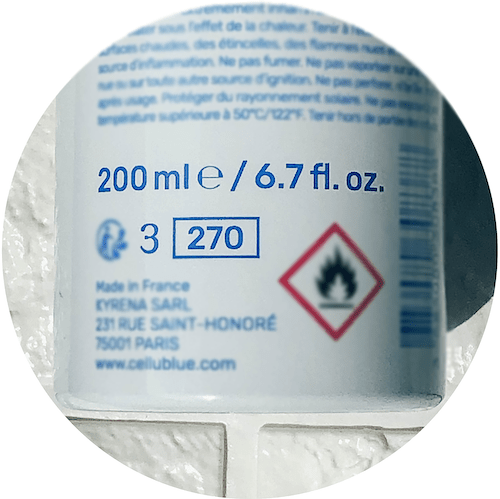
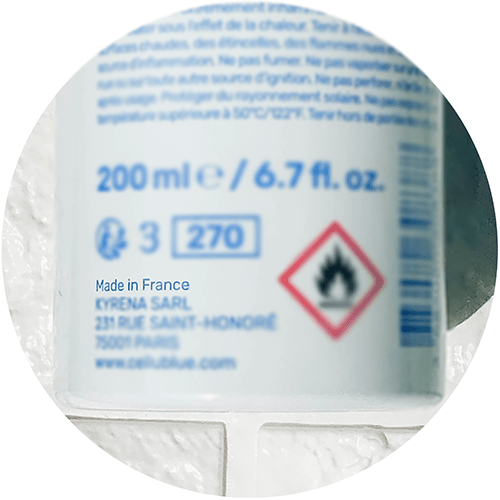
The volume or weight of a product is indicated on the packaging when it exceeds 5 ml or 5 g. Volume is shown in ml and fl.oz (fluid ounces), which corresponds to the American measurement system.
PAO symbol
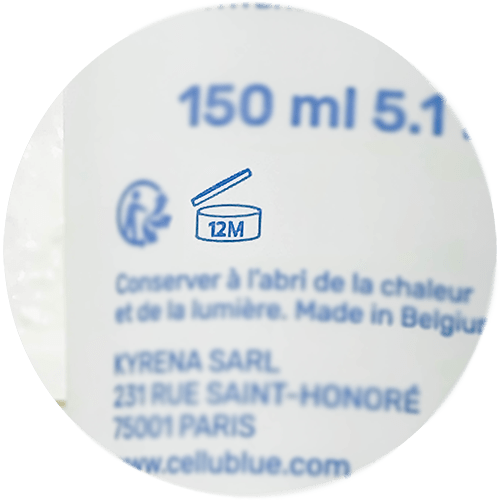
This small PAO symbol, Period After Opening, is represented by an open jar. It indicates how long the product can be kept after opening. This is the maximum shelf life of the product once it has been opened. For example, in the photo shown, the product can be kept for 12 months after opening.
Triman symbol
Since 1 January 2015, the Triman symbol has been mandatory for all companies that produce, import and distribute recyclable products on the French market. They are subject to an extended producer responsibility scheme and must comply with sorting guidelines. (1) This symbol therefore indicates that the company follows sorting instructions and that the product can be sorted for recycling.
At Cellublue, our packaging is recyclable — remember to sort your waste for the planet.
Flammable symbol
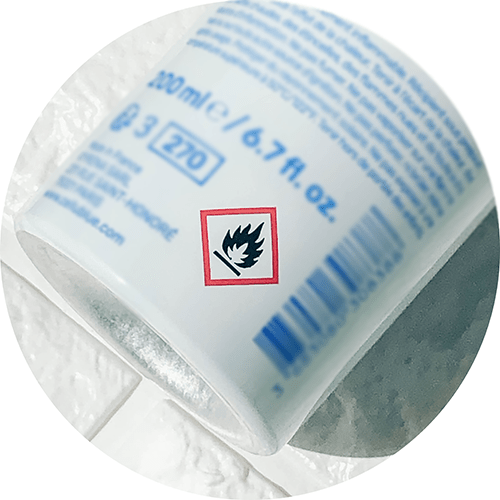
The flammable symbol is mandatory when a product contains gas. All aerosols display this symbol, as they contain flammable propellant gases — as is the case, for example, with spray deodorants or the Cellublue Crépitante Mousse.
Country of manufacture
The mention “Fabriqué en XXX” or “Made in XXX” indicates the country where the product was made. At Cellublue, all our cosmetic products are formulated in France and manufactured in France or in Europe.
Ingredients to avoid
Some ingredients are best avoided in cosmetic formulas.
As a general rule, it is advisable to steer clear of ingredients classified as CMR — meaning they are suspected of being carcinogenic, mutagenic and/or toxic to reproduction.
BHA (butylated hydroxyanisole): antioxidant agent classified as a suspected carcinogen
BHT (antioxidant): suspected endocrine disruptor
Triclosan: antibacterial agent and endocrine disruptor
Cyclopentasiloxane: endocrine disruptor
Cyclotetrasiloxane: toxic to reproduction
Cyclomethicone: a constituent of Cyclopentasiloxane and Cyclotetrasiloxane
DEA: carcinogenic substance
Formaldehyde releasers: often used as preservatives but highly irritating and sensitising => A few examples from this family: Quaternium-15, DMDM hydantoin, Diazolidinyl urea, Imidazonilyl urea
None of our products contain these ingredients, so you can use them with complete peace of mind 🙂
Now you know everything about cosmetic product composition — and how to read our Cellublue product labels!