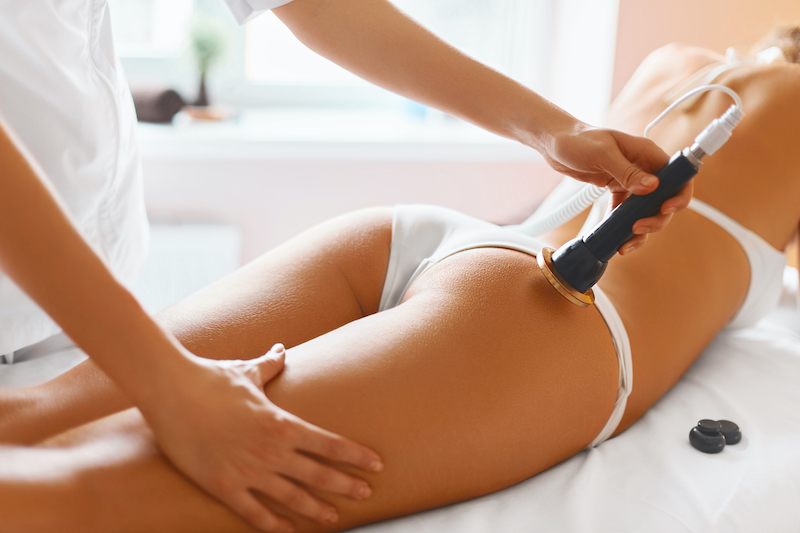
Ultrasound waves operate at frequencies too high for the human ear to detect. Power ultrasound falls between 16 kilohertz and 1 megahertz. It can influence matter at both a physical and chemical level, altering its structure. For this reason, doctors have explored its use in various therapeutic applications, including anti-cellulite treatment using ultrasound.
How doctors use ultrasound
Ultrasound has been used in medicine to treat soft tissues such as tendons and muscles, with the aim of improving circulation and relieving certain types of pain. However, its effectiveness in these areas has never been conclusively proven by medical researchers. Another common medical application involves breaking down kidney stones.
Using ultrasound to treat cellulite raises legitimate questions about its actual effectiveness. Only practitioners with genuine expertise in ultrasound technology are authorised to use this type of technique. Results remain limited and have not been scientifically validated in a clinical care setting.
Focused vs. unfocused ultrasound: what’s the difference?
Focused ultrasound concentrates waves onto a single precise point, whereas unfocused ultrasound disperses energy in a more random pattern. Only focused ultrasound can penetrate deeply enough to act on cellulite. Even so, proven results are not consistently replicated in a convincing way, and the technique may simply not work for some individuals. The long-term effects of ultrasound on fatty deposits have yet to be definitively established.
Is ultrasound treatment for fatty deposits actually beneficial?
Focused ultrasound targets a precise point beneath the skin, generating heat that creates a cavitation effect. Rather than acting directly on surface dimples, the goal is to reach the deep fat layer under the skin. This produces a mechanical effect without affecting the surrounding skin, blood vessels, or nerves. Digital ultrasound systems work by overlapping treatment points, ensuring that no area of the body is treated twice in the same session.
How effective is this treatment for cellulite?
Ultrasound anti-cellulite treatment is taken seriously within the medical community. It is said to achieve results comparable to liposuction, but in a less invasive way. Focused ultrasound does not produce side effects. Around ten sessions, twice a week, are typically required to see a real difference, with results becoming apparent after approximately three months. It is worth noting, however, that the studies supporting this technique appear to have been funded exclusively by medical ultrasound companies — which gives reasonable grounds to question both the method’s effectiveness and the objectivity of those findings.
Qualified practitioners, pricing, and results
Only certified ultrasound specialists are qualified to perform this type of treatment. Localised wave therapy is known as medi-sculpture, or HFU — standing for High-Intensity Focused Ultrasound. This technique can act at depths of up to 6 centimetres by heating the targeted area. A special gel is applied beforehand to facilitate the transmission of ultrasound waves. Another ultrasound-based technique is called morpho-lipo-sculpture, or UMD (Ultrasound with Draining Massage). This involves injecting saline solution under the skin, followed by a manual massage of the area to stimulate lymphatic and venous circulation — helping the body eliminate waste more efficiently. The ultrasound then drains the water along with the fat present in the tissue. Only the HFU technique can be applied across the entire body, though both approaches can be used in combination.
This is, however, a particularly costly procedure. Prices range from €100 to €300 per session, with each session lasting between 45 and 75 minutes. An ultrasound anti-cellulite treatment can never replace a balanced diet and a healthy lifestyle that includes regular physical activity. This type of treatment should above all be considered a last resort, for those who are genuinely affected by stubborn fat deposits. It does not act on the appearance of orange-peel skin, as the issue runs too deep within the skin’s layers.
If you want to tackle your cellulite without spending a fortune or committing to lengthy clinic sessions, you might consider the Cellublue Express Anti-Cellulite Pack, which includes 5 products and 2 coaching guides to help you reduce cellulite.

Potential risks, contraindications, and side effects
Minor skin burns may occur following the application of ultrasound waves. For most people, this does not pose a significant health concern. The treatment does not cause bruising and is generally painless. That said, it is not a physically neutral procedure, and it is important to discuss its suitability with your GP before going ahead. Only a qualified specialist should carry out this type of treatment. People with sensitive skin may not tolerate the waves well. It is not recommended for pregnant women, and is contraindicated for those with eczema or tumours. It is also best avoided if you are already undergoing a physically demanding medical treatment.
Conclusion
The existing studies on this practice are not entirely convincing. Promising results are put forward by specialist practitioners, yet no study has been universally accepted by the broader medical community. The most effective approach to tackling excess fat remains a healthy, balanced diet combined with regular physical activity. Staying well hydrated also supports the body’s natural ability to eliminate fat.