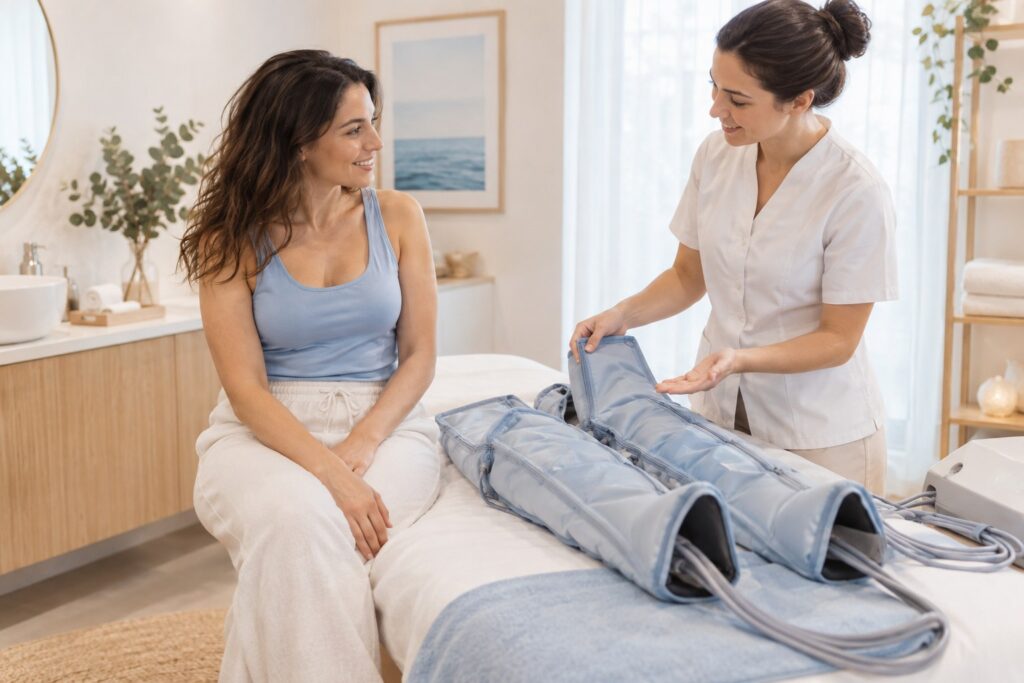
To prepare for your first pressotherapy appointment, contact the centre before you go. Ask what to wear, how check-in works and what health information you should share. Once there, ask how the equipment is cleaned, how to stop the session and what the total price will be before you begin. You do not need to choose the device settings yourself.
This preparation is mainly about avoiding practical surprises. The suitability of the treatment and any precautions must be assessed by the professional based on your situation.
Before booking: explain why you are coming
Describe your request in a few words: perhaps you want to discover how the boots feel, discuss leg discomfort or ask about an aesthetic goal. Separate what you are experiencing from what you hope to achieve, without trying to diagnose yourself.
An unexplained painful or swollen leg requires medical advice before any treatment. Do not book a session in an attempt to make this symptom disappear.
Information to share
Mention any known medical conditions, circulation problems, history of thrombosis, pregnancy, recent surgery, wound or irritation in the area concerned. Also mention any current medication and whether you wear prescribed compression. The professional may ask for further details or medical advice.
To help you remember everything, prepare a short note listing your medication and any recent significant events. Bring a prescription or medical report if the appointment is part of healthcare management and the clinic asks you to do so.
Pressotherapy does not automatically replace prescribed compression stockings. France’s Assurance Maladie explains, in relation to elastic compression, that the type, length and duration are adapted by the doctor to the patient’s situation. This information concerns medical stockings, socks and other compression garments, not the settings used during a treatment at an institute.
Points to confirm with the centre
Arrangements can vary depending on the venue and equipment. It is better to get a precise answer than to follow a generic checklist found online.
| Point to confirm | Question to ask |
|---|---|
| Time on site | “How much time should I allow for check-in, the initial discussion, getting set up and the session?” |
| Clothing | “What clean clothing should I bring or wear?” |
| Accessories | “Do I need socks or protective clothing, or do you provide what is needed?” |
| Skin and cosmetics | “Should I arrive with the area free from cream or oil?” |
| Price | “What is the total price of the first appointment and what does it include?” |
Choose practical clothing without buying things you do not need
Clothing that is easy to take off and put back on can make your arrival simpler. For anything worn under the boots, ask the centre first: do not buy a particular accessory before you have an answer. Also check whether there is somewhere for you to change.

The cupping tool that replicates pinching and rolling, 3 minutes per zone
- The professionals' technique, at home: you lift, glide, and release, and the tool grips the skin fold like a manual pinching and rolling
- Soft silicone that fits thighs, buttocks, stomach, and arms
- 3 minutes per zone, every day, always with a massage oil so the tool glides
As for food and drink, do not impose a fast or drink extra water based on a promise of “drainage”. If the centre recommends a specific preparation, ask what it involves and why it is being suggested.
At the appointment: check the setup and make sure you can stop
Before getting settled, ask how the boots and surfaces that come into contact with you are cleaned between clients. Ask whether individual protection is used and how it is replaced. These are perfectly normal questions when equipment is shared.
Understand what the device will do
Pressotherapy uses compartments that inflate and deflate. A review of intermittent pneumatic compression, including its effects on venous flow, describes how this works. However, it does not provide a universal programme for your first aesthetic appointment.
Ask which areas will be fitted with the boots, what sensations to expect and who selects the settings. Our article on the benefits of pressotherapy looks at the technique in more detail; here, the priority is to understand what will be offered to you personally.
Know how to call for help and stop the session
Before the session starts, ask to be shown how to request help and stop the device. Check that someone can be reached during the session, even if they leave the room.
Report pain, numbness, feeling unwell or any worrying sensation immediately. You do not have to tolerate discomfort to make the session “more effective”. If the setup feels uncomfortable from the outset, say so before the device is switched on.
Before paying for a course: ask for an assessment and a quote
At the end of the appointment, simply describe what you felt: comfort, discomfort and areas of pressure. Ask what the professional makes of this and whether further sessions are relevant. An immediate impression is not enough to establish a lasting result.
If several appointments are recommended, ask why they are considered appropriate, what the total cost will be, the cancellation terms and which services are included. You can take time to think before signing up for a package.
If you are still unsure about the method, read our comparison of lymphatic drainage and pressotherapy. For an aesthetic request, our comparison of anti-cellulite techniques helps put one proposal among the available options, without making a decision under pressure at reception.
Your moisturising care is separate from the appointment
You do not need to buy a cosmetic product to prepare for this session. Crème Hydratante Monoï is a separate daily moisturising product for adults. Apply it to clean, dry and intact skin using circular movements.
It is not presented here as a drainage treatment, post-device recovery product or way to maintain results. After a treatment, ask whether and when to resume your cosmetics rather than planning to apply one immediately.
Checklist to save on your phone
- I have explained my goal and shared the relevant health information.
- I have confirmed the clothing, accessories and total time required.
- I know how the equipment is cleaned and how to stop the session.
- I know the price and what it includes.
- I have allowed time to discuss how it went before booking anything else.

The scrub that leaves skin smooth and skin texture refined*
*User test on 21 volunteers over 4 weeks, based on participants' feedback.
- Olive & apricot kernels: these natural grains gently sweep away dead skin cells
- Caffeine & monoi scent, so your shower instantly smells like a holiday
- In the shower, two to three times a week, massaging your thighs, bottom and stomach




Comments (0)