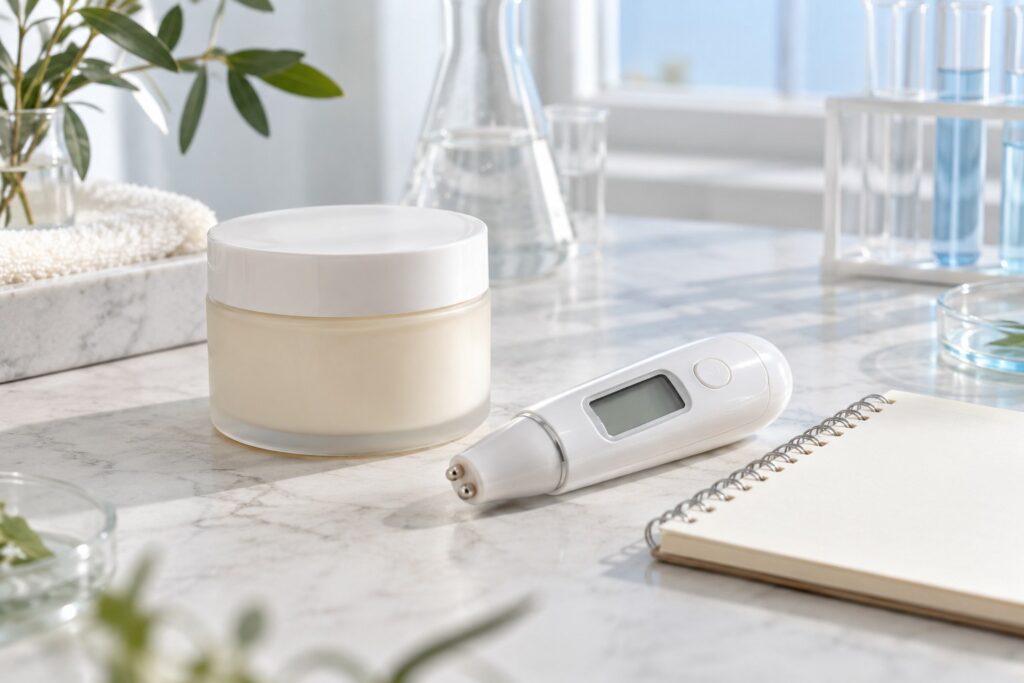
An instrumental test measures a parameter with a device. A self-assessment collects answers from people who use the product. An expert assessment is based on a professional’s observations against defined criteria. These methods answer different questions: to understand a cosmetic result, look at what was assessed, by whom, in how many people and for how long.
Three methods, three types of information
Instrumental testing: a targeted measurement
A device can measure a skin parameter, such as a hydration indicator, or analyse images of the skin’s surface. The result concerns that specific parameter under the conditions of the test.
An instrumental figure should therefore be accompanied by its unit or calculation method. An average change and the percentage of people showing a change are two different pieces of information. Even when it comes from a device, a measurement must be interpreted in light of the protocol: the area studied, measurement conditions and the comparison used.
Self-assessment: participants’ experience
Volunteers answer a questionnaire about their experience: whether their skin feels softer, whether it feels comfortable, whether the texture is pleasant or whether the skin looks smoother to them. This method is useful for describing what users feel or observe for themselves.
The wording of the question matters. “I find my skin smooth” is not the same as “I find my skin smoother than before”. The result summarises the answers to a specific question; it does not become a physical measurement of the skin.
Expert assessment: structured observation
A professional can assess a visible or tactile sign using a scoring grid. For example, they may assign a score to a skin characteristic before and after use.
This assessment differs from participants’ perceptions and from a device-based measurement. To understand it, look for the criterion observed, the scale used and the conditions of comparison. Simply mentioning an expert does not describe the entire protocol.
| Method | What it tells you | What to check |
|---|---|---|
| Instrumental | A measured parameter | Device, unit, change assessed |
| Self-assessment | A reported perception | Question asked, answers included |
| Expert assessment | An assessment based on criteria | Scoring grid, score, observation conditions |
Sample size, duration and criterion: three points to read
Sample size tells you how many people took part. A percentage must be read alongside this number: 100% in a group of 21 volunteers describes that group, not all future users. Also check, when the information is provided, how many people completed the test or answered the question.

The scrub that leaves skin smooth and skin texture refined*
*User test on 21 volunteers over 4 weeks, based on participants' feedback.
- Olive & apricot kernels: these natural grains gently sweep away dead skin cells
- Caffeine & monoi scent, so your shower instantly smells like a holiday
- In the shower, two to three times a week, massaging your thighs, bottom and stomach
Duration places the observation in context. A result collected after four weeks tells you about that period. On its own, it does not say when the effect began or how long it lasts after use of the product stops.
The criterion defines what the result allows you to say. Softness, skin texture and hydration are not interchangeable. An assessment of the skin’s appearance does not demonstrate weight loss.
To put marketing claims into context, you can read our article on what body creams actually promise, then look for the method that corresponds to each claimed benefit.
Example: understanding the “100%” claims for Cellulite Scrub
The Cellulite Scrub product page states that “100% of testers found their skin smooth” and that “100% found their skin texture refined”. The note specifies: user test on 21 volunteers over 4 weeks, based on participants’ feedback.
These are therefore self-assessment results reported by the manufacturer. The 100% figure refers to the proportion of participants who expressed the stated opinion. It does not mean that the skin improved by 100%, and it is not a guarantee of results for every person.
An accurate reading keeps the three elements together: the opinion expressed, the 21 volunteers and the four weeks. These results are not presented as instrumental measurements.
Choosing the right evidence for the question
These methods can complement one another. A questionnaire provides information about a sensation; an instrumental measurement documents a parameter; an expert assessment provides a structured observation. What matters is whether the method matches the claimed benefit.
The annex to the European regulation on cosmetic claims notably provides for appropriate and verifiable evidence, as well as studies relevant to the product and the claimed benefit. It also distinguishes an expression of opinion from a verified claim.
The presence of an ingredient is yet another type of information: understanding the role of a cosmetic active ingredient does not replace assessing the finished product. Likewise, a page of reviews of the Cellublue Anti-Cellulite Cupping Massager reflects user experience, which should be distinguished from a test conducted under a defined protocol.
FAQ
Does “dermatologically tested” mean “measured with a device”?
This statement indicates dermatological supervision, not the measurement method. Check separately whether the test involved a questionnaire, an observation or instrumental testing.
Can you compare two percentages shown for different products?
Only if you also compare their criteria and protocols. Different questions, durations or populations make a direct comparison of limited value.
Sources: Cellulite Scrub manufacturer’s product page consulted on 2 October 2026; annex to Regulation (EU) No 655/2013 of 10 July 2013, common criteria for cosmetic claims.

The cupping tool that replicates pinching and rolling, 3 minutes per zone
- The professionals' technique, at home: you lift, glide, and release, and the tool grips the skin fold like a manual pinching and rolling
- Soft silicone that fits thighs, buttocks, stomach, and arms
- 3 minutes per zone, every day, always with a massage oil so the tool glides



Comments (0)