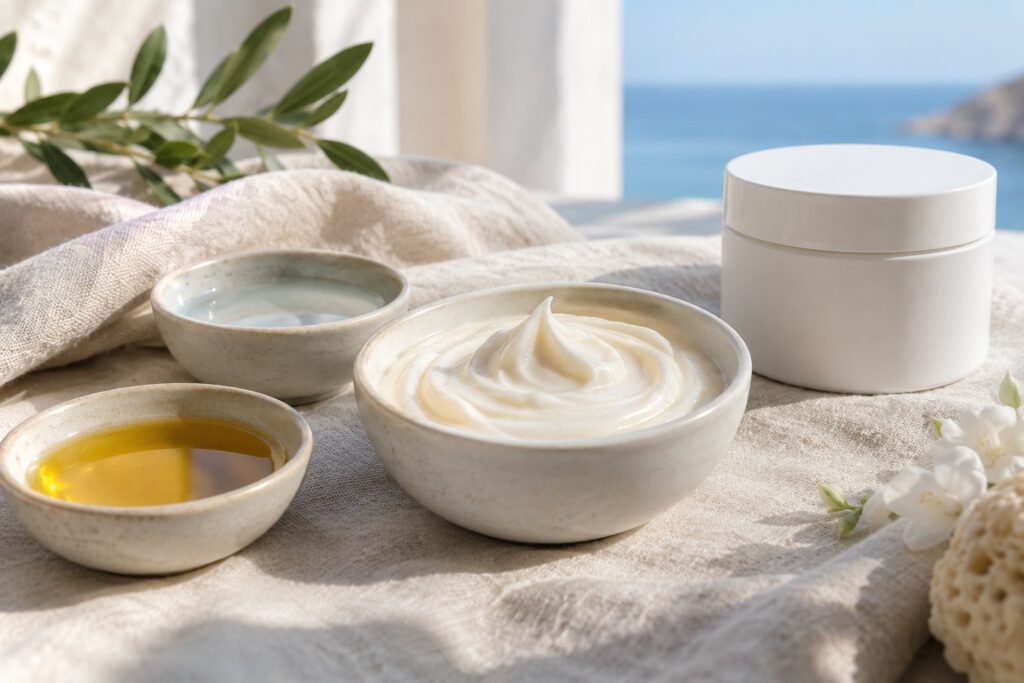
A cosmetic emulsion disperses two liquids that do not naturally mix, most often water and an oil phase. One is distributed as tiny droplets throughout the other. Emulsifiers stabilise this dispersion: the cream looks uniform, even though the water and oil remain distinct at a microscopic level.
This structure makes it possible to combine water-based and oil-based ingredients in many body creams while creating a texture that is pleasant to apply.
Water and oil: dispersion rather than dissolution
Sugar dissolved in water forms a solution. An emulsion works differently: the dispersed phase remains present as droplets surrounded by the other liquid, known as the continuous phase.
When water and oil are simply brought into contact, they tend to form two layers. Agitation can break one of them into droplets, but this usually is not enough to maintain that state over time. The formula must also slow down the droplets from coming back together.
The oil phase may contain several fatty ingredients, not just a plant oil. To learn more about this family of ingredients, see our article on plant oils in body care.
What are emulsifiers used for?
Connecting the two phases at their boundary
An emulsifier has an affinity for both water and fatty substances. It settles at their interface, meaning on the surface of the droplets. It helps the droplets form and contributes to preventing them from merging into larger ones.
You can picture countless small islands surrounded by liquid. The emulsifier helps preserve their shape rather than turning the water and oil into a single substance.
Stabilising a texture without making it permanent
Stability depends on the formula as a whole: the choice of emulsifiers, the proportions of the phases, the size of the droplets and the product’s consistency. Other ingredients may thicken the preparation and slow down the movement of the droplets.

The cupping tool that replicates pinching and rolling, 3 minutes per zone
- The professionals' technique, at home: you lift, glide, and release, and the tool grips the skin fold like a manual pinching and rolling
- Soft silicone that fits thighs, buttocks, stomach, and arms
- 3 minutes per zone, every day, always with a massage oil so the tool glides
An emulsion can still change over time or when storage conditions are unsuitable. Emulsifiers stabilise the dispersion; preservatives meet a different need, limiting the growth of microorganisms. These functions complement each other, but they are not interchangeable.
Oil-in-water or water-in-oil: what is the difference?
The name tells you which liquid forms the droplets and which one surrounds them.
| Type of emulsion | Droplet phase | Continuous phase |
|---|---|---|
| Oil-in-water | Oil phase | Water phase |
| Water-in-oil | Water phase | Oil phase |
This structure influences the first contact with the skin and how the texture behaves. It is not enough to predict the final feel: depending on the complete formula, the product may be thicker or thinner, easier to spread or oilier to the touch.
DermNet, in its overview of topical formulations, describes creams as generally thicker preparations than lotions and gives a water-and-oil emulsion as an example. The resource also points out that manufacturers do not always use the terms “cream”, “lotion” and “gel” in the same way. A product’s commercial name is therefore not a complete technical description.
What you can understand from a specific cream
The ingredient list for the Crème Hydratante Monoï mentions water, sunflower and sweet almond oils, as well as emulsifying ingredients such as GLYCERYL STEARATE CITRATE and SODIUM STEAROYL GLUTAMATE. These elements help explain how a formula combines water-based and oil-based components.
However, the manufacturer’s product information does not specify the exact type of emulsion. The presence of water at the top of the ingredient list or the cream’s appearance is not enough to identify its continuous phase with certainty.
Cellublue describes a melting texture that absorbs quickly without a greasy feel. This description from the manufacturer does not correspond to the physical definition of an emulsion. For storage, the product information states that the cream should be kept away from heat and light.
A cream’s structure is not the same as its skincare promise
The word “emulsion” describes how the formula is organised, not any particular effectiveness. Two emulsions may have different textures and uses.
To distinguish this structure from the role of individual ingredients, our article on what a cosmetic active ingredient is explores another concept. The claims made for body creams are also a separate topic: a uniform texture does not demonstrate a slimming action or weight loss.
FAQ: two questions about emulsions
Why does an emulsion often look white?
The droplets can scatter light, which contributes to a white or opaque appearance. The look also depends on their size and on the other ingredients: not all emulsions have exactly the same colour.
If a cream separates, should it simply be mixed again?
Unexpected separation may indicate that the formula has changed. If your cream’s appearance changes noticeably, check the manufacturer’s instructions or contact them before continuing to use it.
Sources: DermNet, “Topical formulations”, for formulation categories; Cellublue’s public product information for Crème Hydratante Monoï, consulted on 02/10/2026, for the ingredients, manufacturer’s description and storage precautions.

The scrub that leaves skin smooth and skin texture refined*
*User test on 21 volunteers over 4 weeks, based on participants' feedback.
- Olive & apricot kernels: these natural grains gently sweep away dead skin cells
- Caffeine & monoi scent, so your shower instantly smells like a holiday
- In the shower, two to three times a week, massaging your thighs, bottom and stomach




Comments (0)